


 Huawei Expands Global AI Push With Super-Node Launch at MWC 2026
(Yicai) March 3 -- Huawei Technologies unveiled its computing power product matrix at the ongoing Mobile World Congress 2026 in Barcelona, marking the first overseas showcase of its super-node computing cluster as the Chinese telecom equipment giant seeks to offer an alternative to the high-end artificial intelligence computing market dominated by Nvidia.
The product lineup includes the Atlas 950 SuperPoD intelligent computing system, the TaiShan 950 SuperPoD general-purpose server cluster, as well as the Atlas 850E, TaiShan 500, and TaiShan 200 series. The debut underscores Huawei’s push to expand its presence in the global AI infrastructure market amid intensifying competition.
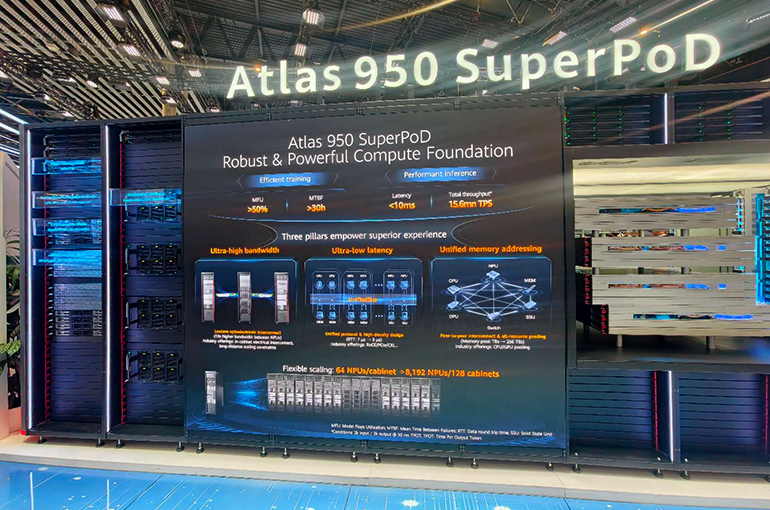
The Atlas 950 SuperPoD covers about 1,000 square meters and consists of 128 cabinets, providing roughly 8 exaFLOPS of FP8 computing power and 16 exaFLOPS of FP4 computing power, staff at the annual tech event said.
By comparison, Nvidia’s Vera Rubin NVL72 AI supercomputer, released in January, comprises 72 Rubin graphics processing units and 36 Vera central processing units, with each rack delivering about 3.6 exaFLOPS of FP4 computing power. While Huawei’s system offers higher total computing power, Nvidia retains an advantage in computing density per rack.
Surging AI Demand Drives Cluster Evolution
Huawei executives said surging demand driven by agentic AI is accelerating the need for large-scale computing capacity. Trillion-parameter models and quadrillion-token training have become common, model context lengths have expanded from the kilobyte to megabyte level, and memory capacity and bandwidth requirements have risen by five to 10 times. In financial risk control and anti-fraud scenarios, reasoning latency has been reduced to 20 milliseconds or even below 10 milliseconds.
As performance gains from a single GPU struggle to keep pace with the computing demands of large models, multi-chip interconnection and higher-level system architectures have become inevitable, the company said.
The Atlas 950 SuperPoD uses a single cabinet equipped with 64 graphics cards as its basic unit and can support up to 8,192 neural processing units for high-speed interconnection, Zhang Xiwei, president of Huawei’s computing product line, said at the launch event. Previously, hundreds of Atlas 900 super nodes based on the Lingqu 1.0 interconnection technology had been commercially deployed.
Last September, Huawei disclosed for the first time details of its chip development roadmap, including the Ascend artificial intelligence chip, the Kunpeng computing chip, super nodes, clusters, and the Lingqu interconnection protocol. These products form the core of Huawei’s competitiveness in the computing field, including the Atlas 950 SuperPoD that debuted overseas this time.
“We believe that only by relying on super nodes and clusters can we overcome the limitations of China’s chip manufacturing technology and provide continuous computing power support and supply for China’s AI computing capabilities,” Xu Zhijun, rotating chairman of Huawei, told Yicai.
According to Huawei’s previously released schedule, the Atlas 950 SuperPoD will be launched in China in the fourth quarter of this year. The company also plans to roll out the Ascend 950PR and Ascend 950DT chips in the first and fourth quarters of this year, respectively.
Editor: Emmi Laine