



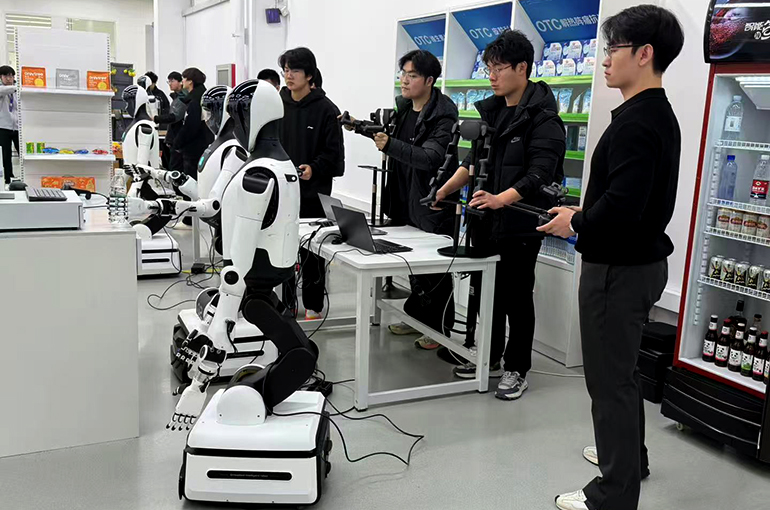
 Over 100 Androids Train for Precision Tasks at X-Humanoid's New Embodied AI Base in Beijing
(Yicai) March 20 -- More than 100 humanoid robots are training to perform highly challenging "precision operations" by using simulation data generated by on-site workers at X-Humanoid's Embodied Intelligence Robot Data and Training Base in Beijing.
Operators carrying virtual reality headsets or using remote operation devices performed movements in scenarios related to home, health and wellness, shopping, industry, medicine, and other services, converting them into training data for robots, Yicai saw during a visit to the base, the first phase of which covers nearly 5,000 square meters, yesterday.
In the home scenario, a robot is carefully washing dishes, while in the health and wellness training field, an android is carefully tucking in a dummy while another practices changing a baby's diaper. For the industrial case, a robotic arm is learning to sort parts and twist screws, training for electric power inspections.
The immersive training for robots is not simply remote control, but "data feeding," a worker said. The base has over 120 devices that can produce 400 hours of data a day, fully committed to "feeding" massive training data to the internal algorithm team and external partners, including robot makers and artificial intelligence model developers, the person added.
The data collected by the robots at the base features precise details that are difficult to replicate through simulation, including force feedback, tactile information, and environmental interference, the worker noted, adding that such key information, known as "physical intuition," can only be trained through multimodal data collected by real robots.
The base's data qualification rate was only 50 percent three months ago, Jiang Weilai, head of the base, told Yicai, "At that time, we faced various challenges, such as overly bright lights causing overexposure in pictures or robots accidentally touching props they were not supposed to touch."
After months and countless rounds of personnel training, process establishment, problem tracing, and quality standard optimization, the data qualification rate has stabilized at 95 percent, Jiang pointed out.
The base, which was set up less than half a year ago, has delivered nearly 20,000 hours of high-quality data to the world, while continuing to move towards its goal of "one million hours." Over 70 percent of its current capacity is dedicated to clients from the service sector, providing core data support for model training and research and development of embodied brains.
In addition, with the explosive growth of the humanoid robot industry, robots differ in sensor layout, joint degrees of freedom, and control interfaces, making the collected data often difficult to be directly reused across various models, making the data silos problem increasingly prominent. To break through this barrier, the base is planning to adopt more technical routes for data collection.
In addition, the base is exploring body-free data collection and teleoperation cabin methods, Jiang said. The first can decouple the strong binding between data and specific robots to some extent, theoretically expanding the data scale and thus solving the problem of data silos, but its effectiveness still needs more verification, he noted, adding that once it succeeds and achieves the same excellent training effect as real robots, it will greatly enrich data and promote the formation of a unified data trading market.
Editor: Martin Kadiev





