



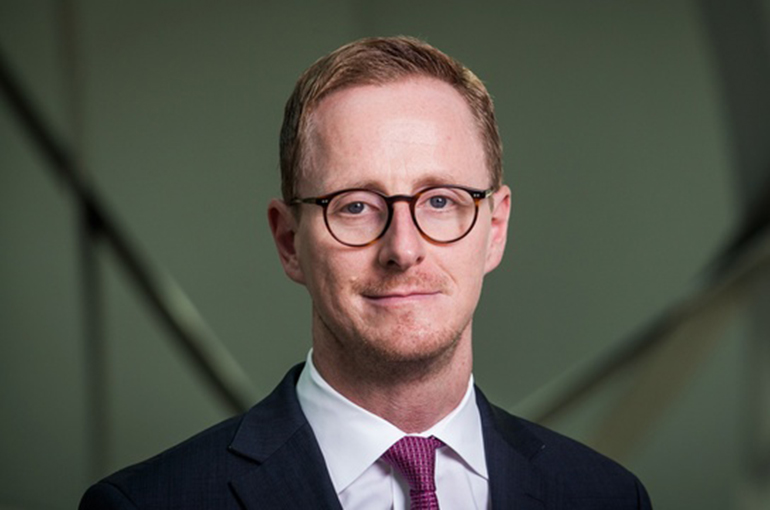
 Int’l Capital Is Shifting Its Allocation Strategy, Deutsche Bank's Managing Director Says
(Yicai) Jan. 20 -- Against the backdrop of artificial intelligence, climate transition, and global structural changes, there have been shifts by international capital to more pragmatic, goal-based portfolios from all-in strategies, according to the managing director of German banking giant Deutsche Bank.
"In this complex environment, one approach for sustainable investment would be to focus on businesses with cash flows tied to essential infrastructure," Markus Müller told Yicai in an interview during the World Economic Forum that kicked off yesterday in Davos, Switzerland. "Utilities can offer this and growth opportunities too," he added.
"In our last client survey, it was notable that most respondents preferred to treat sustainability as an additional factor in investment decision making, not the only determinant," Müller noted. "Nearly half of clients didn't have one dominant sustainability goal, and the weight given to social and governance priorities has risen.
"More clients now view sustainability as a way to manage medium-to-long-term transition risks," he pointed out. "They also expect investment choices to change over an extended time horizon. Near term, they overweight AI and digitization; over one to five years, they add in healthcare and infrastructure; and on a 10-year view, they lean into ocean, mobility, and circular materials themes."
Investor behaviour also points to evolution rather than exit, according to Müller. "In our latest client survey in 2024, 51 percent expected to increase the share of sustainable investments in their portfolios over the next five years, versus 20 percent who expected to reduce them," he explained. "The weight that respondents place on social and governance issues has also risen."
Survey respondents favored AI and healthcare for investments over the next year, but for those over more than 10 years, they see several other sustainability themes as potential return drivers, reinforcing the idea that structural stories can be obscured by near-term noise, Müller said.
Regarding AI investment, Müller warned that investors are already looking beyond AI itself, eyeing energy and infrastructure as part of the AI opportunity.
"Last year, data centers represented about 18 percent of global infrastructure investment, alongside 24 percent in solar and 28 percent in other power generation, which points to durable demand for construction, electrical equipment, and transmission upgrades," Müller noted. "In short, investors are shifting to look at the full AI system -- compute plus secure minerals, resilient energy, and efficient construction -- because that is what will sustain scale and returns."
Capital, Policy Signals From Davos
When asked to what signals he will pay attention to judge whether the discussions at the WEF are likely to influence policy direction and capital flows, Müller identified three signals.
"First, I look for signals that individual countries intend to follow official roadmaps," he said. "One such signal is when national ministerial communiqués reference previous collective decisions on funding targets, instruments, and timelines."
If Davos sessions reference these and start to put some detail on delivery mechanisms, that is a signal of possible near-term capital mobilization, according to Müller.
"Second, I watch for market infrastructure commitments that could unlock cross-border flows," he added. "When national leaders talk about connecting emissions trading systems -- for example, Brazil's proposed 'Open Coalition for the Integration of Carbon Markets -- it signals policy momentum that could have implications for capital flows and secondary liquidity."
Finally, Müller said he tracks which real economy bottlenecks get attention with proposed funding pathway solutions.
"If the Davos discourse ties the AI build-out with its implications for power, grid, and water use to investable vehicles, such as concessional finance, blended finance via public partnership, or regulated-asset frameworks, history suggests that private capital expenditures could follow," he noted. "Water and grid resilience are now prominent themes, thanks largely to AI, and leaders in Davos will surely comment on them."
Editor: Futura Costaglione





