



 iQiyi Overhauls Content Strategy With AI-Driven Creator Ecosystem
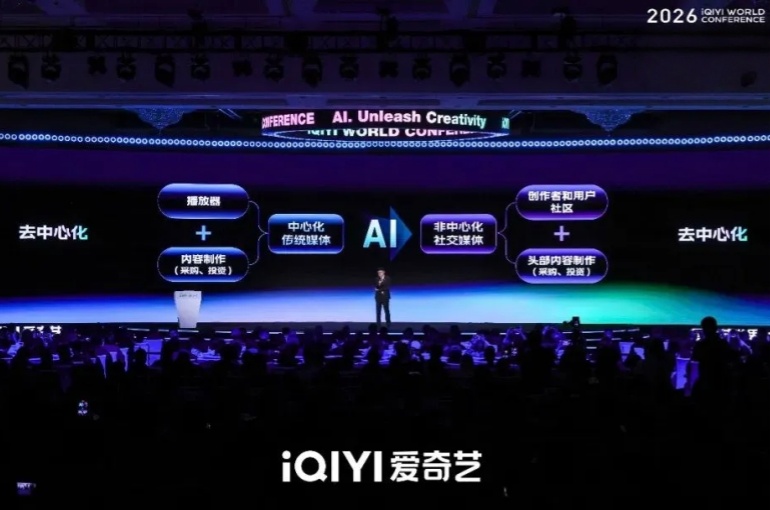
(Yicai) April 21 -- Chinese streaming platform iQiyi said it will shift to a decentralized content model and launched the commercial version of its artificial intelligence production platform, Nadou Pro, at the latest iQiyi World Conference, giving creators greater autonomy over production and revenue.
The move marks a significant overhaul of iQiyi's traditional content model, as the company bets that AI will sharply reduce production costs and compress timelines, making centralized editorial review increasingly impractical as creator numbers and output rise. The platform said creators will be able to access its intellectual property library, talent network, digital assets, distribution channels, and revenue-sharing system.
Founder and Chief Executive Gong Yu said at the conference yesterday that AI economics are driving the shift. Lower costs and faster production will lead to an exponential surge in both creators and content, he said, adding that the increase could be “at least a hundredfold.” To explain why lower costs would expand rather than contract the industry, Gong cited the Jevons paradox, arguing that just as Watt’s more efficient steam engine increased coal consumption rather than reducing it, AI-driven efficiency in film and television production would multiply total output.
“iQiyi will transform into a non-centralized social media-alike platform, building a new content ecosystem where creators own their IP assets, audience relationships, and substantial commercial returns,” Gong said. “Our future work will focus on establishing this new ecosystem through close collaboration with creators.”
From Centralized Platform to Creator Marketplace
Under the new structure, creators will decide independently what to produce, fund projects themselves, and upload finished works to compete directly for audience attention. Revenue will be tied to actual performance with no stated ceiling. iQiyi will focus on providing the technology stack, distribution system, and basic governance rules, while stepping back from most editorial decisions.
The centerpiece of that infrastructure is Nadou Pro, iQiyi's AI-native production platform, which entered commercial launch at the conference. The platform integrates nearly 70 AI agents covering scriptwriting, directing, visual design, editing, and other functions into a single workflow designed to address character and scene consistency, a persistent challenge in AI-generated video.
Creators using Nadou Pro can license from iQiyi's IP library, collaborate with affiliated talent, and draw on a shared digital asset library of virtual sets, props, and AI-rendered characters, with direct access to iQiyi's distribution and monetization systems. Revenue-sharing is linked to performance, and iQiyi is offering a 20 percent subsidy for AI-generated mid-form series through year-end 2026.
Chief Content Officer Wang Xiaohui said conventional storytelling remains central to the strategy. “AI cannot change the reality that IP relies on premium content. Great stories will always command top value,” Wang said. The company also released more than 350 new titles at the conference across dramas, variety shows, films, and animations.
Closing AI’s Storytelling Gap
The rollout also triggered controversy over actor authorization. Gong said at the conference that more than 100 actors had joined iQiyi's AI talent database within Nadou Pro.
However, on the same day, Chinese actor Zhang Ruoyun’s studio said publicly that the actor had not signed any AI-related authorization and that its legal team was following up. The studio of actor Yu Hewei, known for his role in the Chinese adaptation of the 3 Body Problem, issued a similar statement.
iQiyi clarified on April 21 that inclusion in the database indicated only a willingness to discuss potential collaborations, not a grant of likeness rights. The company said that each project would require separate negotiation and a signed agreement before any use of a performer’s image or voice. “There is no situation where an artist has been included in the Nadou Pro talent library without their consent.” Yicai’s review of the platform found 117 artists listed as of publication.
Gong acknowledged that AI-generated content still faces significant creative limitations. Despite improvements in visual quality, works with complete and emotionally resonant narratives remain relatively rare. He described this as a “last half-kilometer” problem, with much current AI-generated content concentrated in visually driven genres such as science fiction and fantasy.
He said two groups are now pulling in opposite directions: traditional filmmakers with strong storytelling experience but limited technical fluency, and AI-native creators who lean into visual capability while neglecting narrative craft. Closing that gap will require the two skill sets to converge, and iQiyi's decentralized model is intended to bring those creators together on one platform.
Editor: Emmi Laine





