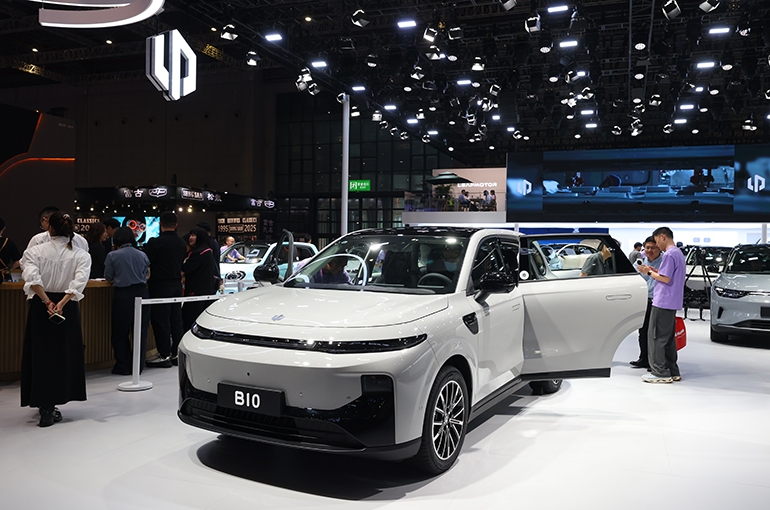
 Leapmotor Leads as 11 Chinese Automakers Set 2026 Sales Growth Targets
(Yicai) Jan. 19 -- Eleven Chinese automakers have announced their sales targets for 2026 since the start of the year, with electric vehicle startup Leapmotor Technology setting the most aggressive growth goal of 68 percent, even as analysts forecast more modest marketwide growth.
The Hangzhou-based carmaker aims to sell one million vehicles this year, according to an announcement by its founder and Chairman Zhu Jiangming. Leapmotor posted year-on-year sales growth of 103 percent last year, delivering 596,555 vehicles and surpassing its annual target of 500,000 units.
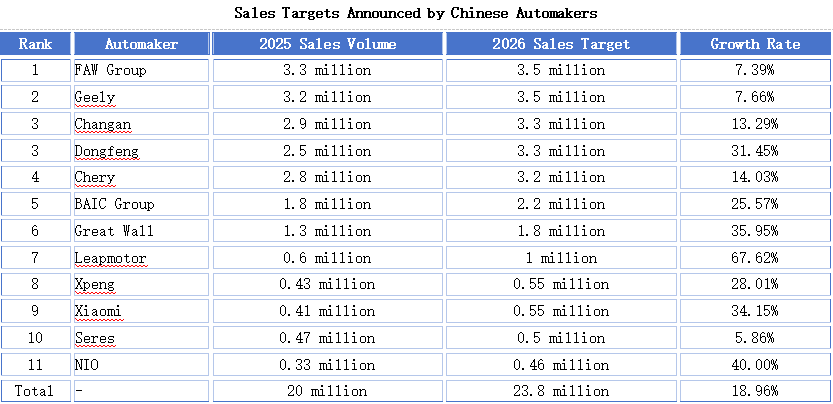
Among other electric vehicle startups, Xpeng is targeting sales of 550,000 to 600,000 units this year, implying growth of 28 percent to 40 percent from last year’s around 429,450 vehicles. Nio has set a sales growth target of 40 percent to 50 percent, after delivering almost 326,030 vehicles last year.
In its third year in the auto industry, tech giant Xiaomi aims to sell 550,000 vehicles this year. Xiaomi Auto recorded a three-fold jump in sales last year to nearly 411,840 units, entering the top 10 new energy vehicle manufacturers in China by sales volume for the first time.
Seres Group, which has partnered with Huawei Technologies to develop the premium electric vehicle brand Aito, is targeting sales of 500,000 units this year, representing growth of about 6 percent from last year.
Ambitious Traditional Carmakers
Among traditional automakers, Great Wall Motor has set the most ambitious target, aiming to boost sales by 36 percent to 1.8 million units.
Moreover, Changan Automobile and BAIC Group, which received the first batch of L3-level autonomous driving road permits from Chinese authorities at the end of last year, are targeting sales growth of 13 percent and 26 percent, respectively, to reach 3.3 million units and 2.2 million units.
Dongfeng Motor Group aims to increase sales by 31 percent to 3.3 million units this year, while Chery Automobile is targeting 14 percent growth to 3.2 million units. Geely Auto plans to lift sales by 8 percent to 3.5 million units, and FAW Group has set a growth target of 7 percent, also aiming for 3.5 million units.
Cautious Analyst Outlook
Despite automakers’ expansion ambitions, industry associations and research institutions have issued more cautious forecasts. China has ended a 12-year NEV purchase tax exemption and replaced it with a 5 percent tax rate, while subsidies for vehicle trade-ins have also been reduced from last year.
The China Association of Automobile Manufacturers expects total vehicle sales in China to rise 1 percent this year to 34.8 million units. Although this would mark the sixth consecutive year of growth since 2021, the increase would be the slowest in nearly six years.
Gong Min, head of China auto industry research at UBS Securities, said the Chinese auto market is likely to see low single-digit declines in wholesale sales and mid single-digit declines in retail sales. New energy vehicle sales, however, are expected to grow by 8 percent against the broader market trend.
Editors: Dou Shicong, Emmi Laine