



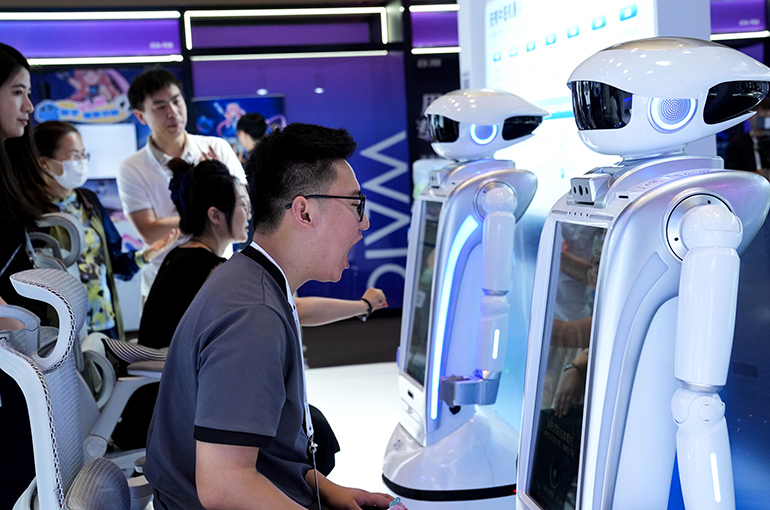
 Medical Robots Could Be Early Commercial Win for Embodied AI Industry, Chinese Expert Says
(Yicai) July 20 -- Medical robots could emerge as one of the earliest commercial applications of embodied intelligence, but challenges remain with the move from lab demonstrations to real-world deployment, according to Prof. Qi Peng of Tongji University, who develops robots for cardiac interventions and blood collection.
The wave of interest in "world models" and "physical artificial intelligence" is being driven largely by researchers with computer science backgrounds who are looking for ways to extend AI into physical systems, Qi told Yicai on the sidelines of the four-day World AI Conference that ends in Shanghai today. Trained in robotics and control theory, he said his path runs in the opposite direction, working to bring AI into machines he has spent years building.
Although researchers are approaching the field from different directions, Qi said both groups are converging on the same objective: creating embodied intelligence, or AI systems capable of perceiving, learning from, and interacting with the real world.
Unlike general-purpose humanoid robots, which are still searching for commercially scalable applications, medical robots are entering a market with clearer demand, specialized users, and highly structured operating environments, Qi noted. AI is transforming medical robots "from highly precise machines into systems that can better perceive environments and support clinical decisions," he said.
Different industries may take different paths toward commercialization. Industrial robots often benefit from clearer workflows, Qi pointed out, while medical robots face much higher barriers, including strict safety requirements, regulatory approval, and physician acceptance.
Qi's team has developed a cardiac intervention robot that integrates multiple imaging systems in real time to assist doctors during procedures. It has also created a blood-drawing robot that uses computer vision to identify veins and automatically adjust needle positioning, achieving a first-attempt success rate above 98 percent, according to Qi.
Despite advances in medical AI, the technology is intended to support doctors rather than replace them, Qi stressed. "The robot can provide suggestions, but whether to accept those suggestions is still decided by the doctor," he said.
For embodied AI as a whole, the biggest challenge is not producing impressive lab demonstrations but achieving dependable performance in complex real-world environments, according to Qi. His cardiac intervention robot performed well in simulations but ran into unexpected problems during early clinical testing, including equipment interference and mismatches between robotic control logic and doctors' operating habits, he pointed out.
The team subsequently worked closely with hospitals to improve the system, Qi said, noting that “lab performance does not equal clinical success.”
Beyond Humanoids, Toward Real Value
A broader debate at this year's WAIC gathering was how quickly AI can move into physical environments.
Companies are struggling with a mismatch between the pace of AI development and that of organizational change, said Du Lan, global chief AI officer at the World Digital Science Academy. "We see many industries where tech is developing quarter by quarter, but organizations take years,” he said.
Future AI systems need to understand and predict changes in the physical world, noted Chen Tianrun, founder and chief executive of AI and semiconductor startup Moxin Technology.
AI is evolving from a tool that provides capabilities into a partner that delivers results, added Zhao Hongyi, founder and chairman of AI and robotics enterprise Yufan Intelligence.
Human and machine intelligence remain fundamentally different, Qi stressed, adding that machines have the edge in computation, while humans retain strengths in emotional connection and interaction.
China's Advantages
China's edge in medical robotics comes from abundant clinical scenarios and a strong engineering ecosystem that can quickly turn medical needs into products, Qi said. But for Chinese companies expanding overseas, the biggest challenge is building trust among doctors, he noted.
"Tech and regulation can be solved step by step, but trust needs time," he pointed out. Surgeons who have relied on established international platforms for years need evidence that new systems can safely improve clinical outcomes, he added.
As embodied intelligence enters the commercialization stage, competition may hinge less on which robot looks most human and more on which systems can deliver measurable value in real-world settings, Qi pointed out.
Editor: Martin Kadiev





