 Meituan’s Drone Delivery Infrastructure Goes Into Commercial Service
(Yicai) May 22 -- Meituan said the drone delivery infrastructure it has built is no longer in the testing stage and has gone into commercial operation, and the Chinese on-demand services giant has also begun recruiting low-altitude logistics providers nationwide.
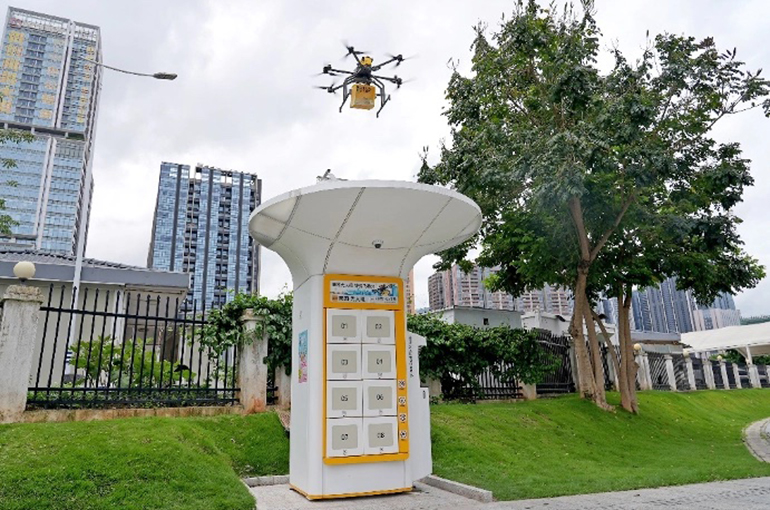
The infrastructure includes Meituan’s self-developed long-range winch-drop drone, the M-Drone 4L Winch, M-Port 3 smart transfer hub, and the M-DaaS 3 drone operations control system, the Beijing-based company said in a statement yesterday.
After delivering its first real order using an unmanned aerial vehicle in Shenzhen in early 2021, Meituan opened its first regular drone route in Shanghai in December 2022 and began pilot services. By the end of last year, its drones had 70 routes in cities such as Shenzhen, Beijing, Shanghai, Guangzhou, Hong Kong, and Dubai, with cumulative orders exceeding 780,000.
Drone delivery orders have been rising over the past five years, especially after the company launched services at night and in the rain, Mao Yinian, vice president and head of Meituan’s drone business, told Yicai. The number of orders a single site can handle has risen from about 10 a day to as many as 400 now, he said.
Equipment, battery, energy use, and site rental costs are all falling as order volumes and flight efficiency improve, Mao said, adding that operating costs per order have been dropping by roughly 40 percent to 50 percent each year.
Meituan’s low-altitude delivery services are mainly used when land transport is more difficult, including the delivery of medical samples, he noted. The company has opened drone delivery routes for medical samples in Shanghai and Sichuan province, enabling urgently needed medical supplies to be sent directly to designated points.
Mao said Meituan is also opening its low-altitude logistics solutions to authorized partners so they can support a broader range of delivery scenarios. The company has signed deals with 10 service providers so far.
Logistics expert Zhao Xiaomin said that because local governments are supportive and leading businesses are investing heavily in local resources, the Guangdong-Hong Kong-Macao Greater Bay Area, the Yangtze River Delta, and the Chengdu-Chongqing Economic Circle are likely to emerge as China’s three leading hubs for commercial low-altitude logistics, with explosive growth this year and next.
The rapid growth of low-altitude logistics will depend not only on policy support and faster technology upgrades, but also on the development of more application scenarios, Zhao said. Operators will need to develop different service products based on real demand in specific use cases, he added.
This new sector still faces major hurdles, said Zhang Yi, chief executive of iiMedia Research. Urban airspace approval, flight safety, noise, and the risk of falling objects all require clearer regulatory rules, he pointed out.
Editors: Tang Shihua, Futura Costaglione