



 Mercedes-Benz, BMW, and Audi Cut China Prices After First-Half Sales Decline
(Yicai) Aug. 18 -- German luxury car giants Mercedes-Benz, BMW Group, and Audi have lowered the prices of some models in China amid declining sales due to the accelerated adoption of new energy vehicles in the Chinese market.
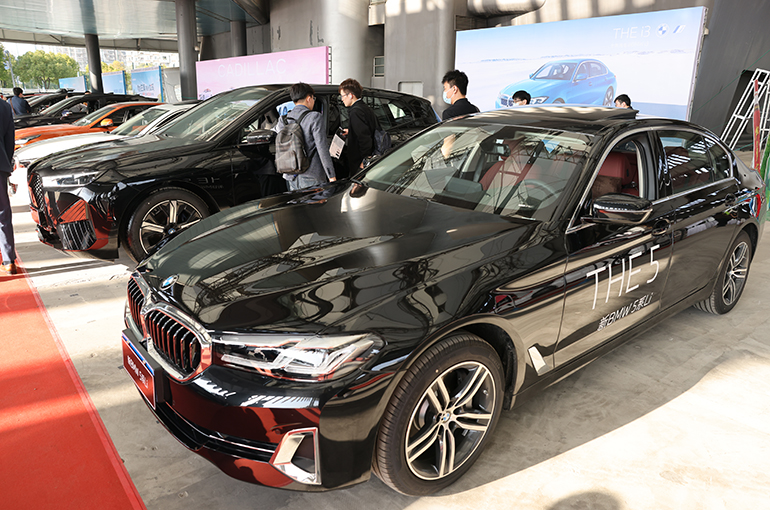
The BMW 5 Series, Mercedes-Benz E-Class, and Audi A6L have faced multiple price cuts since the start of this year after having maintained relatively stable prices over the past years, thanks to good sales in the mid-to-large luxury car market. Popular models starting at over CNY400,000 (USD59,325) have dropped to the CNY300,000 to CNY400,000 range, with actual retail prices at dealers even lower.
BMW, Audi, and Mercedes-Benz sales in China topped 262,000, 233,000, and 210,000 units, respectively, in the first half of this year, each down about 20 percent from a year earlier.
"The official guide price for the BMW 525Li is CNY368,000, while the discounted base price has dropped to around CNY280,000," Wang Yu, sales manager at one of the carmaker's dealerships in Beijing, told Yicai. "The starting price of the BMW 3 Series is only CNY258,000. It used to have an out-of-the-door price of CNY400,000."
The terminal price of the Mercedes-Benz E-Class and Audi A6L has also dropped by more than CNY100,000, with the discounts for some premium models even exceeding CNY200,000. In addition, Mercedes-Benz, BMW, and Audi offer interest subsidies, lower prices for top customers, and other deals.
Several large companies in Beijing have ties with BMW, so their employees can get an additional discount of up to CNY10,000 (USD1,483) from the carmaker.
Automakers are hiking their promotional efforts mainly because of a significant decline in sales, Wang said, noting that sales at the small-to-medium-sized store he works at have dropped to only half of that in the peak period several years ago, when monthly sales reached around 100 vehicles.
Several traditional luxury 4S (sales, spare parts, services, and survey) stores have ceased operations or moved to Chinese NEV brands such as Aito this year, Wang noted. In the context of the overall decline in luxury car sales, big outlets face more operational challenges, with the core reason being the high cost of running such shops, so dealers have become more inclined to control their size, he added.
Finding a balance between relying on discounts to boost sales and preventing excessive brand value loss is a major challenge faced by luxury brands in China, he pointed out.
Against the backdrop of the continuous increase in NEV adoption in China, Mercedes-Benz, BMW, and Audi are also accelerating relevant transformation, launching new platform-based electric vehicles.
Audi has released EVs under the AUDI brand, Mercedes-Benz's EVs based on its new platform have gradually come into the market, and BMW's Neue Klasse models are about to start local production. This year and the next will be key to testing the market acceptance of their new products.
The popularity of traditional luxury NEVs is significantly lower because regular consumers generally do not associate electric cars with such brands, a sales manager at a luxury carmaker told Yicai. In addition, sales are generally affected by pricing factors, he noted.
Although the mechanical performance of NEVs made by traditional luxury carmakers remains excellent, they lag significantly behind Chinese rivals in intelligent configuration and software over-the-air technology evolution speed, including intelligent driving systems, he stressed.
Editors: Tang Shuhua, Martin Kadiev





