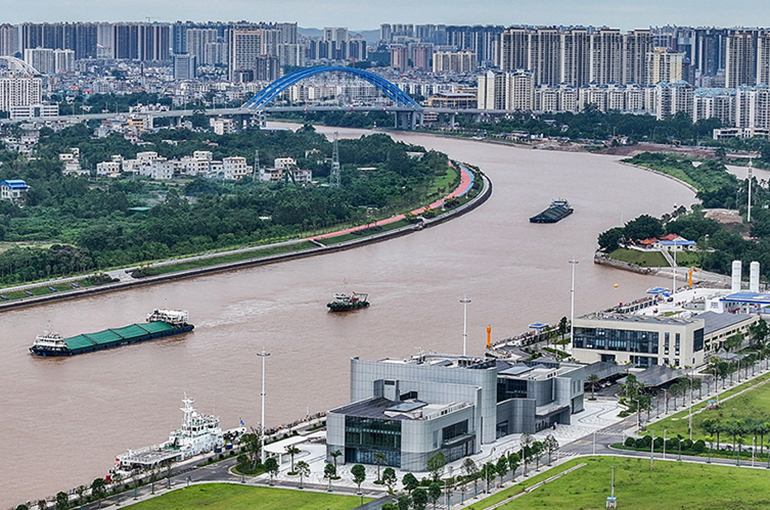
 Pinglu Canal Reshapes Routes for Goods From Southwest China to Global Markets
(Yicai) Sept. 15 -- The Pinglu Canal, a key project under the New International Land-Sea Trade Corridor that connects China's western regions to global markets, will open for navigation tomorrow in the Guangxi Zhuang Autonomous Region, altering sea access trade routes for multiple inland cities in the region, as well as Yunnan, Guizhou, Sichuan, and Hunan provinces and Chongqing.
The canal, with a total investment of around CNY72.7 billion (USD10.8 billion), will connect Xijiang River with Qinjiang River, which flows into the Beibu Gulf, local authorities announced on Sept. 7. Starting construction in 2022, the canal will stretch more than 134 kilometers and can accommodate vessels of up to 5,000 tons.
On Sept. 8, Panamanian-flagged cargo ship Beigang Nanning Borun with a load capacity of 4,443 tons entered the Pinglu Canal from Qinzhou Port, arriving at No. 5 berth in the Liujing operation area of Nanning Port to become the first international vessel to dock there. ILSTC trains carrying goods from multiple inland Chinese cities, such as Chongqing, Zigong, and Chengdu, arrived in Nanning, with the goods to be transported on river-sea direct vessels to the Port of Cần Thơ in Vietnam via the Pinglu Canal.
After the canal opens for navigation, the inland waterway journey of goods from southwestern regions abroad will be shortened by more than 560 km compared to traditional routes, Zhang Zhiwen, spokesperson for Guangxi government, said at a press conference on Sept. 7. The journey to major ports in members of the Association of Southeast Asian Nations will be significantly shortened, cutting the comprehensive logistics cost by 18 percent to 30 percent and saving more than CNY5 billion (USD745.5 million) in transportation costs a year, Zhang added.
The opening of the Pinglu Canal has made Nanning an open port with global shipping functions. Previously, foreign trade goods from Nanning Port had to travel hundreds of kilometers along the Xijiang River to Guangzhou Port, but will now pass through the new canal and head south to the Beibu Gulf for the ASEAN and global markets.
Nanning has not become a seaport city, but 5,000-ton vessels can enter the Xijiang River hinterland through the canal, Cao Jianfei, deputy director of the Institute of Regional Development at Guangxi Academy of Social Sciences, told Yicai. With trains operating from Sichuan, Zigong, and Liuzhou to Nanning Port, the city will likely become the hub for cargo gathering and customs clearance for export in China's southwestern hinterland, Cao said.
The cargo throughput of Nanning Port fell 13 percent to 8.45 million tons last year from the previous year. But according to the port's plans, the figure will exceed 50 million tons by 2035.
In addition to Nanning, there will also be changes in Sichuan and Chongqing, Cao pointed out. Chengdu has put the 'Sichuan -- Pinglu Canal -- Vietnam' river-rail-sea intermodal trains into operation, and chemical fiber goods from Zigong can directly reach the port of Can Tho via Nanning Port, Cao noted, adding that about 90 percent of goods from Sichuan and Chongqing used to be transported abroad via the Yangtze River.
Editor: Martin Kadiev