



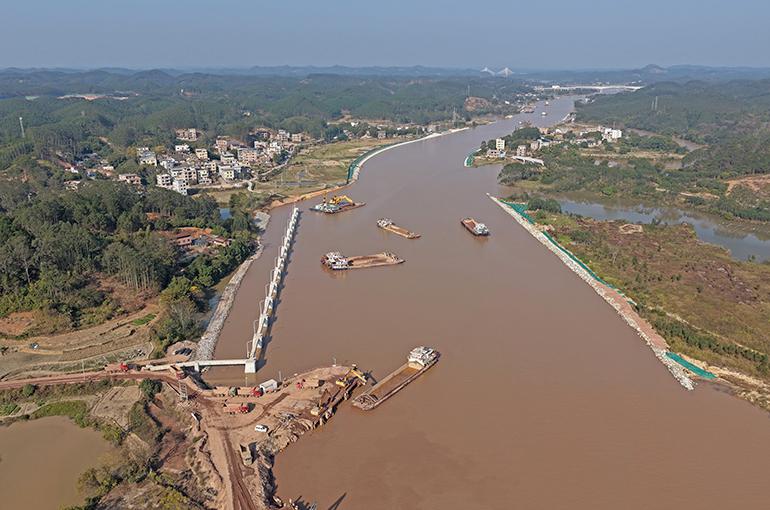
 Pinglu Canal Set for Early Launch, Slashing Southwest China Shipping Distance
(Yicai) Feb. 27 -- The Pinglu Canal in China’s Guangxi Zhuang Autonomous Region is expected to open to navigation in September, three months earlier than originally scheduled this year, significantly shortening the waterway for cargo from southwest China to reach the sea.
The canal, navigable for 5,000-tonne vessels, is invested in and constructed by a state-owned developer under Guangxi’s government. It is designed to connect Guangxi’s largest river, the Xijiang River, with the Qinjiang River, which flows into the Beibu Gulf. The project, with a total estimated investment of CNY72.7 billion (USD10.6 billion), will cut inland voyage distances by more than 560 kilometers and reduce logistics costs for companies by enabling cargo to bypass ports in Guangdong’s Pearl River Delta.
Wei Tao, chairman of the autonomous region known for its rivers and karst formations, announced the earlier opening on Feb. 25 at an on-site meeting for the project. He said the regional government will make every effort to ensure the canal officially opens, and related ceremonies are held during the China-ASEAN Expo in September. Construction of the 134-kilometer canal began in 2022.
Wu Jian, director of the Regional Development Institute at Guangxi Academy of Social Sciences, told Yicai that machinery products manufactured in the city of Liuzhou previously had to be transported by rail or road to Guangzhou Port for export, resulting in long transportation cycles and high costs. After the canal opens, these goods can be shipped directly by water to Qinzhou Port in the Beibu Gulf, significantly shortening delivery times and lowering logistics expenses.
Beyond creating a new logistics corridor, Wu said the canal’s completion and operation will reshape the distribution of local industrial belts, attract related industries to cluster along the route, and enhance companies’ product added value and market competitiveness.
Hao Panfeng, secretary-general of the China Container Industry Association, told Yicai that the Pinglu Canal is effectively a “waterborne expressway,” and its opening will drive the development of logistics, shipping, and industrial systems along the route.
Wei also stressed that the development of the canal economic belt must have clear positioning and promote coordinated growth of transport corridors, logistics, trade, and industries, leveraging the canal’s advantages in large-scale inbound and outbound flows by developing modern pillar industries along the route.
Editors: Tang Shihua, Emmi Laine





