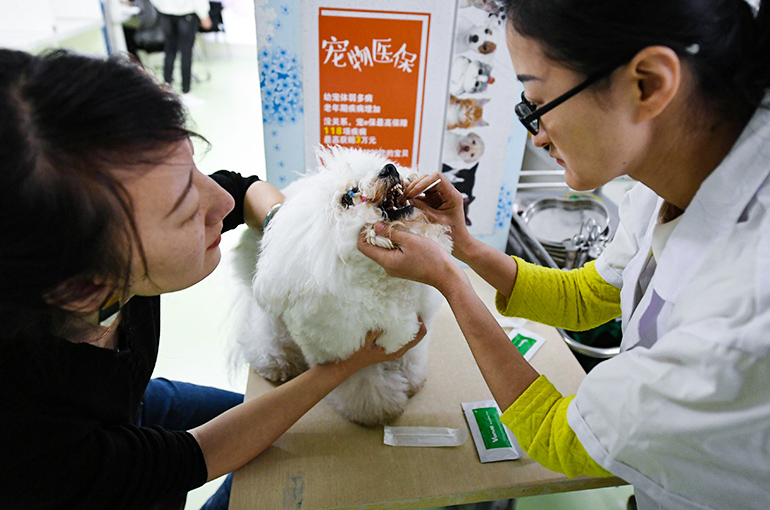
 China’s Pet Insurance Market Expands as Insurers Chase New Growth
(Yicai) Sept. 15 -- Pet insurance, once a niche product in China, is becoming a new growth driver for the nation’s property insurers, with nearly four out of every 100 pets covered, leaving much room for further expansion.
China’s pet insurance premiums reached about CNY3 billion to CNY3.5 billion (USD447.1 million to USD521.6 million) last year, a huge increase from just CNY50 million (USD7.5 million) in 2020, according to a white paper released by Petdata.cn, a prominent statistics and market research platform for the pet industry.
“The growth momentum of pet insurance has shifted from quantity expansion to structural upgrade," said Xu Xian, deputy dean of the School of Economics at Fudan University.
Against the backdrop of an aging population and changing family structures, pets are becoming important members of many families, Xu noted, adding that this shift has generated diverse needs and risks related to medical care, boarding, and transportation, creating new opportunities in various segments of the insurance market.
The white paper shows that the number of pet dogs and cats in urban China reached 126 million last year, an increase of 1.8 percent from 2024, while the urban consumer market for pets grew 4.1 percent CNY312.6 billion (USD46.6 billion) in the period.
Pet ownership began gaining traction in urban China in the 1990s as economic reforms, rising incomes, and eased restrictions on dogs changed attitudes toward companion animals. The market has gathered pace since the 2010s, as younger consumers increasingly treat pets as family members and spending has expanded beyond food and basic supplies to veterinary care, grooming, and other services.
Competition Moves Beyond Scale
ZhongAn Online P & C Insurance has long regarded pet insurance as an important growth engine. The Shanghai-based company’s pet insurance premiums surged nearly 23 percent to CNY691 million (USD103 million) in the first half of this year from a year earlier, according to its latest interim earnings report.
“There's still huge market potential for pet insurance, a sector we’re particularly optimistic about in the long term," ZhongAn General Manager Jiang Xing said on the firm’s earnings conference call.
Almost 4 percent of China’s pets are insured, up from around 1 percent just a few years ago, Zhu Yigang, head of the pet insurance business at ZhongAn, told Yicai. "We expect the the scale of pet insurance to reach a new level within about five years,” he said.
With demand rising, insurers are coming up with new pet insurance products. For instance, ZhongAn recently launched several industry firsts, including specialized medical coverage for parrots and pet cancers. Meanwhile, Ping An Property & Casualty Insurance was the first to offer a plan covering pet transportation by high-speed rail.
Competition in China’s pet insurance sector is shifting away from simply expanding the scale of individual products toward improving quality and services and addressing more specific customer needs, Xu explained. For insurers, that means accurately assessing the risks associated with different types of pets at different stages of their lives and tailoring coverage more closely to the actual needs of pet owners.
Growth Constraints
But several pet industry sources said the sector still faces fundamental hurdles, including inadequate infrastructure for identifying pets and a lack of standardized veterinary treatment and diagnostic protocols.
China has yet to establish a unique system linking individual pets with their owners, Zhu said. For insurers, that creates a basic but critical challenge: determining whether the pet covered when a policy was purchased is the same animal presented when a claim is filed, he pointed out.
Chinese insurers have begun using nose-print recognition technology to identify dogs and cats, but the technology is difficult to extend to other types of pets, Zhu noted.
Another major obstacle is the lack of standardized veterinary care. Almost all pet hospitals in China are privately run, and treatment practices and standards vary widely from one to another.
Examination procedures, treatment plans, and fees, can differ greatly among pet hospitals and are often not sufficiently transparent, said Duan Wenjun, head of pet health business operations at Ant Insurance Agency. Those differences ultimately translate into higher costs for insurers, he noted.
The lack of standardization is also a key reason that pet insurance is often criticized for low per-claim payout limits, rising premiums at renewal, and frequent changes in designated hospitals, Duan said.
Editors: Tang Shihua, Futura Costaglione