



 Product Carbon Footprint Turns Into Common Language Across Global Supply Chains, China President of Tape Giant tesa Says
(Yicai) Oct. 19 -- Product carbon footprint is becoming a common currency or language across global supply chains as more customers, from multinationals to Chinese manufacturers expanding overseas, request relevant data from their suppliers, according to the China president at leading German adhesive tape maker tesa.
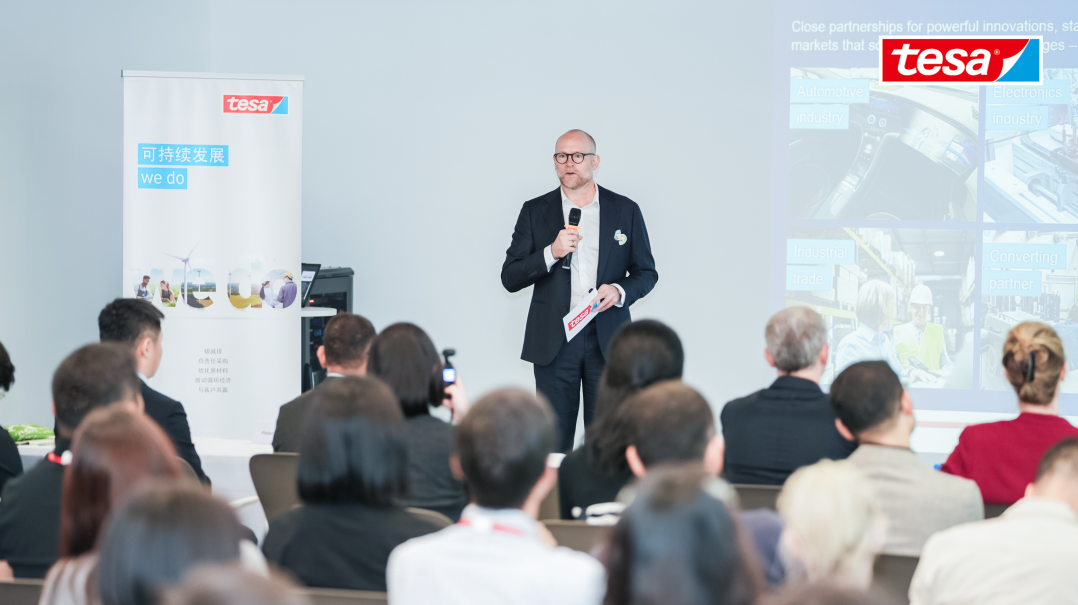
"We need a common currency, or I would even say a language, with our customers, but also with our suppliers," Stephen Hauber told Yicai at tesa's Sustainability Open Day in Suzhou on Oct. 14. "Having the carbon footprint, that's the language to work with."
As a multinational company, tesa develops innovative adhesive tapes and self-adhesive product solutions for various industries, commercial customers, and end consumers for 130 years. There are already more than 7,000 tesa adhesive solutions that help improve the work, products or lives of our customers. Today, the focus is on sustainability and energy-saving processes. tesa invests in the development of products with sustainable contribution and solvent-free manufacturing processes as well as in the use of renewable energy sources at its locations.
Regarding tightening sustainability regulations, Hauber noted that "regulations are necessary. However, customer needs are sometimes even tougher than the regulation itself."
Adhesive tapes are not covered by the European Union's Carbon Border Adjustment Mechanism, but the organization is considering extending the mechanism to some steel- and aluminum-intensive downstream products, which could push carbon requirements further along supply chains.
Chinese companies' overseas expansion is adding to the pressure, Hauber said, noting that when tesa's Chinese customers move into foreign markets, they expect reliability, product quality and performance from suppliers, and they "also have clear sustainability requirements," such as PCF data.
For carbon footprints to work as a common currency, the data must be comparable, Hauber pointed out. The industry still needs to harmonize methods and improve transparency in data quality and data formats, he added. "In the end, it's about cost competitiveness."
Sustainability has become part of competitiveness, Hauber noted. "In the past, speed was very important. Speed and cost, that was a part of being competitive.
"Today, companies recognize sustainability is a competitive element," he said. When it comes to sustainability, if you do not act, "you're out of business," he stressed.
tesa's sales topped EUR1.68 billion (USD1.9 billion) last year, up 1.8 percent on an organic basis from the previous year, according to Beiersdorf's annual financial report. Sales in Africa, Asia, and Australia climbed 6.6 percent to EUR649 million (USD728.4 million) organically, with those in China growing significantly, but the figure in the firm's other two regions -- the Americas and Europe -- fell.
Commercial Incentives Decide Whether Circular Models Work
In his keynote speech at the event, Hauber used an example where tesa had hoped customers would return the plastic end walls that protect the edges of its large tape rolls so they could be reused, but this did not happen es expected. "Then we learned there's a commercial reason." he said.
“Sustainability is an effort. It’s a daily effort … There’s always a commercial element in there,” Hauber said.
So tesa gave customers a reason to take part, setting up a circular model that offers them a form of compensation. In 2025, the company reused 87,499 plastic end walls and 2,190 cores in its local packaging loops, saving about 47 tons of plastic.
Product design offers another route. tesa's Bond & Detach technology, which separates bonded parts through mechanical stretching, is used in more than 1.8 billion smartphones worldwide, making repair, battery replacement, and recycling easier, according to the company.
"You want to have a reliable bond. Later on, you want to make sure that you can separate components when required," Hauber said. "That, of course, is reducing scrap, it is reducing energy, and it makes recyclability much easier."
tesa cut its global Scope 1 and Scope 2 emissions by 50.2 percent between 2018 and the end of last year, according to its annual Sustainability Factbook. However, its Scope 3 emissions, which cover the supply chain, fell only about 2.5 percent to 511,000 tons of carbon dioxide equivalent, remaining short of its 20 percent reduction goal from 2018 by 2030.
Learning From Each Other
Regarding whether "Made in China" is carbon intensive as some outsiders expect, Hauber said that "what happened in the last 40 years in China is breathtaking. I don't think it's carbon intensive.
"I personally tell everybody, when we talk about sustainability, read the policies," he added. "Then you see what's happening here in China, and then you don't talk anymore about CO2-intensive industries and Made in China. No, it's exactly the opposite."
tesa's progress in China reflects this shift. Its Suzhou plant has sourced all of its electricity from renewable sources since 2021 and was named a national green factory by the Ministry of Industry and Information Technology in March. The company's CO2 emissions in China fell 28 percent last year from the level in 2018.
Colleagues in Suzhou are part of tesa's global sustainability team and are in constant exchange with their overseas counterparts, Hauber pointed out. "It's not anymore that we learn from other overseas countries. It's an exchange.
"We are actually learning from each other, and to see the progress coming out of China into overseas and the other way around, this is really nice," he stressed.
Editor: Martin Kadiev





