



 Reaching Global Financial Governance Consensus Is Key to Eliminate Fragmentation, PBOC Ex-Governor Says
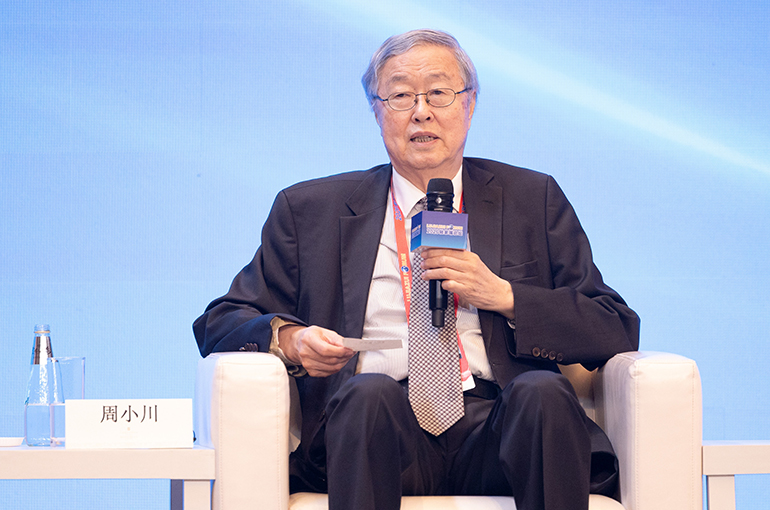
(Yicai) June 18 -- The core of solving the pain points of global financial governance, including fragmentation in the financial system, is to promote the elimination of differences among all parties and reach a consensus, according to Zhou Xiaochuan, former governor of the People’s Bank of China.
There are many international financial governance institutions, such as the International Monetary Fund, the World Bank, the G20, industry regulatory agencies, and the Organization for Economic Cooperation and Development, Zhou said at the 2026 Lujiazui Forum’s Global Financial Governance Reform and Cooperation session yesterday.
However, these institutions have overlaps and gaps in their responsibilities and have not formed a vertically integrated and horizontally coordinated collaborative governance network, making it difficult to cope with complex global financial risks, he explained.
At the functional level, there is a lack of a role similar to that of a “world central bank,” Zhou believes. In fact, the fundamental issues, such as how to build the international monetary system, who should act as the lender of last resort in times of crisis, and who should coordinate financial infrastructure, are still under discussion.
Regulatory agencies are a typical manifestation of the fragmentation dilemma, as they are divided by industry, he noted. The banking industry relies on the Bank for International Settlements, the insurance industry is managed by the International Association of Insurance Supervisors, and the securities industry is regulated by the International Organization of Securities Commissions. Each of them performs their own duties.
However, all previous financial crises are cross-industry risks, and a single regulatory agency is unable to cope with composite financial risks independently. “The 1997 Asian financial crisis originated from excessive debt in the private sector in Thailand, and the 2008 global financial crisis was triggered by shadow banking and financial derivatives,” Zhou noted. “The regulation of banks, insurance, and securities did not have clear responsibilities and did not cover these areas in the past.”
The G20 was formed to make up for the lack of regulatory coordination, but it also has flaws. The G20 has no charter, no permanent secretariat, and no implementation tools, and lacks a stable operating mechanism, Zhou said. Moreover, the boundaries of power and responsibility between the G20, the IMF, and industry regulators are blurred, and there is no normalized collaborative process.
More importantly, the G20’s consensus is extremely unstable. “When there is a crisis, there is more consensus, but when there is no crisis, there is less consensus,” Zhou pointed out. During a crisis, countries are prone to working together, while during a stable period, their interests may diverge and collaboration may fail, making it difficult to sustain long-term financial governance measures, he added.
Furthermore, the imbalance of cross-border financial collaboration and new financial crimes driven by artificial intelligence and cryptocurrencies amplifies governance loopholes, according to Zhou.
The Financial Action Task Force is the only agency worldwide responsible for anti-money laundering and counter-terrorism financing. No institution is coordinating the crackdown on new risks, such as digital cross-border fraud and illegal capital flow of cryptocurrencies, creating an obvious governance gap.
The root cause of the long-standing difficulties lies in the fact that a consensus has not yet been formed, Zhou said. Besides conflicts of interest, the core obstacle is the low level of understanding of objective difficulties. He called on financial regulatory agencies in all countries to “make greater efforts to learn from history, predict the future, grasp better objective laws, and reach consensus”.
Editor: Futura Costaglione





