



 Robotics Firms Get Funding Boost After Chinese New Year TV Gala
(Yicai) March 2 -- Humanoid robots were one of the star turns on China Central Television’s annual lunar new year eve show, and the companies involved are reaping the financial benefit from the exposure.
Noetix Robotics has just secured CNY1 billion (USD145.3 million) in a B-round fundraiser led by Chendao Capital, a Beijing-based subsidiary of battery giant Contemporary Amperex Technology. The unit will use the money to deepen its business ecosystem and build a collaborative mechanism across the industrial chain, it said today.
Three of its robots, the N2, E1, and Bumi, were chosen to appear in a short performance on CCTV’s Spring Festival Gala -- the world’s most-watched TV program -- on Feb. 16. They were seen dancing and doing somersaults, and one of the robots realistically mimicked an actor.
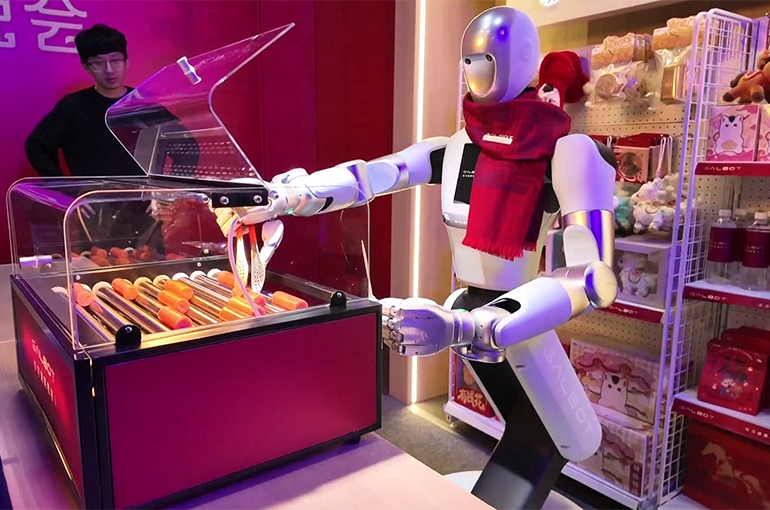
Galbot, another Beijing-based robot maker, announced today that it has completed a new financing round worth CNY2.5 billion (USD363.4 million), with support from the National Artificial Intelligence Industry Investment Fund and state-owned energy giant China Petroleum and Chemical, better known as Sinopec.
Galbot’s G1 humanoid robot also appeared on the Spring Festival Gala, interacting with actors and demonstrating various skills such as folding clothes.
The show’s high-visibility platform has helped to reinforce a wave of investment in embodied-intelligence and humanoid robotics startups. LimX Dynamics announced last month it had gained USD200 million in B-round financing, while GalaXea and AI² Robotics each completed B-round financing worth CNY1 billion.
This year’s Spring Festival Gala was a comprehensive showcase for humanoid robots, from their movement capabilities to their execution of tasks and even their emotional value, Zhong Sheng, an analyst of China’s industrial sector at Morgan Stanley, said in a report.
This is conducive for the acceptance of humanoid robots by the mass market and shows that robots are beginning to move beyond the realm of entertainment and toward practical and functional operations, Zhong said.
As robots start to undertake actual work, their performance evaluation will shift, Huajin Securities said in a research report. Parameters and actions will no longer be the sole criteria, with attention turning instead to sustained uptime, deployment speed, and quantifiable output.
Editor: Dou Shicong, Tom Litting





