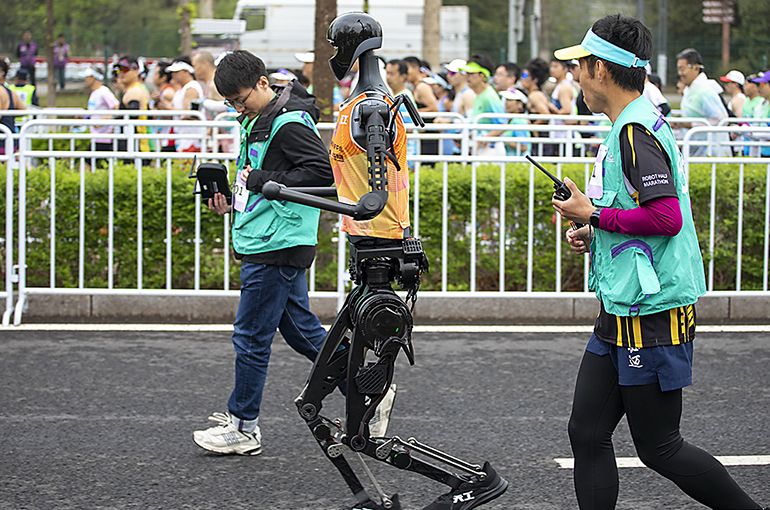
 Robots to Challenge Human Records at World's Second Marathon for Androids in Beijing, CTO of Last Year's Winner Says
(Yicai) March 20 -- Robots competing at the world's second half-marathon for humanoid robots in Beijing next month will challenge records set by human runners, according to the chief technology officer of the maker of last year's winner.
Several teams have said they will "challenge the human champion" record this year, targeting finishing times of "around one hour," Tang Jian told Yicai. Overall speed will likely jump sharply, he added, but remained cautious about the chances of Beijing Humanoid Robot Innovation Center winning again, saying "no one can be 100 percent sure."
The human world record for a half-marathon is 57 minutes 20 seconds, while BHRIC's Tiangong Ultra won last year's half-marathon with a time of two hours, 40 minutes, and 42 seconds, meaning that androids need to double the pace of last year's winner to break the human record.
Robots' leap in speed comes after comprehensive upgrades to their hardware and algorithms, Tang said, adding that the joint torque output and explosive power of this year's participants are much stronger than last year, while new cooling systems technology is being used to ensure stable performance during prolonged high-intensity running.
Optimization of the motion control system has made the robots' gait more human-like, improving energy and running efficiency, Tang noted. In addition, thanks to improved battery performance, some robots may finish without needing to recharge mid-race, he pointed out.
This year's robots will also use electronic maps to independently complete environmental perception, path planning, and real-time decision-making, unlike last year's entries, which required human pacemakers or remote control, Tang said. This year's track will be more complex, posing greater terrain adaptability challenges, he stressed.
Regarding doubts over "whether it makes sense for robots to run marathons," Tang said competing in the event is an extreme test of software and hardware, especially the stability and consistency of motion control algorithms. The race provides a valuable validation scenario for the long-term stable operation of androids in complex environments, he noted.
By the middle of this year, humanoid robots will be able to sprint 100 meters in under 10 seconds, even "faster than Usain Bolt," Wang Xingxing, founder of Unitree Robotics, said at a forum earlier this week. "Athletic capability is a prerequisite for all robots to actually perform work."
Editors: Tang Shihua, Martin Kadiev