



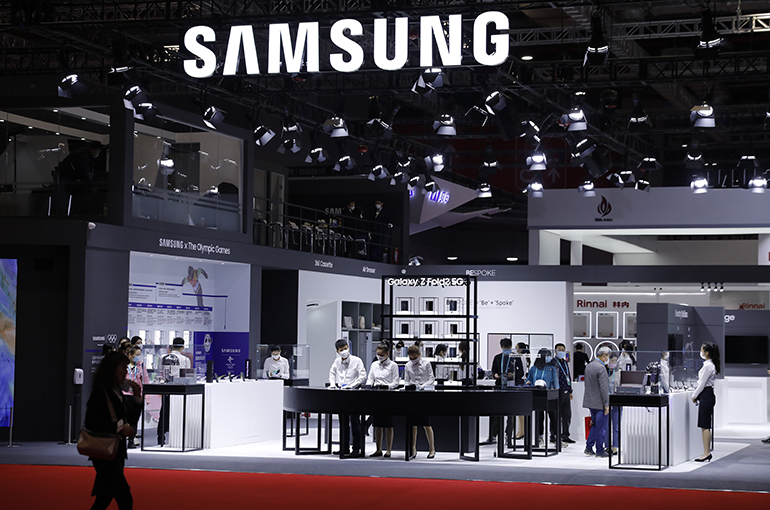
 Samsung to Stop Selling Home Appliances in Chinese Mainland
(Yicai) May 7 -- Samsung Electronics will halt the sale of all types of home appliances in the Chinese mainland as part of adjustments due to the rapidly changing market environment.
The products that will be discontinued include televisions, monitors, large commercial displays, air conditioners, refrigerators, washing machines, dryers, washer-dryer combos, fabric care machines, audio systems, projectors, vacuum cleaners, and air purifiers, the South Korean company announced yesterday, adding that its smartphone business will not be affected.
Samsung's home appliance business in the Chinese mainland boomed around 2014 and 2015, when it sold about USD3 billion worth of TVs, USD1 billion in other home appliances, as well as over USD20 billion in mobile phones a year.
"Samsung's adjustment in China is the result of both the global industrial competitive landscape and its own strategic choices," said Dong Min, secretary-general of the China Video Industry Association, The Paper reported.
In recent years, Chinese home appliance firms, such as Hisense Group, TCL Electronics Holdings, and Xiaomi, have grown rapidly, exerting significant pressure on Samsung, which struggled to maintain its brand premium due to its similar offerings, Dong explained.
Moreover, Samsung's retreat from liquid crystal display panel manufacturing has made its TV business reliant on Chinese panel suppliers, further weakening its competitive edge, he added.
As of April 5, Samsung's shares in the Chinese offline TV, refrigerator, and washing machine markets were only 3.6 percent, 0.4 percent, and 0.4 percent, respectively, ranking fifth, 14th, and 15th nationwide, according to data from AVC.
Meanwhile, Samsung remains heavily invested in its business-to-business operations in China, including storage solutions, electronic components, and medical equipment.
The company had 16 manufacturing enterprises and 13 research and development centers in China in cities such as Beijing, Shanghai, Tianjin, Suzhou, Shenzhen, and Xi'an at the end of last year, with its total investment in the country nearing USD56.7 billion, about 90 percent of which was allocated to high-tech industries.
Samsung is also strengthening its semiconductor business in China. On March 27, it held the China Flash Market Summit, better known as MemoryS, in Shenzhen. On April 7, it launched its next-generation high-bandwidth memory products through an announcement on the official Weibo account of Samsung Semiconductor.
Editor: Futura Costaglione





