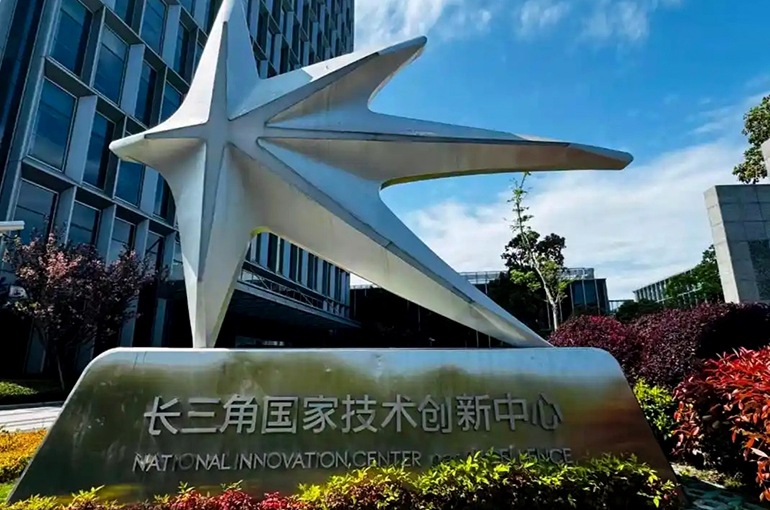
 Yangtze River Delta Innovation Center's Job Is to Speed Tech From Lab to Market, Director Says
(Yicai) May 19 -- The Yangtze River Delta National Technology Innovation Center focuses on advancing scientific and technological achievements "from phase one to 10" and serves as a core hub for in-depth integration of technological and industrial innovation, according to its Director Liu Qing.
The one-to-10 innovative product development process refers to the engineering optimization, pilot testing, and small batch verification that turns laboratory prototypes into market-ready products. It is the core to transform original innovation into stable, replicable, and cost-effective goods.
The Yangtze River Delta National Technology Innovation Center was founded in 2021 by the governments of Shanghai, Anhui province, Jiangsu province, and Zhejiang province as a cross-regional comprehensive platform dedicated to technological innovation and commercialization. It aims to facilitate the transformation of laboratory research outcomes into factory-scale industrial production.
To smooth the progress from one to 10, the Yangtze River Delta National Technology Innovation Center is building bridges between local enterprises with global innovation resources.
The center integrates large scientific facilities, national laboratories, and university research resources in Shanghai, links up scientific and technological outcomes from major innovation hubs, including Nanjing, Hangzhou, and Hefei, polls global research achievements and talents to conduct conceptual verification and pilot-scale expansion for original research results, and delivers targeted technological achievements that meet the actual demands of local enterprises.
The Yangtze River Delta National Technology Innovation Center pioneered a financing mechanism integrating allocation and investment for scientific research, which has now been promoted nationwide. The center allocates fiscal funds as grants to support promising original and cutting-edge technology startup projects, which pay back the financing in the form of equities based on market valuation after they secure market-oriented financing.
The project selection mainly relies on evaluations from experts and in-depth due diligence conducted by the center's professionals, Liu noted. Amid a rapid growth in the number of applications, the center has kept optimizing its investment mechanisms and recently introduced a follow-up investment mechanism.
"Without this mechanism, professionals bear no project risks and cannot share development gains, which would result in insufficient constraints and positive incentives during project screening," Liu explained.
The follow-up investment mechanism covers due diligence teams, department heads, and relevant management committee members, aligning the interests of investment teams and sci-tech projects via shared risks and returns.
As of April 30, the Yangtze River Delta National Technology Innovation Center had invested in 197 projects under the allocation-investment integration model, with an average grant of CNY25 million (USD3.5 million) per project. So far, 39 projects have fulfilled research and development targets, 29 of which have obtained equity investment from market-oriented capital and completed equity conversion. They have attracted nearly CNY2.4 billion (USD331.2 million) investment from market-oriented capital.
Boosting Free Flow of Innovation Factors
The four provincial-level regions in the Yangtze River Delta Region need to break invisible administrative barriers to enable the free flow of talents, research facilities, academic achievements, and capital across the region, striving to build a world-class innovation engine comparable to Silicon Valley, Liu said.
For example, scholars based in Hefei should be allowed to carry out research work freely in Shanghai, and research outcomes developed by Shanghai academicians should be easily incubated and industrialized in Ningbo, he explained. Deeper integration lies in realizing the cross-regional flow of local fiscal funds.
"For instance, when enterprises in Suzhou invite experts from Shanghai to tackle technical bottlenecks, these experts should be eligible to receive fiscal funding support from Suzhou," Liu added.
In his view, whether innovation factors such as fiscal funds can flow across administrative regions in line with market rules is a key criterion to judge if the Yangtze River Delta Region has built a barrier-free integrated innovation hub.
During the process of integrated sci-tech development in the Yangtze River Delta Region, Shanghai needs to further consolidate its leading role, Liu believes. With a more open mindset, the city should attract global innovative talents on behalf of the entire region and even the whole country, and vigorously foster the R&D economy.
"Shanghai should develop R&D as an independent industry and regard technologies as tradable commodities, building itself into a cluster of R&D centers for leading enterprises across the Yangtze River Delta Region and the whole nation," Liu said. "Shanghai boasts outstanding advantages in high-caliber talents, advanced research equipment, cutting-edge research capabilities, and internationalized, professional, and refined government services that are hard to match."
Editors: Tang Shihua, Futura Costaglione