 Seventh Shanghai Innovation Forum to Launch USD808 Million Support Program for Young Scientists
(Yicai) May 8 -- The upcoming seventh Shanghai Y50 Forum for Innovation and Entrepreneurship will launch a seed program with CNY5.5 billion (USD808 million) of funds to support innovation and entrepreneurship by young scientists from local universities, creating a system covering "sowing, seedling cultivation, and growth."
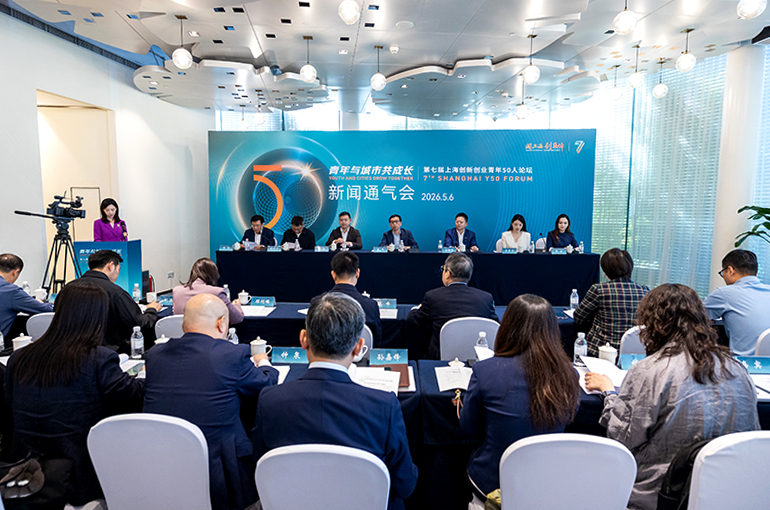
The program will set up a direct equity investment fund of CNY500 million (USD73.5 million) and provide an additional CNY5 billion credit facility, Qi Shi, chairman of East Money Information, one of the key organizers of the Y50 Forum that will be held on May 10, said on May 6. It will focus on high-quality early-stage startups in hard tech sectors, including artificial intelligence, integrated circuits, and biomedicine, with initial equity funding and low-cost credit financing, Qi added.
The program will comprehensively support young university entrepreneurs in terms of capital, venues, services, and resources, lowering entry barriers and boosting success rates. Support includes graded rent reductions and exemptions for office space, rental discounts for talent apartments, and housing purchase subsidies.
"Shanghai has introduced a host of favorable policies and strategic support for innovative and entrepreneurial young people, enabling us to fully unleash our vitality and momentum," Hu Jiateng, a doctoral candidate in surgery at Shanghai Jiao Tong University School of Medicine and a representative of this year's Y50 Forum, told Yicai. "These policies help projects solve practical problems in daily operations and offer effective support for young talents.
"The policies allow us to nurture our innovative and entrepreneurial ideas from small potted plants into towering trees, and together with other growing projects, form a vibrant landscape," Hu noted. "In addition, the Y50 Forum will provide us with an innovation' consultation room,' where young people from different industries can break down industrial boundaries and offer solutions to each other's challenges."
Hu, who is also the head of the Youth Science and Technology Innovation Studio for the research and translation of aortic medical devices and related intelligent systems at Shanghai Jiao Tong University School of Medicine, hopes to meet potential cross-industry partners at the Y50 Forum. "During a pre-forum event, I met a young AI algorithm researcher, and we may collaborate in the future."
The Shanghai University Innovation and Entrepreneurship Community Initiative, which will also launch at this year's Y50 Forum, aims to build a collaborative, open innovation ecosystem for young university innovators and entrepreneurs.
In addition, the Shanghai Youth Sci-Tech Innovation Carnival, a key part of the Y50 Forum, has been fully upgraded, focusing on three sections: project roadshows, investment matchmaking, and ecology exhibitions. It will build a platform for young entrepreneurs from over ten key universities to connect with investment institutions and innovation parks.
This year's carnival features five special sessions: integrated circuits, biomedicine, AI, future industries, and Hong Kong, Macao, Taiwan, and overseas sessions, noted Zhang Le, senior director of global public affairs at Fosun International, one of Y50 Forum's organizers. The mentor panels comprise investment and research institutes, as well as leading industrial firms, providing professional reviews, industrial matchmaking, and improving the efficiency of investment and financing connections, Zhang added.
"Integrated circuits, biomedicine, and AI are the core hard tech sectors in Shanghai and key areas for the commercialization of university research achievements," Zhang said. "Specialized roadshows can precisely match capital and industrial resources for relevant startups."
Future industries cover various cutting-edge technologies, including quantum technology, commercial aerospace, controlled nuclear fusion, and brain-computer interfaces, Zhang noted, adding that innovation projects in future industries align with Shanghai's long-term urban innovation strategy.
The Hong Kong, Macao, Taiwan, and overseas session is designed to attract global young innovators and entrepreneurs to Shanghai, enhancing the internationalization level of projects and achievements, Zhang pointed out.
For the first time, the Y50 Forum has set up three satellite venues at Stanford University, the National University of Singapore, and the University of Hong Kong. Through video links, keynote sharing, and panel discussions, it will build an innovation and entrepreneurship exchange platform for young people between Shanghai and the US, Singapore, and Hong Kong, enabling young scholars and entrepreneurs to experience Shanghai's innovation and entrepreneurship ecosystem firsthand and attract more overseas talents to the city.
Editors: Tang Shihua, Martin Kadiev