



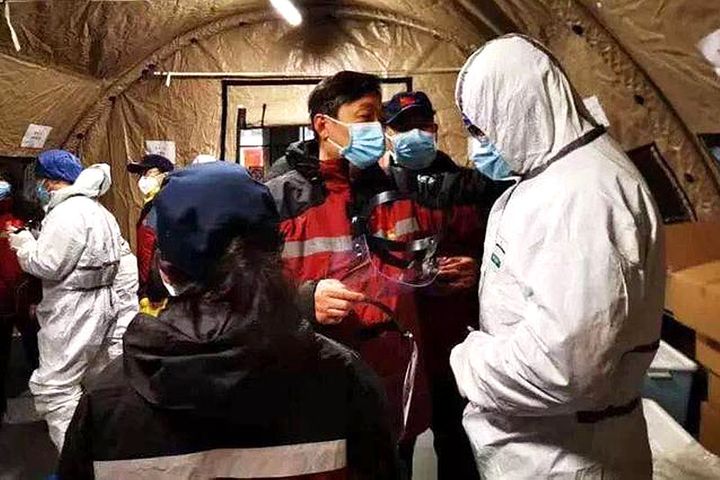
 Shanghai Hospital's Mobile Unit in Wuhan Played Vital Role in Covid-19 Epidemic Control
(Yicai Global) March 23 -- Shanghai East Hospital's mobile medical unit in the epidemic epicenter of Wuhan, Hubei province was erected in just three hours. By implementing a seamless work model and adhering to the highest standards the makeshift hospital was able to effectively treat mild cases of Covid-19 and help stem the spread of the virus.
"We had zero infection of medical staff, zero recall and zero patient deaths," Vice President and pulmonologist Lei Han told Yicai Global.
On Feb. 7, Shanghai East Hospital sent half of its emergency medical aid team, some 53 people, to Wuhan to help fight the epidemic. That day the team built one of the city's first and largest modular hospitals in just three hours. It had 25 tents and the capacity of a medium-sized hospital. Patients began to be admitted that same afternoon, Lei said.
The initial idea was that the makeshift hospital should only treat mild cases of the disease and that it should focus on people aged between 18 to 65 without underlying health issues, Lei said. However, this plan became difficult to implement, because the initial screening involved too many patients, he added.
Comprising treatment wards, life support units, technical support cabins, storage modules, staff dressing and ablution rooms as well as a fever clinic, the modular hospital's first job was to test all the incoming. Those who tested positive were immediately admitted for care. Such fast action helped to control the spread of infection and also gave patients a much better chance of recovery.
Strictest Standards
"At that time, the patient mortality rate in Wuhan was about 3 percent and our modular hospital admitted more than 1,000 patients. You can imagine what a feat it was to have no fatalities," Lei said.
In other to do this, we needed to follow the strictest standards in using personal protective equipment and carrying out medical procedures such as collecting throat test strips. If we tripped up at a single point, the risk of complications would rise, he added.
"The most important task is to ensure patients' needs," Lei said. This means that patient diagnosis and treatment must be smooth and uninterrupted. All drugs, testing, radiation, infection control and other facilities must be well linked. Managing patients' food and water intake as well as their emotional state are also important, he said.
Each patient was appointed a designated physician with whom they could communicate at any time, even after work hours by using the WeChat social messaging app or by text message, Lei said. Each shift had a designated area of responsibility so that each patient was properly observed without leaving any 'dead spots' in wards.
Due to the shortage of doctors, nurses also played the role of 'doctor assistants' and undertook some tasks such as implementing doctor's orders and explaining the illness condition, said Lei.
Successful Mission
From mid-February the number of new patients began to drop markedly, showing that the hospital was effectively controlling the source of contagion within society, he said. We then shifted our focus from treatment to diagnosis and detection, he added.
By March 10, the epidemic was deemed to be under control and all the city's 16 modular hospitals were closed. In the little over a month that the Shanghai East Hospital's mobile unit had been operating, it had treated over 1,780 patients.
Editor: Tang Shihua, Kim Taylor





