 Shanghai Swells Ranks of City's High-Tech Incubators to 18
(Yicai) Dec. 19 -- Shanghai has inaugurated six new top-notch incubators, bringing the total number to 18. They will help accelerate the transformation of key and core technology research and development in the city and the rapid growth of related enterprises.
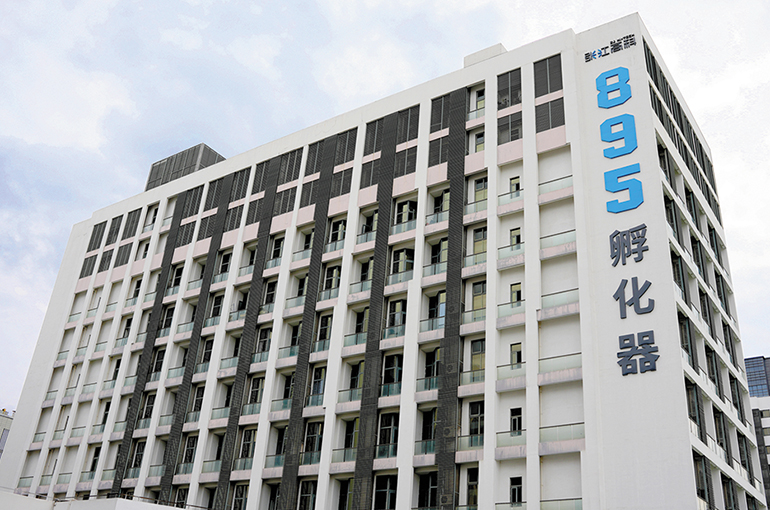
The new high-quality incubators are Synlonx Brain-Computer Interface Super Incubator, Zhangjiang Hi-Tech 895 Entrepreneurship Camp, Nest.Bio Shanghai Innovation Incubation Platform, Shanghai AMI Sanjiang New Materials Industry Innovation Center, Shutonglian Valley Blockchain Application Innovation Incubator, and neoBay Global Innovation and Entrepreneurship Community, Yicai learned from the Shanghai’s science and technology commission.
High-quality incubators are formed by universities, research institutes, leading technology enterprises, and top investment institutions, and are operated by first-class incubation talents. Startups that settle in such incubators can enjoy full support, including finance, investment, talent, and technology.
Compared with ordinary incubators, they focus more on ‘key and core technology’ enterprises, pay attention to cutting-edge technologies and future industries, and support the transformation of disruptive scientific and technological achievements.
AMI Sanjiang is the only incubator of the six that focuses on new material firms. Its founder Zhang Pinshu told Yicai that it not only supports product R&D but also the development of production processes and equipment, the scale-up of production, the making of technologies for pilot plant testing, and the verification of products by customers.
This incubator plans to cultivate 30 to 50 enterprises within the next three years and form a complete growth chain for material startups from pilot plant testing to industrial production in Shanghai’s Baoshan district, where AMI Sanjiang is based, Zhang said.
AMI Sanjiang chose to settle in Shanghai because of the industrial resources in the city and the Yangtze River Delta region, Zhang noted. “Shanghai is home to China’s densest material-related industrial chain and has rich scientific research resources.”
The rapid development of emerging industries in Shanghai is fueling demand for advanced materials. This means that the enterprises AMI Sanjiang will incubate include startups producing skin products for robots, membrane materials for chips, lightweight metals, and precision dispersion materials, Zhang noted.
Incubators not only provide the physical space for the business growth of the companies they incubate but also bind and develop hand in hand with them, according to Zhang. “Each incubator has equity in firms they incubate to share risks.”
Zhangjiang Hi-Tech 895, which was established 10 years ago, is now the largest incubator by operating area in Shanghai. It has incubated more than 1,500 companies and successfully cultivated over 170 high-tech firms and 140 specialized, distinctive, and innovative enterprises.
Zhangjiang Hi-Tech 895 is a “24-hour incubator,” its head Yuan Quan told Yicai. “As long as it is a high-quality project, Zhangjiang Hi-Tech 895 will immediately invest money in it.” Meanwhile, entrepreneurs can focus on R&D without distractions.
Zhangjiang Hi-Tech 895’s 895 Startup Camp, which was held 16 times, serves as a bridge for the integration of industrial resources among enterprises. A total of 486 enterprises have participated in the camp, with a total valuation of CNY170 billion (USD24.1 billion).
The head of an aerospace firm told Yicai that it attended the 895 Startup Camp because it provided cooperation opportunities with the many participating upstream and downstream enterprises.
Developing satellites requires suppliers from many industries, such as materials, electronics, and semiconductors, so it is not easy for them to come together. The 895 Startup Camp is a platform enabling this gathering, presenting potential opportunities for cooperation.
Editors: Tang Shihua, Futura Costaglione