



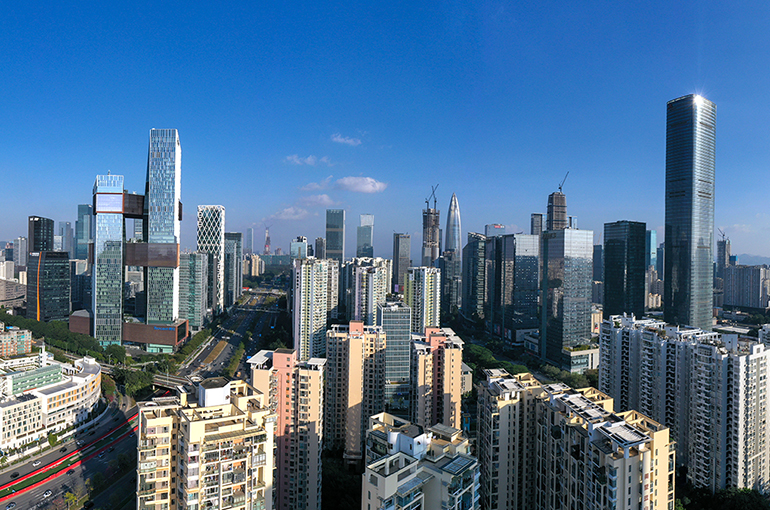
 Shenzhen's Nanshan District Becomes China's Third With GDP of Over CNY1 Trillion
(Yicai) Jan. 30 -- Shenzhen's Nanshan district, home to tech giant Tencent Holdings and drone maker DJI Technology, has become the third administrative region under the jurisdiction of a Chinese city to see its gross domestic product exceed CNY1 trillion (USD143.9 billion).
Nanshan's economy likely grew 6 percent to over CNY1 trillion last year from 2024, Li Xiaoning, head of the district government, said at a local meeting of the People's Congress on Jan. 27. Its GDP per square kilometer is expected to reach CNY5.4 billion (USD777 million) and per capita CNY540,000 (USD77,705), both among the top in China, Li added.
Pudong New Area in Shanghai and Haidian district in Beijing are the other two Chinese districts with a GDP of over CNY1 trillion. Nanshan's GDP was only CNY7.8 billion when it was founded in 1990 and first topped CNY100 billion (14.4 billion) in 2005.
Nanshan's economic growth has provided an innovative model for regional economic development in China, experts told Yicai, noting that its experience may reshape the development logic of the country's urban agglomerations.
Nanshan covers an area of only 185 sq km, or just a tenth of Shenzhen. However, it contributes one-fourth of the city's GDP, one-third of patents, and two-fifths of listed companies.
The rapid economic development of Nanshan is attributed to its high investment in research and development and the concentration of innovative firms. Industrial robot maker Ubtech Robotics, telecom equipment firm ZTE, and consumer electronics giant Skyworth Group are among others based there, while Huawei Technologies has its R&D headquarters in the district.
Nanshan had over 637,000 market entities by the end of last year, including 6,037 high-tech companies, 36 Manufacturing Single Champion enterprises, 394 specialized, refined, distinctive, and innovative "Little Giant" firms, and 28 unicorns, according to official figures. The number of listed companies registered in the district has topped 218.
Nanshan's R&D investment intensity (the ratio of R&D expenditure to GDP) was 2.9 times higher than the national average at 7.9 percent last year, while the number of invention patents per 10,000 people reached 860, or 22.9 times more than the national average. The cumulative number of international patents under the Patent Cooperation Treaty stood at 25,000, accounting for 7.1 percent of the total in China.
Transforming geographical advantages into institutional ones is another key factor for Nanshan's economic development. As it faces the Hong Kong Special Administrative Region across the sea, the district was the first to turn the concept of "Shenzhen-Hong Kong urban integration" into reality.
For example, Nanshan has taken the lead nationwide in experimenting with a special legal and dispute resolution mechanism for Hong Kong-funded companies, allowing eligible such firms to choose Hong Kong law in their contracts and submit disputes to its arbitration.
With the help of the Qianhai Shenzhen-Hong Kong Modern Service Industry Cooperation Zone, Nanshan is also exploring cross-border data flow, cross-border investment and financing, and mutual recognition of cross-border professional qualifications with Hong Kong.
Editors: Tang Shihua, Martin Kadiev





