



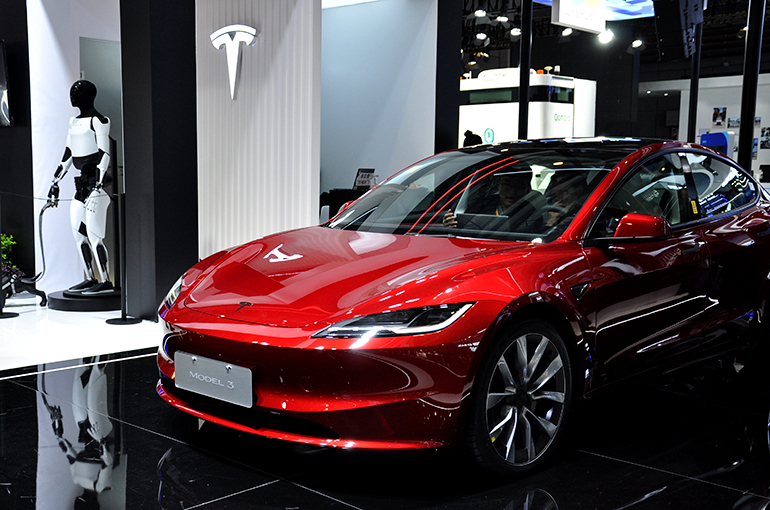
 Tesla Doesn’t Exclude Suppliers Based on Country of Origin, VP Says
(Yicai) Nov. 26 -- A supplier’s country of origin is not an exclusionary criterion, Tesla Vice President Grace Tao said following a newspaper report that the electric carmaker seeks to eliminate Chinese-made parts from vehicles it produces in the United States.
Tesla selects suppliers using the same exacting and objective standards worldwide, namely quality, cost, technological maturity, and long-term supply continuity, Tao said today on Chinese microblogging website Weibo.
She added that Tesla’s high cost-performance in the Chinese market reflects the Shanghai Gigafactory’s “made in China” approach and noted the firm works with more than 400 Chinese suppliers, over 60 of which are already part of its global procurement network.
The Wall Street Journal reported on Nov. 15 that Tesla is requiring suppliers to exclude China-made components from the vehicles it produces in the US. The California-based company aims to shift to non-China parts entirely within one to two years, the report said, citing people familiar with the matter.
News reports in April also said certain China-made components were already being swapped for parts produced in other regions -- mainly Mexico, Canada, other North American sites, and places in Europe and Asia -- and that Tesla has been encouraging some Chinese suppliers to shift their production overseas.
China shipped USD13 billion to USD20 billion of auto components to the US last year, accounting for about 16 percent of China’s entire auto part exports. The products included body parts, aluminum alloy wheels, powertrains, chassis parts, tires, glasses, electrical and electronic components, and auto chips.
Moves to “de-Sinicize” auto supply chains have two drivers, according to Chen Bing, special commentator for Shenzhen Television. First, risk mitigation because companies fear that US President Donald Trump may adopt more aggressive trade policies after mid-term elections next year, pushing for a return of “US manufacturing.”
Second, momentum and sentiment as many US and European firms are making changes to their supply chains, using the current respite in China-US trade tensions as a buffer period to re-shore or diversify sourcing.
A recent report by Roland Berger said the global auto industry is beginning to decouple, with China emerging as the leader, Europe taking a back seat, and the US becoming increasingly isolated. For the US that implies stronger protectionist measures, meaning that growth will largely rely on domestic original equipment manufacturers.
Decoupling does not simply mean that each region acts independently, the report noted. China is leading battery development with direct access to critical raw materials and deep technical know-how.
Outside of China, Europe, the US, Japan, and South Korea remain closely interconnected and generally aligned with international standards, such as regulations from the International Organization for Standardization, the Automotive Open System Architecture, and the United Nations Economic Commission for Europe.
Editor: Futura Costaglione





