



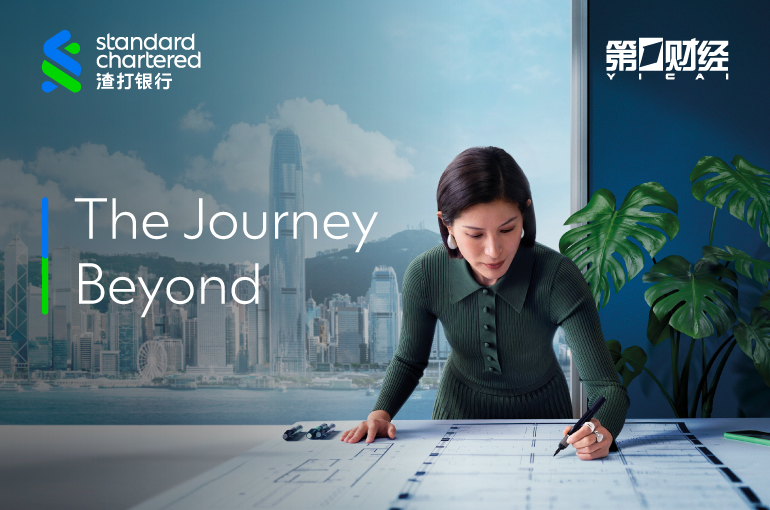
 The Journey Beyond: A Global Journey of Chinese Pioneers
Standard Chartered, in Collaboration With Yicai, Explores the Path of Transformation From the "World's Factory" to a "Global Hub."
Introduction
Currently, the globalization of Chinese enterprises is unfolding with unprecedented breadth and depth. Against this backdrop of our times, Standard Chartered, in collaboration with Yicai, has jointly launched the communication series "The Journey Beyond". This initiative aims to meticulously document and interpret the structural transformation of Chinese small and medium-sized enterprises as they expand overseas. This collaborative effort itself represents a response to the new era of cooperation -- in a complex and ever-changing global environment, only through cross-border synergy can we gain deeper and more penetrating insights.
From supporting technology companies in establishing overseas innovation and operation hubs to assisting industrial companies in optimizing cross-regional supply chains and global operational networks, Standard Chartered's practices across diverse markets consistently reaffirm its role: it not only engages in the present development of enterprises but also focuses on how business achievements transcend time and space, solidifying into sustainable and scalable long-term foundations.
Meanwhile, the successful global expansion of any enterprise is a process of integrating into a broader ecosystem. Financial institutions, financial media, think tanks, legal and professional service providers, and local partners collectively form an "ecological network" that supports enterprises in their ambitious ventures. The Journey Beyond was born precisely from this shared understanding -- embracing the dual roles of "connector" and "chronicler" to integrate into and energize this ecosystem, providing enterprises with support that transcends a single dimension.
The Times Are Pushing Us Forward: From an "Optional Question" to a "Mandatory Question"
As we stand in 2026, the inaugural year of the 15th Five-Year Plan, a consensus is becoming increasingly clear: for the vast number of Chinese enterprises, especially SMEs, globalization has evolved from an optional "choice" into a "mandatory question" concerning long-term survival and development.
The global industrial chain is undergoing profound restructuring, while regional cooperation continues to deepen. Against this macro backdrop, Chinese enterprises are being repositioned within the global economic structure. For SMEs, going global is no longer merely an expansion of scale, but rather a structural spillover that involves capabilities, technology, management, and even business models.
A profound yet silent transformation is underway: countless SMEs are evolving from the "capillaries of the world's factory" into "critical nodes in the global value network." Each proactive leap by an individual enterprise accumulates, on a broader scale, into collective momentum for industrial structural adjustment.
In our long-term practice of observation, one conclusion has been repeatedly validated: enterprises that ultimately achieve sustained and steady growth often begin systematically contemplating three sets of relationships earlier -- time, space, and people. How can a business transcend economic cycles? How can resources be efficiently allocated across different geographical spaces? How can long-term consensus be fostered at the levels of the enterprise, the team, and even the family? These questions constitute the core propositions of globalization and call for more systematic and patient approaches to support.
The New Landscape of Global Expansion: Four Profiles and One Common Logic
Through our hands-on experience accompanying and observing companies in their global expansion journeys, Standard Chartered has observed that enterprises at different development stages and with diverse business models are facing distinct yet highly structured challenges. Among them, four typical enterprise profiles stand out most clearly.
The first category comprises cross-border trading SMEs. These companies have deep roots in ASEAN and Belt and Road markets, and their operations often involve multi-currency settlements. The convenience of using minor currencies, the ability to manage exchange rate fluctuations, and the balance between the efficiency and stability of capital flows constitute the most practical considerations in their daily operations.
The second category consists of manufacturing enterprises operating across multiple markets. These companies have established production and operational entities in various jurisdictions, and the challenges of supply chain coordination, cross-border capital allocation, as well as compliance and risk management arising from decentralized operations require them to develop more mature systemic capabilities.
The third category includes overseas investment and listing-oriented enterprises. These companies face the global capital markets, requiring partners with cross-cycle perspectives and long-term patience for tasks ranging from early-stage investment structure design and compliance pathway planning, to managing the pace of the listing process, and continuous post-listing value management.
The fourth category features leaders who embody both entrepreneurial and familial roles. While driving the internationalization of their enterprises, they simultaneously engage in personal and family wealth planning, intergenerational succession, and responsibility arrangements. At the convergence of career, wealth, and family, the demand for "long-term order" becomes increasingly prominent.
The paths may differ and the stages may vary, yet the underlying logic of these enterprises is highly consistent: in a global environment of high uncertainty, they proactively seek and construct a stable structure capable of withstanding volatility and enduring cycles. The process of going global is, in essence, a global upgrade of a company's governance structure, resource allocation framework, and risk management architecture.
From Service Providers to Eco-system Co-Builders
When the demands of enterprises undergo profound changes, the role of supporters must also evolve. Whether it is financial institutions or finance media, their value is shifting from being just “service providers” or “information observers” to being understanders, co-builders, and long-term companions of the enterprise globalization ecosystem.
For Standard Chartered, the significance of the international network lies not only in its coverage but also in the judgment accumulated from long-term and in-depth participation in real trade, real investment, and real operations. The judgment is reflected in whether it can understand the growth stage of an enterprise and whether it can truly comprehend the operational rhythms of different markets in terms of policy, economy, and culture.
More importantly, Standard Chartered is an integral part of the ecosystem for enterprises going global. Truly sustainable support comes from connection and collaboration -- working with multiple partners such as legal, consulting, investment, and local service institutions to build a stable supporting network, help enterprises reduce information asymmetry and quickly blend into the local business system.
In this process, Yicai plays an equally important role. Through long-term, professional, and restrained records and analysis, it presents the judgments, choices, and corrections of enterprises at critical junctures as a basis for public discussions that can be understood and learned by more market entities.
The Journey Beyond: A Notepad and a Companion
Based on the above observations and reflections, Standard Chartered and Yicai jointly launched the communication column The Journey Beyond. It is not a simple showcase of success stories, but a long-term notepad of the real business world.
We focus our “camera lens” on the key decision-making moments in the process of enterprises going global, pay attention to those moments of hesitation, trial and error, correction and restart, present the structural choices that determine the fate and the real process of how their ecosystem partners collaborate with and support them.
Through The Journey Beyond, we hope to present not only individual enterprises’ struggle to success, but also a picture of the ecosystem composed of enterprises, financial institutions, media and professional service partners. When these practices are carefully recorded, deeply analyzed and widely shared, they can gradually converge into “public goods for thinking” that the entire business society can learn from, making more pioneers not feel alone on their journey.
Conclusion
Globalization is entering a new phase where resilience, wisdom and collaborative capabilities are tested more than ever. Moving forward requires not only courage but also clear judgment, a solid structure and reliable long-term partners.
The Journey Beyond witnesses and is the starting point of an ecological companionship. Standard Chartered and Yicai expect to have continuous observations, thinking and exploration in the longer run and in the broader space through the program, together with Chinese enterprises that are embarking on or about to embark on their journeys, as well as all those who pay attention to and participate in the process of China’s business globalization.
The journey is long, but collaboration will help us go further. May this program pay tribute to every brave start and accompany every steady growth.





