



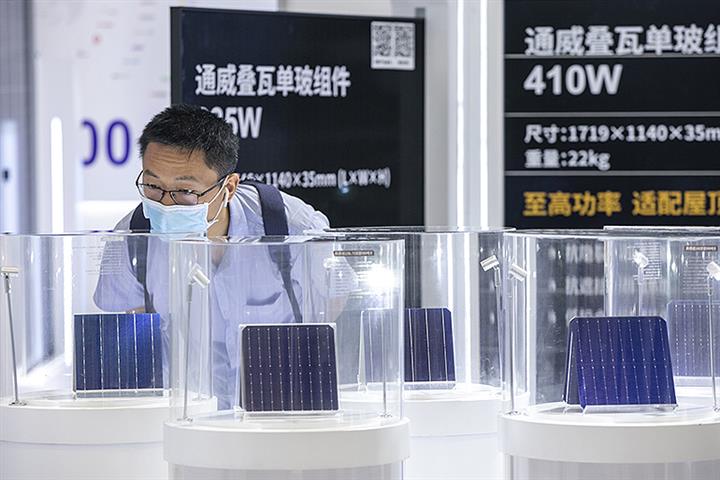
 Tongwei Topples Longi as China’s Highest Earning PV Firm as Silicon Prices Surge
(Yicai Global) Sept. 5 -- Tongwei was the biggest earner in China’s photovoltaic sector in the first half, ousting solar panel manufacturer Longi Green Energy Technology from its long-standing throne, as soaring silicon prices propelled the Chinese silicon giant to reach record profit and revenue.
Tongwei’s net profit for the six months ended June 30 more than quadrupled from the same period last year to CNY12.2 billion (USD1.7 billion), according to the Chengdu, southwestern Sichuan province-based company’s latest earnings report. Revenue more than doubled to CNY60.3 billion (USD8.7 billion).
Longi had to settle for second place with revenue of CNY50.4 billion (USD7.2 billion), a gain of 43.6 percent year on year, according to the semi-annual financial reports released by 80 listed PV firms.
In terms of profit, though, it was relegated to fourth place, behind that of two other silicon suppliers Daqo New Energy and Tebian Electric Apparatus. Daqo’s net profit jumped almost four-and-a-half times to CNY9.5 billion (USD1.3 billion), Tebian’s more than doubled to CNY6.9 billion, while Longi logged a modest 29.7 percent increase to CNY6.4 billion.
The price of silicon has more than doubled since the beginning of the year to as much as CNY312,000 (USD45,000) per ton, as demand outstrips supply, and shows no sign of levelling off this year, according to the latest data from the Silicon Industry of China Nonferrous Metals Association.
But it is not only the raw material producers who are doing well. China’s PV industry is booming and there has been a huge increase in solar power installations this year, benefiting the whole industrial chain. The country’s newly installed PV capacity more than doubled in the first half from the same period last year to 30.8 GW while solar panel exports jumped 74.3 percent to 78.6 GW.
China’s solar station builders submitted bids for nearly 100 GW of PV modules in the eight months ended Aug. 31, an all-time high and more than twice the amount bid for during the whole of 2021, according to incomplete statistics. And prices jumped more than 30 percent from the start of 2021 to as much as CNY2 (USD0.30).
Riding the Wave
As a result, despite the jump in raw material costs, big PV wafer makers in the upper reaches of the industry chain are still able to make money. And a shortage of large-size silicon wafers means that those who produce them still have pricing power over their customers.
TCL Zhonghuan Renewable Energy Technology, for instance, logged a 92.1 percent surge in net profit in the first half from a year earlier to CNY2.9 billion (USD418 million), while revenue soared 80 percent to CNY31.7 billion (USD4.5 billion). Its solar wafer sales accounted for 77.1 percent of total revenue.
Further down the industrial chain, leading solar cell manufacturers did better in the second quarter than in the first quarter, with shipments jumping 20.1 percent to 2.2 GW. Battery maker Shanghai Aiko Solar Energy’s gross margin expanded to 11 percent in the three months ended June 30 from 7.4 percent in the previous quarter, while that of Drinda climbed 0.16 percentage points to 10.3 percent.
Riding the wave, many cell and wafer manufacturers did much better in the first half than the same time last year. Aiko posted a 27-fold jump in net profit, while wafer makers Risen Energy and Jolywood both logged a close to seven-and-a-half-fold leap.
PV equipment suppliers also did well. Qingdao GaoCe Technology, a manufacturer of silicon wafer cutting equipment and diamond wire auxiliary materials, reported a more than three-fold gain in net profit year on year to CNY237 million (USD34.25 million) while revenue more than doubled to CNY1.3 billion.
Despite the rising cost and less pricing power compared with other sectors of the industrial chain, leading solar panel maker Trina Solar still posted a 79.8 percent jump in net profit to CNY1.2 billion and a 76.9 percent leap in revenue to CNY35.7 billion. Its gross profit margin edged up 0.19 percent from a year ago.
Editors: Tang Shihua, Kim Taylor





