 China Says High Exports, Big Trade Surpluses Don’t Equate to Overcapacity
(Yicai) July 29 -- High export volumes and large trade surpluses should not be interpreted as evidence of “excess capacity,” China’s commerce ministry has said in a new paper, following claims that the world’s second-largest economy suffers from industrial overcapacity.
Capacity issues are a normal phenomenon arising during global economic development alongside industrial upgrading, market fluctuations, and changes in the division of labor, according to the policy document -- China’s Position on the So-called Excess Capacity Issue -- released yesterday.
Countries should regard capacity disputes objectively, adopting a market-oriented and global perspective grounded in economic principles, and they should prioritize cooperation over confrontation and work together to resolve bottlenecks in global supply and demand, it said.
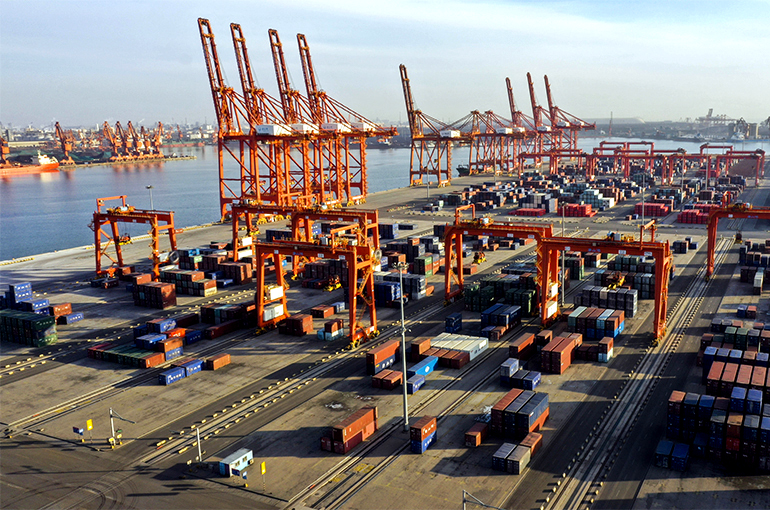
China's trade in goods surged 17 percent to CNY25.47 trillion (USD3.76 trillion) in the first half from a year earlier, surpassing the CNY25 trillion mark for the first time, He Shaojun, head of the ministry’s foreign trade department, said at a press briefing held by the State Council Information Office yesterday. The trade surplus narrowed 4.7 percent, he added.
The current account surplus is about 3.7 percent of gross domestic product, a level considered reasonable by international standards, He noted, adding that China has not experienced significant balance-of-payments imbalances, given the deficits in both services trade and the capital and financial accounts.
China does not deliberately pursue a trade surplus and will continue expanding imports, with plans to hold more than 100 “Export to China” events a year to share development opportunities with the world, He pointed out.
China has contributed around 30 percent to global economic growth over the past decade, Vice Minister Yan Dong said at the briefing. Through its advantages in market scale, industrial development, and technological progress, China provides global development dividends — what the international community calls "China Opportunity 2.0,” he noted.
Capacity utilization rates need to be assessed based on the specific circumstances of countries and industries, as there is no unified global standard, said Lin Weilong, head of the ministry’s policy research office.
China's capacity utilization rate for industrial enterprises above a designated size exceeded 74 percent last year, staying within a reasonable range, Lin noted, adding that the rate in some traditional sectors was temporarily lower, mainly because of structural adjustments and the green transition, which he called a normal consequence of industrial upgrading.
Addressing the narrative that "subsidies cause excess capacity,” Han Yong, director-general of the ministry's department of World Trade Organization affairs, said industrial subsidies are not inherently problematic and have no necessary links to excess capacity.
Han pointed out that the United States has pledged to invest USD750 billion into climate, energy, and healthcare between 2022 and 2031 through its Inflation Reduction Act, with subsidies for electric vehicles limited to those manufactured locally or in North America.
Meanwhile, the European Union has vowed to spend over EUR1.44 trillion (USD1.64 trillion) on the clean energy transition between 2021 and 2030 and its Industrial Accelerator Act proposes to boost industrial capacity and speed up decarbonization in strategic sectors, tying financial support to “Made in EU" investments and creating investment barriers and institutional discrimination, Han added.
Editor: Futura Costaglione