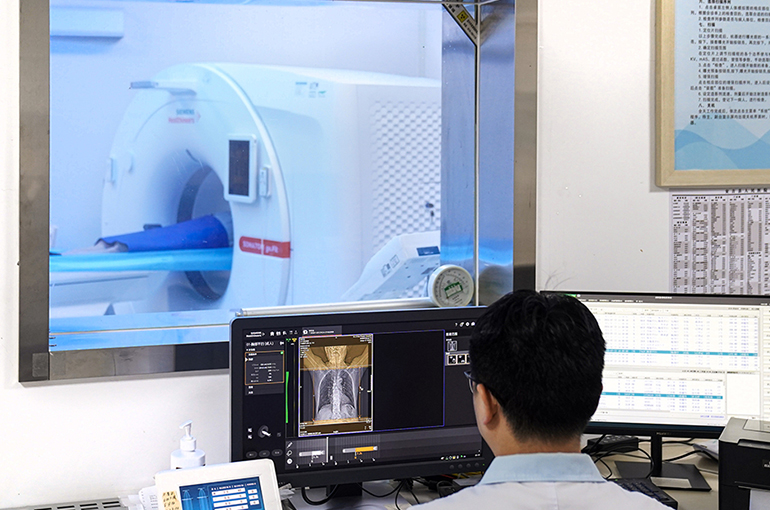
 Delegates Urge Stronger Oversight of AI in Healthcare at Two Sessions
(Yicai) March 6 -- Delegates and medical experts at this year's Two Sessions, China’s annual policy setting meetings, are calling for clearer boundaries, stronger data security and better-defined accountability in the use of artificial intelligence in healthcare.
AI has already proven its value in medical imaging, pathological diagnosis and disease screening at the grassroots level, while surgical robots are also beginning to show their potential, said Ge Junbo, an academician at the Chinese Academy of Sciences, director of cardiology at Zhongshan Hospital of Fudan University and a member of the Chinese People's Political Consultative Conference, which is the country’s top political advisory body.
As the technology and algorithms continue to improve, AI capabilities will eventually surpass even the best doctors, evolving from an assistant tool to a diagnostic system capable of independent judgment, he said.
Ge also raised two critical questions that remain unanswered, namely how to protect patient privacy and who is liable when AI gets it wrong. Both issues are still being debated, and workable solutions are expected to emerge through industry experience over time, he said.
Clear limits on what AI can and cannot do in clinical settings need to be set, said Geng Funeng, chairman of Good Doctor Pharmaceutical Group and a deputy of the National People’s Congress, the country’s parliament. Doctors must retain their ability to critically assess AI-generated results and bear full responsibility for patient safety, he said.
The reluctance of large public hospitals to share data has long been a bottleneck for AI development in healthcare. Hospitals should move from "not daring to share" to "sharing by the rules," said Zhu Tongyu, vice president of Shanghai Medical College at Fudan University and a CPPCC member.
To achieve this, Zhu proposed introducing clear rules and traceable technical safeguards, applying the principle of minimum necessary data use and implementing tiered data management. He also suggested introducing blockchain-backed digital contracts for end-to-end auditability, while clearly defining data data ownership and patient informed-consent mechanisms.
Cao Peng, a CPPCC member and chairman of e-retailer JD.com's technology committee, took the argument further, proposing the establishment of a national healthcare data-sharing platform. Such a platform could rely on technologies such as privacy computing and blockchain technology to provide compliant, high-quality data support for training medical AI models, he said.
Editor: Kim Taylor