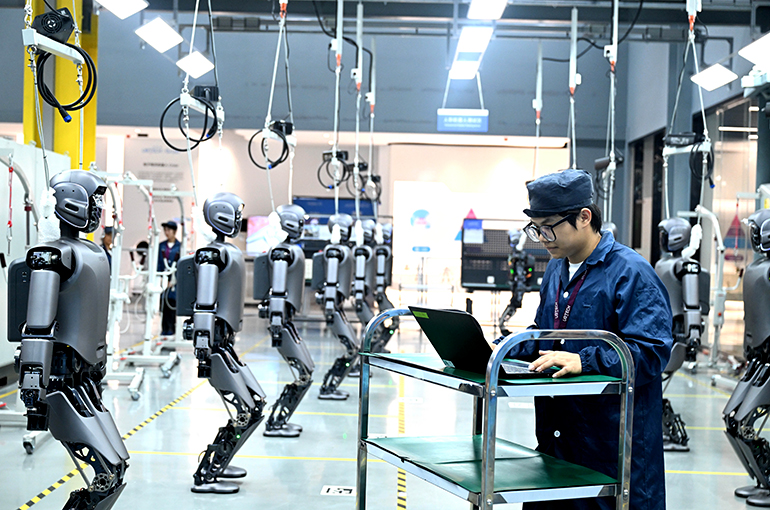
 China Should Build National Platforms for Embodied AI, Haier’s Chairman Says
(Yicai) March 5 -- Haier Group’s chairman has called for China to set up open-innovation platforms for embodied intelligence so as to accelerate the development of related technologies and expand the real-world use of resulting products.
China should build national-level open-innovation platforms for embodied intelligence, launch a dedicated national data program, and accelerate development of an industrial-grade standards framework for embodied intelligence robots that spans design, manufacture, testing, and deployment, Zhou Yunjie, who is also Haier’s chief executive and a deputy to the National People's Congress told Yicai yesterday ahead of the NPC’s annual meeting, which kicked off today.
He also urged the government to set standards for robot system integration and process adaptation tailored to specific application scenarios.
Zhou recommended creating a national key research and development program for embodied intelligence focused on making breakthroughs in core algorithms, including multimodal perception and understanding, environment adaptive learning, and bionic dexterous manipulation, and support the R&D and industrialization of high-precision sensors, intelligent joints, real-time control systems, and other key hardware components.
Furthermore, he suggested that China should pilot intensive, application-level deployments of embodied intelligence across specific production steps, including complex assembly, precision inspection, high-risk operations, and customized manufacturing, to generate a set of replicable, scalable benchmark cases.
China's embodied intelligence industry still urgently needs to break through multiple development bottlenecks, Zhou pointed out.
These obstacles include that artificial intelligence models, precision mechanisms, drive control systems, and other technologies do not yet operate in a coordinated and efficient system, industry-level data sharing mechanisms are absent, high-fidelity simulation and training platforms are in short supply, practical deployments remain shallow, hardware interface and safety standards are fragmented, and safety and performance standards are incomplete.
Zhou said implementing the proposed platforms, data initiatives, standards, and R&D programs would help overcome these obstacles.
The meeting of the NPC, China’s parliament, is one of the country's two most important annual political gatherings and runs through March 12, while the Chinese People's Political Consultative Conference, the top political advisory body, opened yesterday and ends its session on March 11.
Editors: Tang Shihua, Martin Kadiev