



 Wuhan's Optics Valley Sets Up USD29.3 Million Sensor Industry Fund
(Yicai) April 13 -- Wuhan's Donghu New Technology Development Zone, known as Optics Valley, has unveiled a CNY200 million (USD29.3 million) intelligent sensor science and technology innovation fund to support startups and establish an institute to intensify efforts to solve common technical problems in the industry.
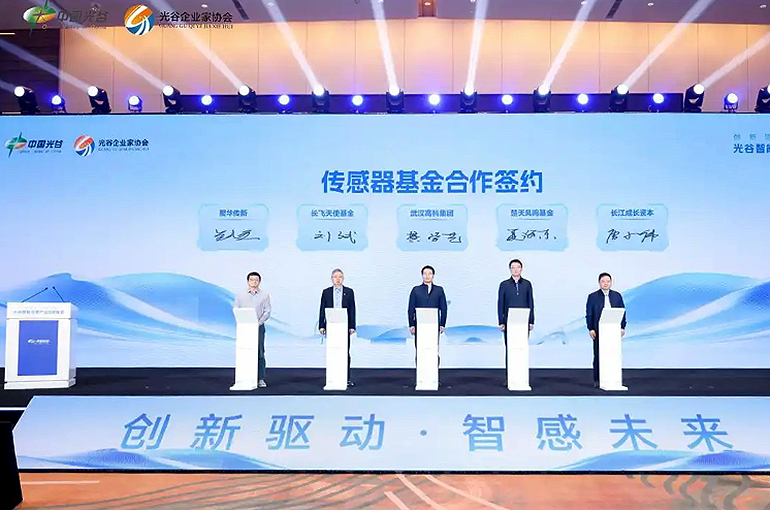
The fund, initiated by Wuhan Hi-Tech Holding Group, was set up at the Optics Valley Intelligent Sensor Industry Innovation Summit yesterday. It will focus on investing in innovative projects and research carriers in the sensor area during the seed and startup stages, aiming to bridge the entire chain from "basic research to pilot-scale transformation and large-scale application," helping the local intelligent sensor industry cluster expand and upgrade.
The Optics Valley is the birthplace and a core hub of China's optoelectronic information sector. Wuhan High-Tech signed sensor fund cooperation deals with several investment institutions at the event, such as Hubei Chutian Fengming Fund, aiming to create a comprehensive lifecycle investment fund cluster for the zone's intelligent sensor industry.
The sensor industry is an important fulcrum for leveraging trillion-dollar markets, including artificial intelligence and smart terminals, Nie Bo, general manager of Xiaogan Huagong Gaoli Electronics, told Yicai. Its development can attract more upstream and downstream firms to gather in the Optics Valley, driving a larger economic output in the sensor application sector, he added.
The Intelligent Sensor Technology Innovation Research Institute will strive to promote breakthroughs in key core technologies of domestic intelligent sensors and ensure the security and stability of the supply chain, said You Zheng, an academician of the Chinese Academy of Engineering and president of Huazhong University of Science and Technology. It will be devoted to achieving breakthroughs in core materials, key processes, and basic devices of sensors, driving the in-depth transformation, evolution, and upgrading of the local optoelectronic information sector, You added.
The institute will focus on intelligent perception microsystems, embodied intelligent sensors, smart medical sensors, inertial and automotive-grade sensors, environmental perception, and future sensors, You said, noting that it will build platforms for sensor design, verification, and testing to promote breakthroughs in sensor tech and application.
In addition, the institute will be dedicated to addressing common technical challenges faced by sensor companies, helping them reduce "trial and error" costs and solve the problem of high-end sensors still relying on imports, Nie pointed out.
Wuhan has already formed a complete Sensor supply chain covering design, manufacturing, packaging, testing, and system integration, with such products being core components for the digital and intelligent transformation of various industries.
Hubei province aims to increase the number of high-quality intelligent sensor firms in the Optics Valley to around 100 from about 30 and boost the industry to CNY30 billion from CNY21 billion (USD4.4 billion from USD3.1 billion) over the next five years, driving application industries to exceed CNY500 billion (USD73.2 billion), according to a plan released by the provincial government last month.
Editors: Tang Shihua, Martin Kadiev





