



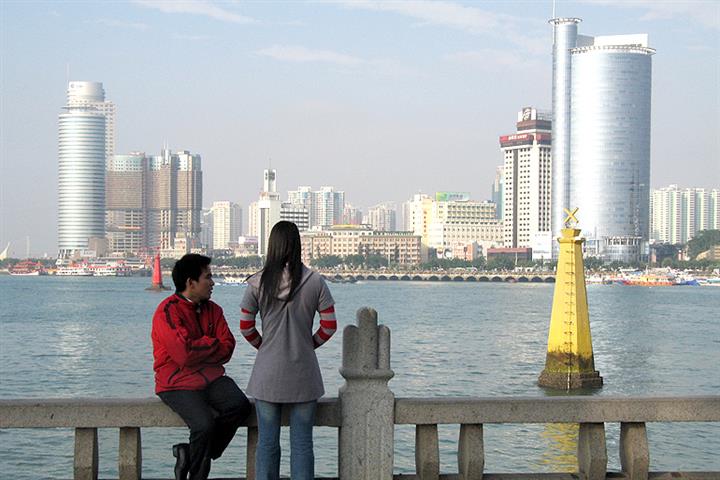
 Xiamen Ranks First in Resident Debt Among 23 Chinese Cities
(Yicai Global) Sept. 8 -- China’s southeastern cities of Xiamen, Hangzhou, Nanjing and Shenzhen ranked among the highest in resident debt ratios. Xiamen was first in one major indicator, the leverage ratio of resident funds, but Hangzhou was first in another, the household leverage ratio. China’s urban resident leverage ratio is higher in the south and lower in the north, Yicai Global found based on its statistics and calculations run on 23 key cities.
The country has many statistical methods to calculate the leverage ratio, but the two metrics are frequently used.The leverage ratio of resident funds is the result of the household loan balance divided by the household deposit balance, and the household leverage ratio is the result of the household loan balance divided by gross domestic product.
Of the cities the statistics covered, the leverage ratios of resident funds in Xiamen, Hangzhou, Nanjing, Shenzhen, Hefei, Suzhou and Guangzhou all topped 100 percent. First-ranked Xiamen reached 161.7 percent.
Their leverage ratios of residents' funds are high because home prices are and because of residents’ enthusiasm for investment.
High leverage ratio of residents’ funds is mainly due to home loans, and house costs are a key factor in these loans and average home loans in cities with high house prices are also high, said Zhang Bo, head of 58 Anjuke Real Estate Research Institute.
Company of Giants
Xiamen’s 161.7 percent leverage ratio of residents’ funds is nearly 23 percentage points higher than second-ranked Hangzhou, but Xiamen’s economic and demographic indexes are not as high. Xiamen posted CNY599.5 billion (USD87.7 billion) in GDP last year, ranking 33rd nationwide, and it had an urban population of around 3.5 million, in 27th place, per statistics.
Xiamen is comparable to first-tier cities such as Beijing, Shanghai and Shenzhen in home prices. The city’s average unit housing price was CNY48,285 (USD7,063.44) per square meter last month, ranking fourth nationwide behind Shenzhen, Beijing and Shanghai, but before the first-tier city of Guangzhou, per data from China Real Estate Association's housing price platform.
Hangzhou ranked second with a high leverage ratio of resident funds of 138.8 percent last year, followed by Nanjing with 137.9 percent and first-tier city Shenzhen with 137.2 percent.
Hangzhou, Wenzhou, Xiamen, Shenzhen and Nanjing ranked top five in the household leverage ratio.
Exorbitant housing prices and resident leverage ratio can easily have a crowding out effect on consumption and trigger financial risks. Maintaining steady and healthy development of the real estate market is thus key to holding the resident leverage ratio in check.
Dongguan, Hangzhou, Ningbo, Shenzhen and Nanjing -- all in the midst of real estate booms -- have issued regulatory policies to tighten real estate controls in the second half to help the market develop stably and soundly.
Shenzhen, for example, issued a regulation on July 15 which requires a buyer to have been a registered permanent resident in the city for at least three years and to have paid social insurance for the same period to qualify to buy a house, and a non-permanent resident must have paid social insurance for at least five years.
Editor: Ben Armour





