



 Younger Consumers Pour New Life Into China’s Languishing Wine Market
(Yicai) Feb. 3 -- China’s wine market, after years of stagnation, is showing early signs of a turnaround as a growing cohort of younger consumers begins to invigorate the sector by opening up new growth opportunities such as fueling demand for healthier, more youthful wines and accelerating sales via instant retail channels.
Last year, China’s wine market showed many positive signs, including the rise of Generation Z and female consumers, the parallel push toward health-conscious and youthful wine offerings, rapid growth in white wine and faster instant retail sales, Yin Kai, founder of beverage platform Chaoyinhui, told Yicai. However, whether these trends can continue and gain momentum this year remains to be seen, he added.
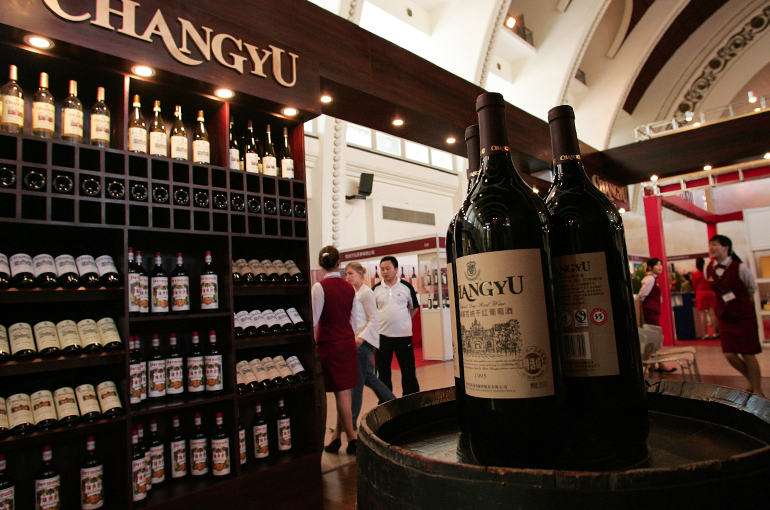
Yantai Changyu Pioneer Wine recently warned that net profit is expected to plunge by as much as 82 percent last year from the year before, according to the leading Chinese wine producer’s recently released 2025 earnings forecast.
Customs data also show that China’s total wine imports in 2025 slumped 26.7 percent year on year to about 210 million liters, while the total value tumbled 10.9 percent to roughly USD1.4 billion.
Sales have nearly halved over the past six years, said Li Liang, a regional distributor for a Shanghai-based wine trading company in northern China. In 2019, revenue was around CNY31 million (USD4.5 million), but by 2025, it had fallen to about CNY15 million.
What has left Li even more perplexed is that last year the company stepped up spending, including hosting more wine tastings and client dinners, and offering tours to wineries in Europe to ordering customers, as well as rolling out many low-priced new products, yet it still could not boost sales.
Generational Shift
However, a generational shift among consumers is sending some encouraging signals. Yang Zhengjian, dean of the WBO Wine Business School, said that on some instant retail platforms, sales of newer, high–value-for-money red and white wines even surpassed those of long-established, dominant labels last year.
The drinking participation rate among Generation Z, defined as those born between 1995 and 2009, rose to 73 percent last year from 66 percent in 2023, according to the 2025 Insights Report on Young People’s Drinking Habits by Endata. Wine was the second most popular alcoholic beverage, after beer.
Some small and medium-sized wineries in China are adopting a more market-oriented approach to survive, Yicai learned. Feng Qing, owner of the Ningxia Leirenshou Winery, was one of the first winery owners to experiment with social content e-commerce. He often appears on social media playing the role of a good-natured boss being “set up” by his employees, while casually sharing glimpses of the winery and vineyards. Leirenshou’s Douyin account has quietly surpassed 220,000 orders, placing it among the short-video platform’s top 10 wine sellers.
Most of the wines sold on Leirenshou’s online store are priced below CNY100 (USD14) per bottle. This strategy aims to encourage ordinary consumers, which are the primary customer base, to start drinking wine, Feng said. However, low prices on e-commerce platforms do not equate to low quality, he added.
In 2025, wine producers, including Xige Estate and Changyu, launched youth-oriented, mass-market products, in an attempt to break consumers’ outdated perception that low-priced wine equals low quality by offering products with a high quality-to-price ratio.
Editor: Kim Taylor





