



 Hong Kong’s First Five-Year Plan Can Help Secure Its Place as a Global Financial Centre
(Yicai) Oct. 27 -- That was Milton Friedman’s verdict in 1980. From Victoria Harbour, he saw a city with little beyond a deep-water port and industrious people. Its virtue, in his account, was not the absence of public institutions. It was an administration that kept trade open, contracts enforceable and entrepreneurs free to adapt.[1]
Friedman would therefore have been startled by the event of October 9: Hong Kong’s Legislative Council passed a motion supporting the territory’s first Five-Year Plan for Economic and Social Development. But the proper response is not to treat the plan as the obituary of Hong Kong’s free-market tradition. It is to ask whether an open economy can remain open when the systems on which it depends — payments, capital markets, supply chains and regulatory standards — are being reorganised by geopolitics.
The distinction matters. LegCo did not enact an economic-planning law. Its own records classify the measure as a government motion “not intended to have legislative effect”. John Lee, the chief executive, calls the 2026–30 document a “forward-looking, strategic, and directional guiding document”; the annual Policy Address is to be its implementation plan.[2] [3] That is a mandate for coordination, not a licence to direct every firm.
The plan itself contains the right starting point. It restates Hong Kong’s commitment to a “free and open economic system” with the free flow of capital, goods, people and information, and says it was formulated using an “evidence-based approach”.[4] If that language becomes operational rather than decorative, a five-year horizon could reinforce the very conditions that made Hong Kong valuable to the world.
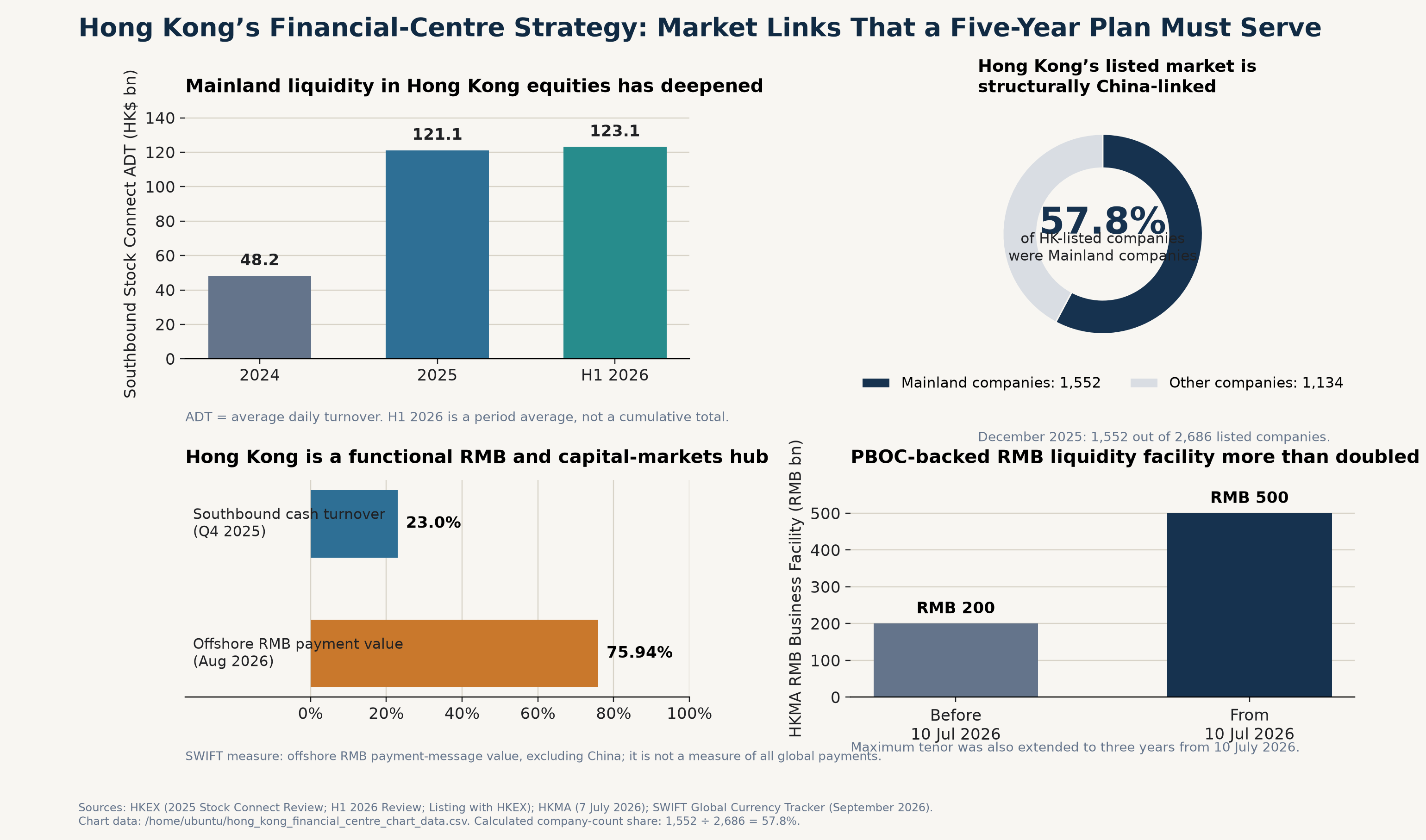
Chart note: Southbound Stock Connect figures are average daily turnover. The 57.8% figure is a calculated company-count share (1,552 Mainland companies out of 2,686 listed companies). SWIFT’s offshore-RMB measure excludes China and covers the payment messages in its tracker, not all payments.
The need for this has become harder to ignore. UN Trade and Development says tariffs are likely to remain both protectionist and strategic instruments in 2026, and estimates that about 18,000 discriminatory trade measures have been introduced since 2020.[5] The WTO’s March baseline forecast world merchandise-trade volume growth of 1.9 per cent in 2026, after 4.6 per cent in 2025, and warned that trade-policy uncertainty remained historically high.[6]
In this environment, a financial centre cannot prosper merely by declaring itself laissez-faire. It must make it easier for capital, goods and information to move lawfully across newly complicated borders. That is particularly true for Hong Kong because it has become both an international market and China’s principal international market interface.
The arithmetic is plain. HKEX reported that, at December 2025, 1,552 Mainland companies were listed in Hong Kong, with combined market value of US$4.8tn. The exchange had 2,686 listed companies in all, meaning that Mainland companies represented 57.8 per cent of the listed-company count.[7] [8] The market’s funding engine is increasingly connected to the mainland too. Southbound Stock Connect average daily turnover rose from HK$48.2bn in 2024 to HK$121.1bn in 2025; by the fourth quarter, it accounted for 23.0 per cent of Hong Kong cash-equities turnover. In the first half of 2026, daily Southbound turnover reached HK$123.1bn.[9] [10]
Those facts do not make Hong Kong less international. They define the particular form of its internationalism. A city whose exchange channels mainland savings into globally accessible securities, and global capital into Chinese opportunity, needs rules, clearing systems and currency markets built for that job. The alternative is not an untouched market. It is a market whose infrastructure is designed elsewhere.
The plan’s second insight is that corporate globalisation is now a service business. The government’s GoGlobal Task Force brings together the HKMA, HKEX, InvestHK and agencies responsible for trade, law and finance. By April, it had held more than 10 events attended by more than 3,000 Mainland-company representatives. Hong Kong has also signed a co-operation memorandum with the Ministry of Commerce and joined a Guangdong-Hong Kong-Macao alliance for overseas professional services.[11]
That is the practical meaning of policy alignment. It should not mean replacing commercial judgement with official judgement. It should mean joining up the services that exporters and investors actually need: listing and fundraising, treasury management, legal advice, insurance, compliance and access to foreign markets. The plan’s stated objective — to help Mainland companies establish cross-border industry, supply and value chains through Hong Kong — is persuasive precisely because it treats the city as a platform rather than a protected destination.[12]
Nothing demonstrates the case for an active, market-compatible framework more clearly than the renminbi. In July, the People’s Bank of China and the HKMA increased the HKMA’s RMB Business Facility from RMB200bn to RMB500bn and extended its maximum tenor to three years.[13] At a Hong Kong summit later that month, PBOC governor Pan Gongsheng said the city handled “over 70 percent” of global cross-border RMB transactions.[14] Hong Kong’s 2025 offshore RMB lending reached a record RMB935bn, while RMB bond issuance exceeded RMB1tn for a second consecutive year. SWIFT’s September tracker put Hong Kong’s share of offshore RMB payment value at 75.94 per cent for August.[15] [16]
These are not trophies to be polished. They are a call to build the next layer: a deeper dim sum bond market, reliable liquidity and hedging instruments, more RMB counters in Stock Connect, and direct exchange arrangements with regional currencies. The plan rightly links these to wider financial-market access, and to engagement with ASEAN and Belt and Road markets.[12] [15]
It follows that close operational coordination with national authorities — and with neighbouring Guangdong — is unavoidable. RMB liquidity is provided through PBOC arrangements; cross-border investment requires mutually recognised rules; and company globalisation depends on a connected service network. The plan explicitly places the Greater Bay Area at the centre of rule alignment and proposes further work on Wealth Management Connect, Bond Connect and Stock Connect.[4] [17]
But this is also where the plan must be most disciplined. Alignment should make Hong Kong a more reliable interpreter between systems, not erase the institutional features that give foreign issuers and investors confidence in using it. Its success should be measured by whether it preserves transparent rules, arms-length regulation, open access and the capacity to settle disputes under internationally recognised standards.
That point brings Sir John Cowperthwaite back into the picture. Hong Kong’s financial secretary from 1961 to 1971 is remembered for the line: “Papa does not know best” — a rebuke to the idea that officials should prescribe what businesses do.[18] In a 1970 LegCo debate, he opposed official GNP accounts, arguing that Hong Kong’s government had too little leverage over the economy to need them for policy formation; he warned that the figures might prompt policies designed to have direct effects on the economy.[19]
The historical lesson is subtler than a command to govern blindly. Cowperthwaite was resisting an official impulse to choose for firms. He was not arguing against the rule of law, reliable statistics, financial infrastructure or public accountability. Indeed, the current plan’s claim to be evidence-based is a useful corrective: a government that coordinates payments, market access and cross-boundary standards must publish the evidence by which it asks to be judged.
Hong Kong should therefore turn the plan into a public scorecard, not a catalogue of administrative targets. Each annual Policy Address should report plainly on offshore RMB liquidity and product breadth, use of RMB in trade and investment, the depth of Connect schemes, the number and quality of companies using Hong Kong to expand abroad, and — above all — international participation in its markets. The test is whether the state is reducing transaction costs and widening choice, not deciding which companies win.
It would be presumptuous to recruit Friedman and Cowperthwaite to endorse a document written decades after their time. They might well dislike its vocabulary. But neither man’s defence of economic freedom required a government to be inert while the infrastructure of global commerce changed around it. Their harder lesson is that public policy should supply rules, information and institutions that let firms make their own adjustments — and then submit itself to the same empirical test.
Friedman’s Hong Kong was admired because it could adapt. Today’s world gives it a different task: to preserve that adaptability while constructing the cross-border financial architecture that an era of tariffs, fragmented payment systems and competing standards demands. The first Five-Year Plan will deserve its name if it protects an open market by making Hong Kong the place where China and the world can still do business with each other.
 Zhou XinZhou Xin is one of China’s most distinguished journalists, formerly one of the founders of Yicai Global; Chief Hong Kong correspondent for Shanghai TV; a business editor with CBN, and associate editor-in-chief of Caixin Media.





