 Hong Kong’s IPO Break-Price Conundrum: Pathways to Restore Market Confidence
Editor's Note: The cure is not to revive the first-day “pop”, but to make price discovery, float and post-listing liquidity credible again.
(Yicai) Oct. 8 -- At SHEIN’s Hong Kong debut, founder Sky Xu did not speak. The number that mattered was HKD43.80: the intraday low, 9.8 percent below the fast-fashion group’s HKD48.56 offer price. The stock recovered to close at HKD48.50, only 0.12 percent below issue, after what Reuters reported were stabilisation measures. It is a warning, rather than a basis for speculation about Xu’s expression. A company once valued privately at almost USD100 billion had come to market at about USD26 billion. By 28 September, after quarterly adjusted profit fell 67 percent year on year, the shares were 27.3 percent below the offer price. [1][2]
SHEIN was not an isolated mishap. In July, Zhongji Innolight—the Shenzhen-listed supplier of data-centre optical components—raised HKD53.4 billion, Hong Kong’s largest share sale of the year, and still closed 2 percent below offer after a 10.2 percent intraday fall. On 29 September, RoboTechnik, whose equipment serves solar cells and optical-AI infrastructure, ended 4.95 percent below offer; Red Avenue New Materials fell 9.1 percent. [3][4]
The evidence is serious, but it does not support the claim that every new issue or every A+H listing is failing. Futu’s month-end broker-platform compilation puts the first-day break rate at 41.2 percent in July and 58.3 percent in September; August’s zero rate rests on just two deals. The South China Morning Post separately reported that 14 of 30 third-quarter debutants had opened below offer by 29 September. Yet the same 29 September cohort included Shenzhen Kinwong Electronic, up 10.3 percent, and Direct Drive Tech, up 7.4 percent. [5][6]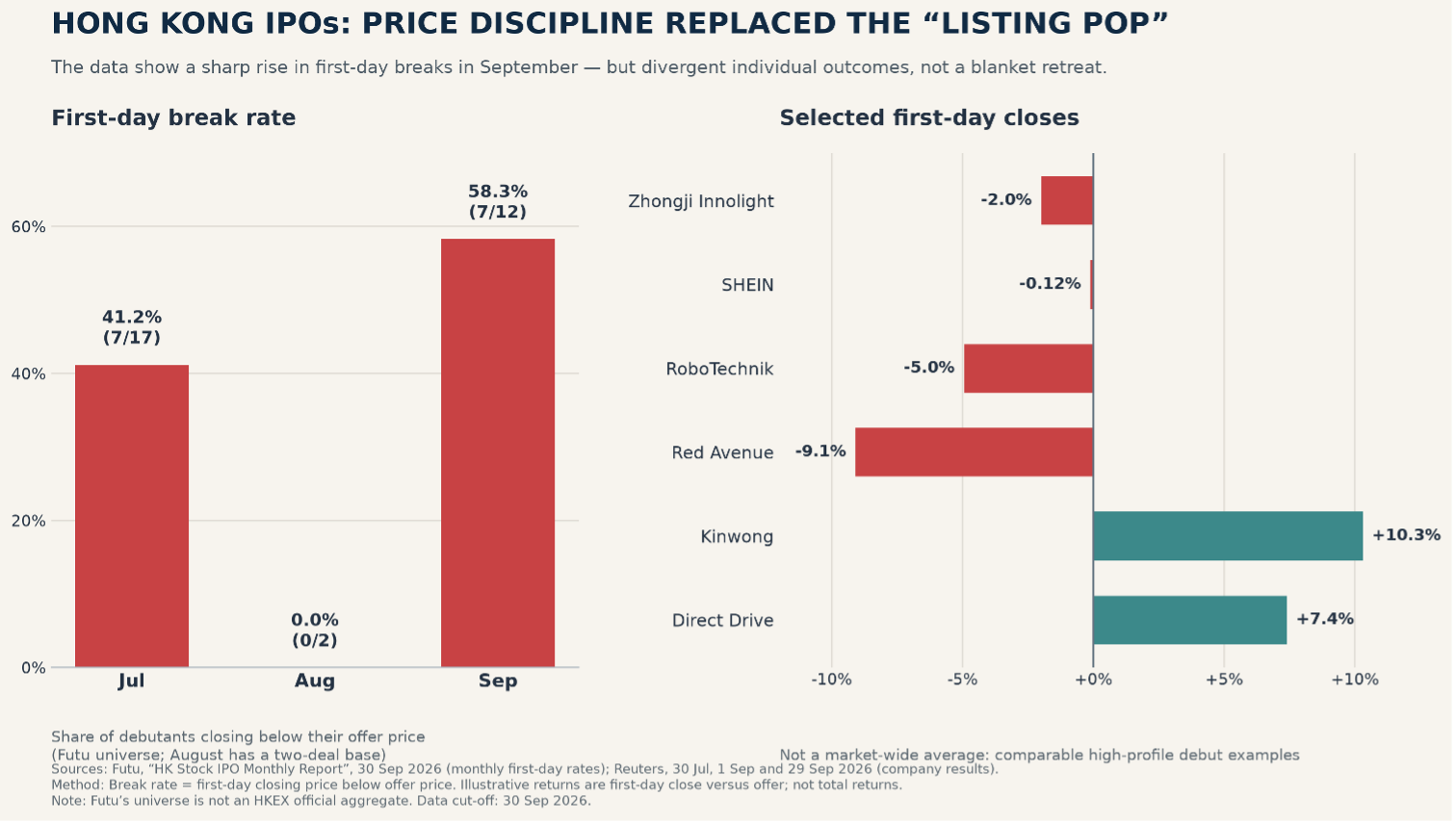
A revival in fundraising, not in indiscriminate valuation
Hong Kong does not lack issuers. It has more supply than the marginal buyer is willing to finance at an automatic liquidity premium. KPMG counted 85 IPOs raising HKD209.9 billion in the first half, the city’s strongest first half in five years. Twenty-four were A+H listings, accounting for 58 percent of proceeds. Through August, HKEX recorded 106 newly listed companies and HKD342.4 billion of IPO fundraising, up 153.5 percent year on year. At the same time, average daily securities turnover fell 17.5 percent month on month, from HKD307.2 billion in July to HKD253.4 billion in August. [7][8]
This is not proof that each offer was overpriced. It is evidence that crowded deal calendars—often packed with Chinese technology, industrial and A+H names—can exhaust the pool of price-insensitive capital. The contrast with the first half is revealing: EY estimated an average first-day IPO return of 61 percent. By July, Morgan Stanley was warning of secondary-selling pressure, while Goldman Sachs estimated HKD274 billion of locked-up Hong Kong shares would be released over the following year and said prices historically fall 4 to 7 percent within three to six months of release. [9]
That is why a subscription headline can mislead. Zhongji’s Hong Kong offer was subscribed 16.84 times by retail investors and 9.73 times internationally, yet its top 25 holders owned 61.38 percent of the Hong Kong share capital at listing. A strong book can coexist with a narrow float and volatile marginal pricing. SHEIN supplies the fundamental corollary: a 70 percent valuation cut did not compensate for slower growth, higher cross-border charges and a second-quarter margin that fell to 2.1 percent from 6.2 percent. [2][3]
The currency explanation has the sign wrong
A popular explanation must first be inverted. A fall in USD/CNY means a stronger, not weaker, renminbi. On 21 September, the onshore yuan reached 6.6950 per dollar, its strongest level since January 2023; Reuters put its year-to-date gain at 4.45 percent. Renminbi depreciation is therefore not a plausible catch-all explanation for the summer’s A+H break prices. [10]
The more convincing explanation is valuation segmentation. A mainland company brings its A-share price as an unavoidable reference, but sells H shares into a different investor base, a Hong Kong-dollar market linked to the US dollar and an increasingly crowded issuance calendar. If the offer is anchored too closely to the onshore price rather than the offshore market’s required discount, it can open below water. Zhongji’s Shenzhen shares fell 9.1 percent on the day its H shares closed 2 percent lower, while the Hang Seng TECH Index fell 1.3 percent: that is stronger evidence of a common reassessment of AI risk and valuation than of an FX event. [3]
Relative-value flows can compound the problem. CNBC, citing Wind and market participants, reported that some capital moves to often-cheaper A shares once a Hong Kong issuer joins Stock Connect. That does not indict the A+H channel. It makes transparent pricing—and a credible offshore discount—more important. [11]
A transmission mechanism, not a virus
The weakness feels contagious because the old ritual has reversed. A hot sector, a huge retail subscription multiple and a roster of cornerstone investors once looked like a shortcut to a first-day gain. They no longer are. Futu reported that Mech-Mind Robot closed 1.87 percent lower despite a 3,835-times retail subscription; Medcaptain fell almost 43 percent despite a 436-times subscription. Longsys, with 14 industry cornerstone investors, ended 1.02 percent below issue. [5]
Those broker-platform figures are not an official HKEX aggregate, but their direction matches the Reuters-reported cases. A broken deal makes the next retail subscriber less willing to borrow, makes institutional orders more price-sensitive and deprives the next book of a presumed scarce-float premium. The loop can reach consumer, healthcare, semiconductors and robotics. It is not, however, universal: Kinwong and Direct Drive demonstrate that the market will still reward a valuation it regards as credible.
The route out
Hong Kong should not ration listings mechanically, nor promise issuers a ceremonial pop. It should stop treating an opaque offer price as sufficient price discovery.
First, every A+H prospectus should include a standardised offshore-parity table at pricing: the A-share 20-day volume-weighted average price, the FX convention, the H-share offer, the resulting A/H discount or premium, and the post-listing free float after cornerstone allocations. The information exists; presenting it coherently would force the market to confront the actual valuation bridge.
Second, the exchange and its advisers should apply a liquidity test to the marketing calendar: a rolling public view of funds sought by sector and listing week, alongside turnover and imminent lock-up releases. It need not be a quota. But four offerings trading on one day do not necessarily have four deep books.
Third, disclosure should make the support architecture visible. Hong Kong has already required at least 40 percent of an initial IPO allocation to go to the bookbuilding placing tranche. The next step is sharper disclosure of tradeable float, demand composition and stabilisation arrangements. “Oversubscribed” should no longer substitute for “liquid”. [12]
HKEX’s current competitiveness consultation is welcome, but it addresses post-listing transactions and spin-offs rather than primary-market pricing; it closes on 30 November. That leaves a clear agenda for HKEX, the Securities and Futures Commission, underwriters and anchor investors. [13]
The puzzle will not clear at the next opening bell. A provisional improvement could emerge in the fourth quarter if issuers accept deeper offshore discounts and supply becomes less concentrated. The real test, however, is likely to fall in January–March 2027, when the July–September cohort has delivered more results and six-month cornerstone lock-ups, including SHEIN’s, begin to expire.1 If those shares can be absorbed without another disorderly fall, Hong Kong will have achieved something more valuable than the easy gains of the first half: confidence that an IPO price is an informed starting point, not merely a hopeful point before the real market takes over.
Sources
1. Reuters, “Shein makes lacklustre Hong Kong debut as investors fret about growth and regulatory risks”, 1 September 2026. https://www.reuters.com/legal/transactional/shein-set-lacklustre-debut-after-setbacks-cause-huge-drop-valuation-2026-08-31/
2. Reuters, “Shein quarterly profit falls 67% as costs jump, Europe sales slump”, 28–29 September 2026. https://www.reuters.com/business/retail-consumer/shein-returns-profit-second-quarter-2026-09-28/
3. Reuters, “Zhongji slips in Hong Kong as AI selloff weighs on $6.8 billion debut”, 30 July 2026. https://www.reuters.com/world/asia-pacific/zhongji-innolight-debut-lower-hong-kongs-biggest-share-sale-this-year-2026-07-30/
4. Reuters, “China’s RoboTechnik ends nearly 5% down in mixed Hong Kong debuts”, 29 September 2026. https://www.reuters.com/world/asia-pacific/chinas-robotechnik-slip-hong-kong-trading-debut-2026-09-29/
5. Futu, “HK Stock IPO Monthly Report | September new listings…”, 30 September 2026. Secondary-market compilation; cited as such, not as an official HKEX aggregate. https://q.futunn.com/feed/117359310471972?futusource=news_hotnews_list&lang=en-us
6. South China Morning Post, “Hong Kong’s IPO revival faces test as 3 new stocks stumble on debut”, 29 September 2026. https://www.scmp.com/business/banking-finance/article/3369156/hong-kongs-ipo-revival-faces-test-three-new-stocks-stumble-debut
7. KPMG China, “Hong Kong delivers strongest first-half IPO performance in five years…”, 30 June 2026. https://kpmg.com/cn/en/media/press-releases/2026/06/hk-delivers-strongest-first-half-ipo-performance-in-5-years-driven-by-record-breaking-a-h-and-specialist-technology-listings.html
8. HKEX, Monthly Market Highlights—August 2026. https://www.hkex.com.hk/Market-Data/Statistics/Consolidated-Reports/HKEX-Monthly-Market-Highlights?sc_lang=en
9. Reuters, “Record wave of IPO lock-up shares to hit Hong Kong market”, 6 July 2026. https://www.reuters.com/world/china/record-wave-ipo-lock-up-shares-hit-hong-kong-market-2026-07-06/
10. Reuters, “Yuan hits fresh multi-year peak as PBOC eases curb ahead of Trump-Xi summit”, 21 September 2026. https://www.reuters.com/world/asia-pacific/yuan-hits-fresh-multi-year-peak-pboc-eases-curb-ahead-trump-xi-summit-2026-09-21/
11. CNBC, “Hong Kong’s IPO boom is developing a performance problem”, 8 June 2026. https://www.cnbc.com/2026/06/08/hong-kongs-ipo-boom-is-developing-a-performance-problem.html
12. Hong Kong Government, “Measures to optimise initial public offering market”, 13 May 2026. https://www.info.gov.hk/gia/general/202605/13/P2026051200604.htm
13. HKEX, “Exchange publishes consultation paper on phase II of listing framework competitiveness review”, 21 September 2026. https://www.hkex.com.hk/News/Regulatory-Announcements/2026/260921news?sc_lang=en
 Zhou XinZhou Xin is one of China’s most distinguished journalists, formerly one of the founders of Yicai Global; Chief Hong Kong correspondent for Shanghai TV; a business editor with CBN, and associate editor-in-chief of Caixin Media.