



 AI Glasses to Have 'iPhone Moment' in 2027 or 2028, China's RayNeo Founder Says
(Yicai) Jan. 13 -- Artificial intelligence glasses will have their "iPhone moment” next year or the year after, as the industry is growing rapidly and products are maturing fast, according to the founder of RayNeo, a leading Chinese maker of augmented reality glasses.
An “iPhone moment” refers to a transformative event or technological breakthrough that radically reshapes an industry and sets a new benchmark, just like the impact of Apple’s first iPhone in 2007.
RayNeo is building "the next-generation iPhone," aiming to make its glasses work independently of smartphones, Li Hongwei, who is also the firm’s chief executive, said in an interview with Yicai during the Consumer Electronics Show in Las Vegas.
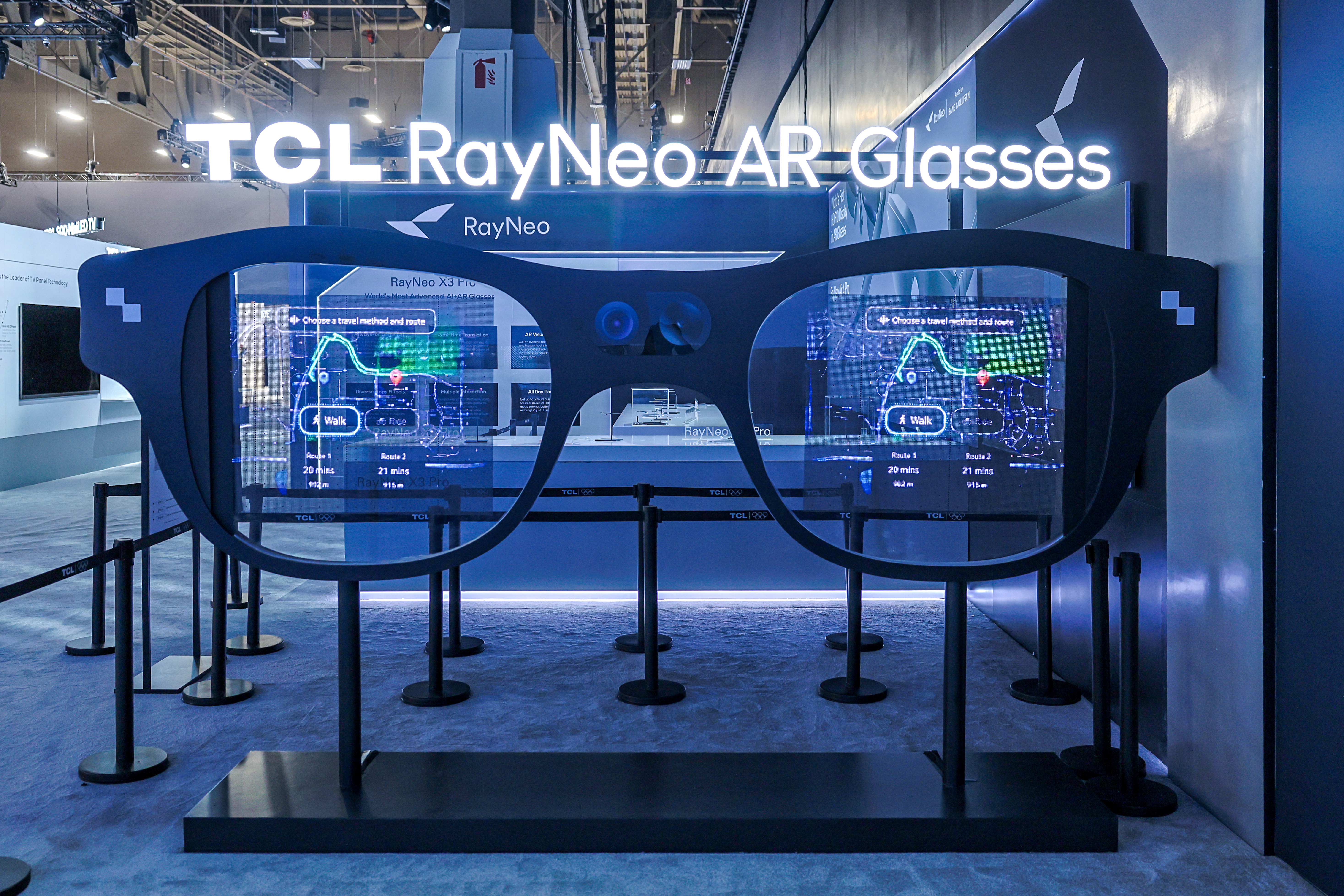
At the three-day CES, which ended on Jan. 9, RayNeo debuted the world's first consumer AR glasses integrated with eSIM and the fourth generation of cellular network technology.
Just prior to the event, the Shenzhen-based company raised CNY1 billion (USD143 million) from investors such as China Mobile and China Unicom, marking the first joint investment in the sector by two of the country's big three telecom service providers.
The global market for AR smart glasses saw record high shipments in the third quarter of last year, with RayNeo ranking first with a 24 percent share, according to data from Counterpoint. Sales by the firm, set up in 2021, surged fourfold last year.
Excerpts from the interview are below:
Yicai: What was the key factor that attracted China Mobile and China Unicom to invest in RayNeo?
Li Hongwei: They see RayNeo is making products for the future. We’re really building the next-gen iPhone. At this year's CES, we brought the world's first AR glasses supporting eSIM, aiming to enable glasses to work independently of smartphones.
In addition, perhaps only RayNeo and Meta are truly commercializing color diffractive MicroLED waveguide products, because color is essential to building an ecosystem.
Everyone has also seen RayNeo achieve success, including sales growth and the accumulation of product and technology capabilities.
Yicai: How will the use of AR glasses fundamentally change with eSIM products breaking free from smartphone Bluetooth connections?
Li: The addition of eSIM changes the past state where smart glasses had to rely on smartphones. Just like electric vehicles, you can hardly imagine buying a car and having to spend ages pairing it with your phone, unable to listen to music or watch videos when it isn't around.
If RayNeo's X3 Pro defined the benchmark for AR glasses display and AI interaction, then the new eSIM model completes the upgrade in product positioning ‘from smartphone accessory to independent terminal.’
Yicai: While the industry is taking a minimalist approach to achieve longer battery life, why does RayNeo insist on full-color MicroLED? Doesn't this bring cost and comfort challenges?
Li: The core reason is that only full-color displays can build an ecosystem, while monochrome green cannot. Take the simplest example: if someone sends you an emoji on WeChat, a monochrome green display cannot show it; only color can carry complete information and have the chance to become the next-gen computing device.
RayNeo was the only developer to release color MicroLED products in the past, because color is really difficult. It spent a long time and committed many resources to tackling this problem, which led to the current 'Firefly Optical Engine' and X3 Pro.
To mass-produce this optical module, we had to build our own production line and design the production equipment, truly starting from scratch.
RayNeo has done a lot of work on the user experience and cost concerns. In the products we will release next year, everyone will see that color displays, compared to monochrome green ones, they do not increase the cost of the user experience by much, with weight and power consumption being controlled very well. This is also our recent breakthrough.
Yicai: RayNeo set up an optical production headquarters in Jiaxing. How does this 'self-developed and self-produced' heavy asset model balance risk and efficiency?
Li: We have a lot of self-developed technologies. For example, the full-color MicroLED optical engine is something we designed, have patents for, developed, and produced. On the one hand, there are indeed confidentiality requirements that mean only we can do it ourselves. On the other hand, it is also true that only we can produce it, because others simply cannot make it.
At this stage, we also have many new technological explorations, and the combination of in-house R&D and in-house manufacturing allows us to quickly validate ideas and better control costs.
More importantly, this is part of our strategy. AR is the next-gen computing device, with the optical module is one of its most critical core components. The market may not be big now, and costs may be relatively high, but as technology matures and demand grows, the potential will be enormous.
The optical modules produced at the Jiaxing plant will not only be used by RayNeo but will also be supplied to its partners, which will further improve factory efficiency.
Yicai: Competition in the AI glasses field is intense, with cross-industry giants such as Alibaba and Baidu, as well as vertical players like Xreal and Rokid. Where do you see RayNeo’s advantages and competitive moat?
Li: RayNeo's biggest advantage is that it has a clear vision. Looking back at every strategic choice in the past, especially those that went against the industry consensus, we made the right calls. Another very important point is that RayNeo has a a strong team that has accumulated strong capabilities over the past four years. Our optical display, spatial computing, and AI model capabilities are all industry-leading.
For example, on the color issue, everyone knows color is important, but very few are really investing resources in it. You cannot pin your hopes on waiting for the supply chain tech to mature. Pure solution integration is what large companies do, but for a completely new category, you cannot lead by waiting.
RayNeo ranked first in the world by AR glasses shipments in the first nine months of last year based on Counterpoint data, which has been the case for the past four years, with last year's sales being four times more than in 2024. Meta and RayNeo are among the few brands that have achieved sustained and stable growth.
Competition itself is not the most critical issue right now. What matters most is creating products that exceed user experience standards in landmark use cases. The industry trend is becoming increasingly clear: it is concentrating more and more toward leading players.
In this environment, creating products that exceed user experience standards is the key to driving the market forward, and this is also our most important task for this year.
Yicai: How does RayNeo view competition with global giants like Meta and Apple, and where will the next phase of overseas market expansion focus?
Li: From our perspective, the most important issue right now is not the competition, but making good products. The problem in the industry today is that many products have not reached the experience standards of mass users, with products being usable, but not good enough. We need to make products that exceed user experience standards in 2026. This is our priority.
As for overseas markets, we will proceed according to our original plan. Next year, everyone will see relatively rapid growth in North America and Europe.
Yicai: When will the 'iPhone moment' for AI glasses arrive, and what factors will play a decisive role before it arrives?
Li: It should be in 2027 or 2028. The industry is growing rapidly, and products are maturing quickly.
I divide the industry’s development into three stages. The first stage is from now until the ‘iPhone moment.’ The second stage is from the iPhone moment to the iPhone 4 moment. The third stage is from the iPhone 4 moment to determining the winner
The key to competition in the first stage is whether you can build the 'iPhone.' The core logic is about who has the determination and capability, and who has sufficient resources, including money and talent, to create products that exceed user expectations.
Why do we need to raise relatively large amounts of capital? This is the Matthew effect in the industry. The result of this concentration in the leaders is determining who can truly build the ‘iPhone’ of this market.
This is what RayNeo is doing, so we focus on who can make color glasses, whose product experience is the best. At this stage, these are the main variables.
The core logic of the second stage is product leadership. It is the process by which a revolutionary product definition becomes a mass market product. In that era, iPhones delivered a much better experience than Android phones.
The third stage is when the remaining players engage in 'hand-to-hand combat' across all dimensions.
Editor: Martin Kadiev





