



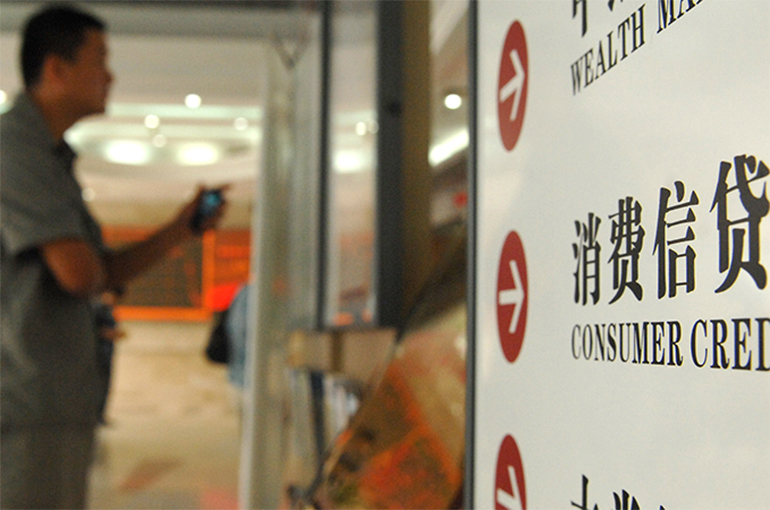
 China’s Consumer Loan Rate Subsidies Spur Bank Lending
(Yicai) Dec. 15 -- Introduced 100 days ago, a Chinese government policy to subsidize interest rates on consumer loans has prompted commercial banks to ramp up lending, though the gains have yet to show up in the central bank’s data.
The one-year policy, which took effect on Sept. 1, offers a 1 percentage point rebate on eligible personal loans made by banks. If a loan’s interest rate is 2 percent or below, the subsidy is capped at half that rate. Qualifying uses include everyday spending and big ticket items like autos, medical and elderly care, education, tourism, electronics, and home furnishings.
Several bankers told Yicai that since the policy took effect, their banks have stepped up promotion of consumer loans for cars, appliances, and major household expenses such as renovations, with monthly new loan signings rising across the board.
Recent earnings reports from listed banks also point to a pickup in consumer lending and related spending. For instance, Bank of Communications said lending jumped by more than 20 percent in September from August, while the balance of consumer loans was up nearly 30 percent at the end of the month from a year ago. At the end of October, nearly 1 million customers had qualified for rate subsidies, with some 1.8 million identifiable qualifying consumer transactions.
Still, bankers and analysts caution that despite this policy and other incentives, relatively strict borrower screening at many banks limits the scheme’s reach.
This partly explains why the latest figures from the People’s Bank of China do not yet show a policy-driven rebound. Household lending fell by a net CNY206 billion (USD28.4 billion) last month, a year-on-year decline of CNY476 billion, with both short-term and medium-to-long-term loan growth weaker than a year earlier.
In the first 11 months, yuan-denominated lending rose by CNY15.36 trillion (USD2.12 trillion), but household lending increased by only CNY533.3 billion. Short-term loans to households fell by CNY732.8 billion, remaining the main drag on overall loan growth.
Alongside central government subsidies, several local authorities, including the provinces of Sichuan and Guizhou and the municipality of Chongqing, have rolled out their own interest rate subsidy programs for consumer loans, in a shift to “local subsidy” from “national subsidy.”
Local governments typically require subsidized loans to be spent locally, with loan issuance and management usually handled by city and rural commercial banks, said Xue Hongyan, a special researcher at Sushang Bank.
Local subsidy programs can use limited fiscal funds to stimulate bank lending and household consumption choices, said Yu Xiaoming, a senior investment advisor at Jufeng Investment Advisory, adding that he expects more regional banks to sign up to these programs.
Editors: Tang Shihua, Emmi Laine





