



 Brazilian Beef Prices to Rise as Imports to China Near Quota
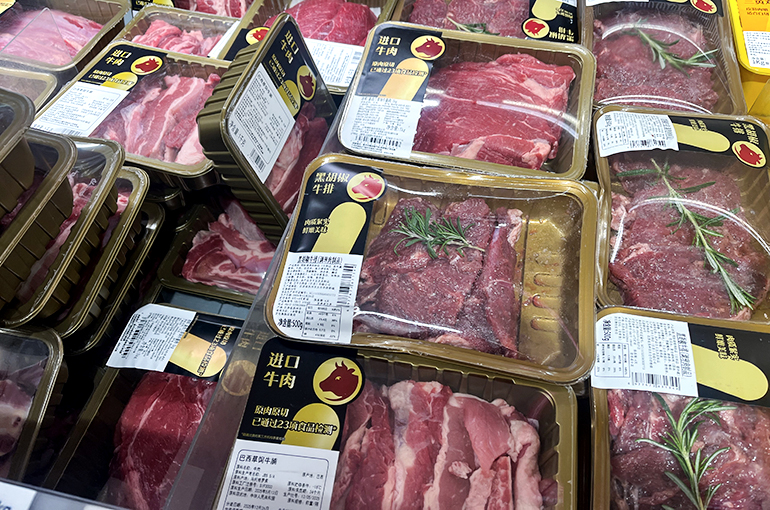
(Yicai) July 27 -- Brazil’s beef imports to China are about to reach the annual quota, which will set off an additional 55 percent tariff. Downstream sellers, including supermarkets and caterers, will soon start raising product prices.
Brazilian beef imports had reached 80 percent of the annual quota allowed under China’s safeguard measures on imported beef by July 21, according to the latest announcement by the Ministry of Commerce. Industry insiders believe the quota will be exhausted in one to two months.
Since the commerce ministry unveiled the safeguard measures at the end of last year, importers have operated at full capacity this year to procure goods at pre-tariff prices, racing to stockpile sufficient inventory before the quota is reached and the extra 55 percent tariff is triggered, Li Jia, sales representative at a large imported beef trader, told Yicai. Therefore, China’s Brazilian beef inventory is relatively ample, he added.
Brazil was China’s largest beef supplier last year, accounting for about half of the total at CNY56.3 billion (USD8.3 billion), according to the General Administration of Customs. Brazilian beef holds a massive share of China’s overall beef imports, so when it reaches the quota and triggers the additional tariff, it will experience significant price fluctuations, Li explained.
“Recently, as imported Brazilian beef has reached 80 percent of the quota, prices have started to fluctuate, rising by about CNY2 (29 US cents) per kilogram,” Li noted. Australian beef, which reached the quota on June 19 and triggered the additional tariff the following day, is already CNY20 (USD2.95) more expensive per kg.
Brazilian beef is mainly purchased by business-to-business clients, as it is primarily used in supermarket pre-made dishes and in the catering industry, He Wei, an insider who has worked in procurement for a large supermarket chain for many years, told Yicai. Rising raw material costs will exert significant pressure on these businesses, which may have to switch to beef imported from other countries, such as Uruguay.
Weizhixiang Food reported CNY700 million (USD103.4 million) in revenue last year, CNY290 million of which was from beef products. If import tariffs on Brazilian beef rise, the Chinese producer of semi-finished foods will have to implement cost-containing measures, such as locking in prices in advance or switching to beef from other origins, it told Yicai.
Some beef traders plan to place orders for Australian beef after October, Gao Ge, another imported beef trader, told Yicai. Given the long shipping cycle, the goods would be declared for customs next year, allowing traders to use the new quota and avoiding the window for the additional tariff, he explained.
About half a month after the news broke about the 55 percent additional tariff on Australian beef, product prices at a major Chinese supermarket surged 17 percent to 30 percent.
RT-Mart’s Australian beef sales dropped significantly since prices surged after the additional tariff was implemented. The Chinese hypermarket chain’s new strategy involves expanding procurement channels for domestic fresh beef to supplement supply, while increasing beef imports from Argentina and New Zealand to replenish stock.
Editor: Futura Costaglione





