



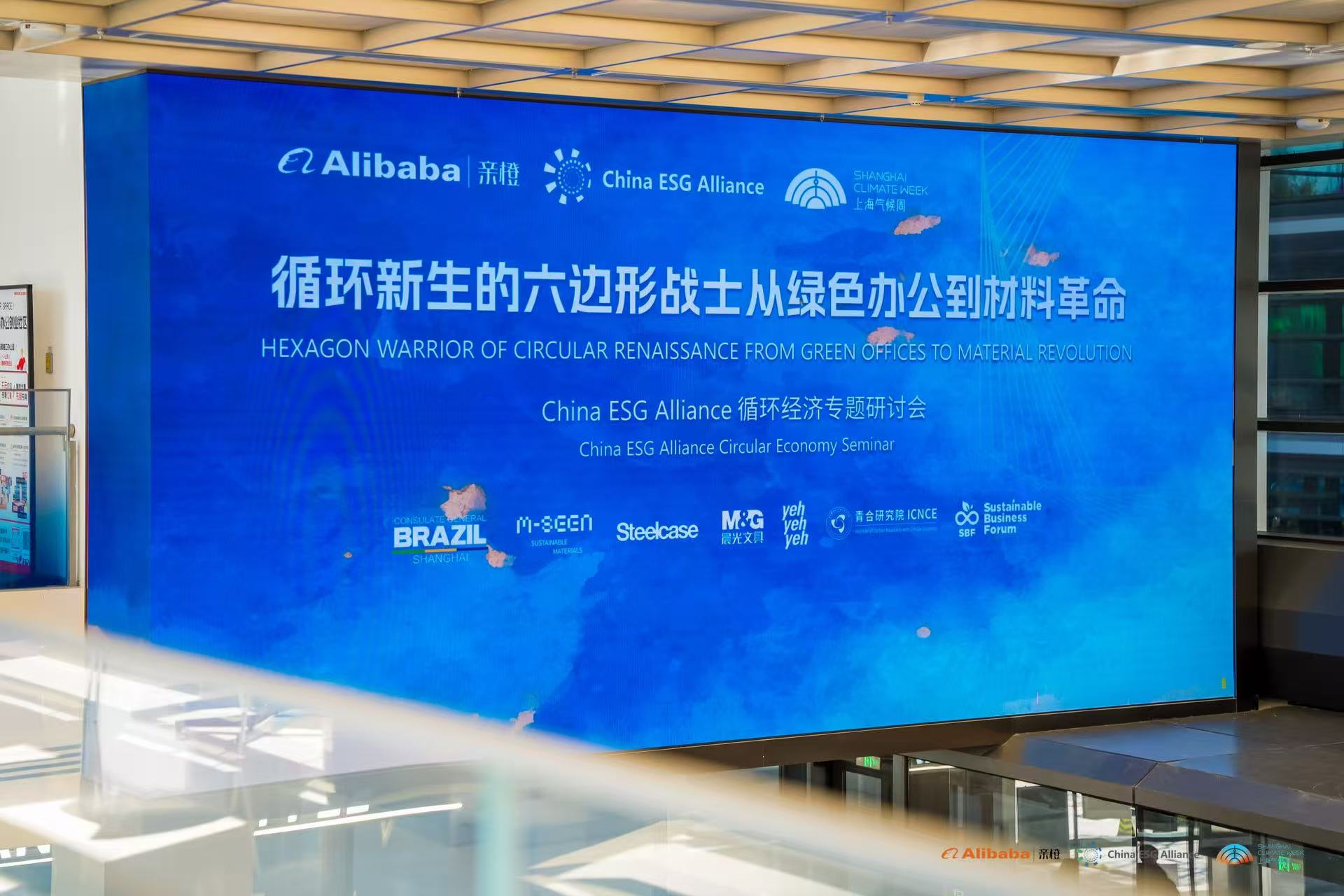
 Brazilian Diplomat, Corporate Heads Discuss Sustainability at China ESG Alliance Seminar
(Yicai) Dec. 5 -- A Brazilian diplomat from the Consulate General of Brazil in Shanghai, global business representatives, and scholars have attended a seminar hosted by the China Environmental, Social, and Governance Alliance and Chinese e-commerce giant Alibaba Group Holding, sharing their visions and practices on sustainable development.
"Brazil and China have a lot to contribute to the debate about energy transition and the promotion of sustainable practices for consumption and production,” Lucas Lima, head of the science, technology, and innovation at the Consulate General of Brazil in Shanghai, said at the China ESG Alliance Circular Economy Seminar on Dec. 3.
Founded in April 2023, the China ESG Alliance is a non-profit organization aiming to leverage expert insights and industry resources to create responsible climate solutions. Its members include global corporate giants, such as Microsoft, L'Oreal, Lenovo Group, and Tencent Holdings.
"Cooperation in science, technology, and innovation is one of the pillars of the Brazil-China strategic partnership," Lima noted. “China is leading the efforts on solar and wind power infrastructure, and it has also demonstrated impressive advances in artificial intelligence and batteries.”
For example, AI can help predict and respond to climate emergencies and monitor deforestation, Lima pointed out. However, it also brings intensive use of energy and water in data centers, so it is important to reduce the environmental impacts of the proliferation of AI systems.
Brazil has built one of the cleanest energy mixes in the world, with renewable energies, such as solar and wind power, accounting for over 88 percent, according to Lima. He also mentioned that the country launched an initiative to raise USD125 billion from loans and investments to prevent the loss of tropical forests globally at the 30th United Nations Climate Change Conference held in Belém last month.
Steelcase has committed to achieving net-zero carbon emissions by 2050, Gao Qi, a sustainability consultant at the leading US provider of office furniture solutions, said at the seminar.
To achieve this goal, Steelcase is reducing carbon emissions during production by using sustainable materials and designing products for circularity, Gao noted. Since 2023, the company has increased recycled content in products to 41 percent from 20 percent and reduced the cradle-to-grave carbon footprint by 43 percent, she added.
Steelcase is also helping Alibaba, one of its major clients in China, to achieve its environmental goals. They are achieving carbon neutrality for Scope 1 and Scope 2 emissions and halving carbon intensity for Scope 3 emissions by 2030.
Steelcase has developed Ali Workstation 2.0 for Alibaba, which is able to cut the carbon footprint by 7 percent from that of the 1.0 version if excluding packaging, Gao pointed out.
US aerospace and automation giant Honeywell is striving to promote the use of sustainable aviation fuel made from biomass sources, such as kitchen waste and agricultural residue, Eva Lu, senior business development manager at Honeywell's chemistry arm Honeywell UOP, said at the seminar.
Using SAF can reduce lifecycle carbon emissions by up to 80 percent compared to traditional jet fuel, Lu noted. China started a pilot program in September last year to use SAF at four airports in Beijing, Chengdu, Zhengzhou, and Ningbo, and has gradually expanded it to more airports this year.
UOP has worked with Chinese environmental tech company Jiaao Enprotech to build a plant in China’s Lianyungang to produce 370,000 tons of SAF from waste oil per year, Lu mentioned, adding that the estimated annual demand for SAF in China's aviation industry will reach 20 million tons by 2030, as the country pushes to achieve its carbon neutrality goal.
Editor: Futura Costaglione





