



 China Sets New Maglev World Speed Records
(Yicai) Dec. 29 -- China has set new world speed records for two different types of magnetic levitation technologies, an achievement that further paves the way to next-generation ultra-high-speed rail transport and electromagnetic space launch systems.
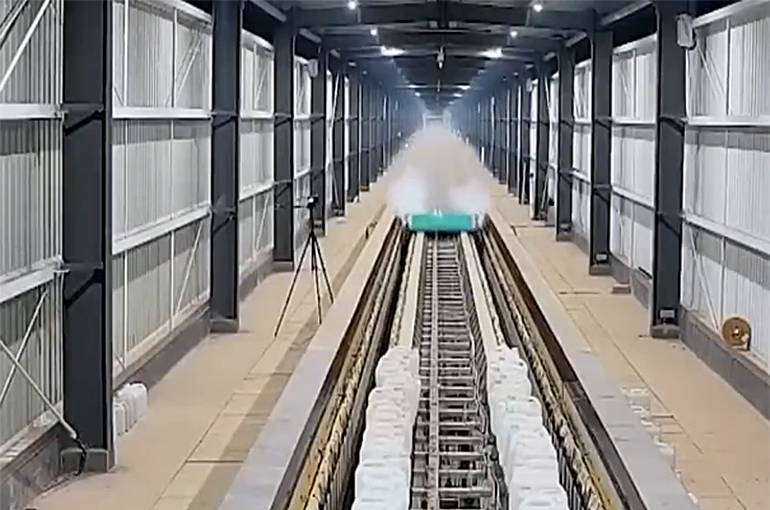
A research team from the National University of Defense Technology in Hunan province accelerated a one-tonne train to 700 kilometers per hour in just two seconds and achieved a safe stop in a superconducting electric maglev experiment, surpassing the 648 km/h record it set earlier this year, the university announced on Dec. 26.
On the same day, East Lake Laboratory in Hubei province announced it had accelerated a 1.1-tonne train to 800 km/h in 5.3 seconds, using a system than combines permanent magnet electric suspension guidance and electromagnetic propulsion. The lab has smashed the world record three times over the past six months.
A 600 km/h high-speed maglev train system developed by CRRC, China’s state-owned rail equipment manufacturer, rolled off the production line in Qingdao, Shandong province in 2021, underscoring the country’s ability to translate research into full-scale industrial production.
China has now developed and mastered three distinct technological approaches to maglev transportation: conventional electromagnetic levitation, permanent-magnet electrodynamic levitation, and superconducting electrodynamic levitation. While electromagnetic levitation is comparatively mature, its top speeds are slower than those possible with the other two.
In theory, superconducting maglev trains could bring about ultra-high-speed journeys, potentially reducing the travel time between Beijing and Shanghai to about 1.5 hours, an analyst told Yicai.
Beyond rail transport, the technology also opens up new possibilities for space launch systems, the analyst added. By using superconducting electromagnetic catapults to accelerate spacecraft to hypersonic speeds prior to engine ignition, it may be possible to slash rocket fuel consumption and launch costs, the person pointed out.
China has five maglev rail links already in day-to-day use: the Shanghai Maglev Train, Beijing Subway Line S1, Changsha Metro Line S2, Fenghuang Maglev Express in Hunan province, and Qingyuan Maglev Tourist Line in Guangdong province. Only the Shanghai line is high-speed, reaching up to 400 km/h, while the others are around 100 km/h.
Editors: Dou Shicong, Martin Kadiev





