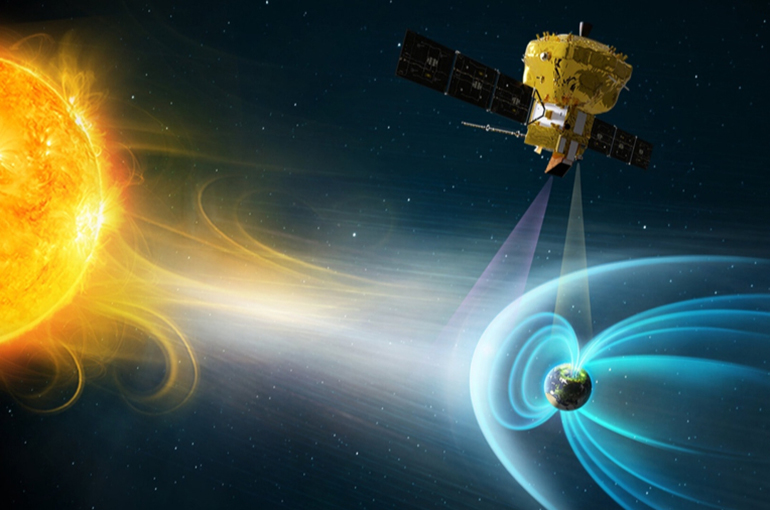
 China, Europe Jointly Launch SMILE Space Weather Satellite
(Yicai) May 20 -- The Solar Wind Magnetosphere Ionosphere Link Explorer satellite, jointly developed by Chinese and European scientists, has been successfully launched, marking a breakthrough in the first space science exploration mission featuring comprehensive and in-depth collaboration between China and Europe.
The SMILE satellite lifted off at 11.52 Beijing time yesterday on a Vega-C rocket from the Kourou Space Center in French Guiana and successfully entered its planned orbit, the China National Space Administration announced yesterday. Utilizing pioneering X-ray imaging technology, the satellite will perform the first-ever panoramic observations of the interaction between the solar wind and Earth’s magnetosphere.
Building on the achievements of the Double Star mission, jointly conducted by China and Europe in the early 21st century, the CNSA and the European Space Agency unveiled the SMILE project in 2015 to deepen bilateral cooperation and further reveal the mechanisms of how solar activity impacts Earth’s space environment.
The Chinese Academy of Sciences developed the SMILE satellite platform, the magnetometer, the light ion analyzer, and the ultraviolet aurora imager, while the European side developed the payload module and the Soft X-ray imager and provided the launch vehicle and launch site.
With the four advanced scientific instruments, the SMILE satellite will collect and transmit high-precision data on solar wind-magnetosphere interactions, which will help scientists improve their space weather forecasting capabilities and provide a scientific basis for protecting Earth’s high-tech systems and human activities, the CNSA noted.
The SMILE satellite has a designed lifespan of three years, and it will undergo a two-month in-orbit commissioning phase after maneuvering into its final science orbit, before transitioning to routine observations. During operations, Chinese and European scientists will jointly handle data processing, inversion, and scientific analysis, and openly share the results with the global research community.
Editors: Dou Shicong, Futura Costaglione