



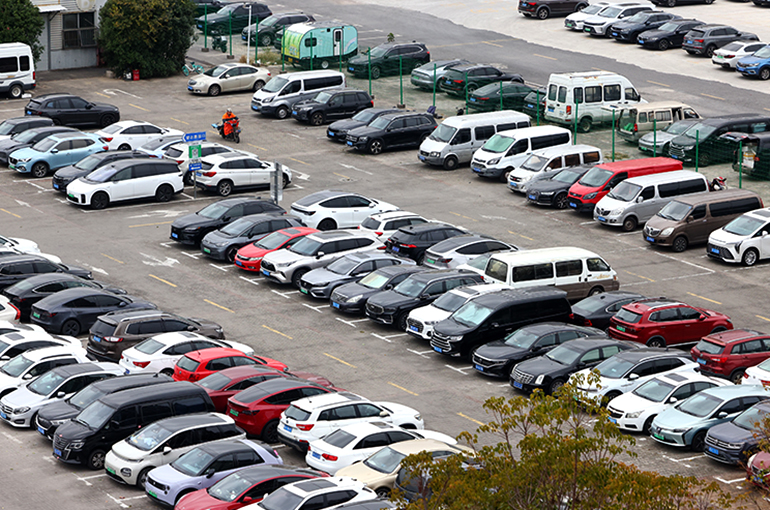
 China Has 371 Million Registered Cars at End of First Half
(Yicai) July 16 -- China had about 476 million motor vehicles at the end of the first half of this year, 371 million of which were automobiles.
The number of cities with more than one million registered cars increased to 105 as of June 30 from 101 a year earlier, Cui Dongshu, secretary general of the China Passenger Car Association, said in an article citing data from the Ministry of Public Security that he posted on its official WeChat account yesterday.
Among them, 20 cities had between two and three million autos, 18 had between three and five million, Zhengzhou, Suzhou, Shanghai, Xi'an, Hangzhou, and Wuhan had between five and six million, and Chengdu, Chongqing, and Beijing had more than six million.
Cities with more than five million registered cars having no purchase restrictions, allow the market to develop steadily, Cui noted, adding that auto ownership in cities with curbs, such as Shenzhen, Guangzhou, and Tianjin, is lagging behind. He suggested that cities with fewer than five million autos should relax their restrictions to release demand.
China had nearly 49 million new energy vehicles as of June 30, accounting for 13.2 percent of the total, up from 10.3 percent a year earlier, according to the MPS data. Of them, pure electric vehicles reached 33.7 million, making up almost 69 percent of the NEV total.
More than 10.5 million new cars were registered in China in the first half, down 16 percent from the same period last year. The slowdown in the net growth rate of vehicle ownership is due to a decline in the number of new drivers due to the aging population, which is leading market consumption to shift from first-time purchases to upgrades and replacements, Cui explained.
Fossil fuel cars are facing dual constraints of purchase restrictions and traffic limitations, and they are also required to pay over CNY1 trillion (USD147.8 billion) in fuel taxes, Cui said, adding that China should promote equal rights for all vehicles, allowing fossil fuel auto drivers to resume normal consumption patterns.
About the recently released 15th Five-Year Plan for Expanding Consumption, Cui noted that the consumption potential of the silver economy and rural mobility has not yet been fully realized.
He suggested establishing standards for economical vehicles, introducing a C7 driver's license, and launching tax deductions for vehicle purchases to effectively lower the entry barriers for basic demand and address the bottlenecks in high-end replacements, providing support for the continuous expansion of the auto market during the 15th Five-Year Plan period (2026-2030).
Editor: Futura Costaglione





