



 China’s First Big Policy Statement of 2026 Hones In on Drone, Robot Use in Farming
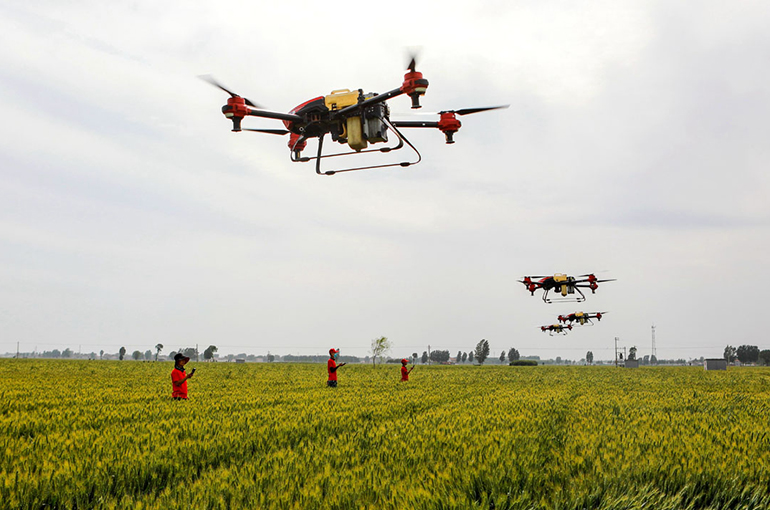
(Yicai) Feb. 5 -- China has for the first time placed the use of drones and robots in agriculture at the center of its annual top-level policy blueprint for the sector, underscoring the growing role of unmanned aerial vehicles as “indispensable tools” for farmers.
The No. 1 Central Document, released on Feb. 3, calls for expanding the use of drones, the Internet of Things, and robots in farming, as well as faster breakthroughs in key technologies related to agricultural biomanufacturing.
The document is released by China's central authorities at the start of every year and is a key indicator of policy priorities for the year ahead. Since 2004, it has consistently focused on agriculture, rural areas, and the welfare of farmers.
“China has become the world's largest country by the number of agricultural drones in service,” Zhu Weidong, deputy director of the Office of the Central Financial Commission and deputy director of the Office of the Central Rural Work Leading Group, said at a press conference on the document yesterday.
“Of the roughly 500,000 agricultural drones in use worldwide, more than 300,000 are in China,” Zhu said, adding that their use has expanded quickly from crop protection, seeding, and fertilizing to farmland monitoring and the transport of agricultural supplies and produce.
“Drones have become indispensable tools for many farmers, just like sickles and hoes in the past,” he noted.
Zhu stressed the need to seize the opportunities presented by the ongoing technological revolution by deepening the integration of artificial intelligence with agriculture, broadening the deployment of drones, IoT, and robots, and enabling more new forms of productive forces to serve as a “new engine” for modern agricultural development.
“Agricultural scientific and technological achievements should not be confined to academic papers or patent applications, but must be genuinely implemented in rural areas,” he said.
Zhu called for adherence to demand-driven and application-oriented principles, accelerating the commercialization and deployment of farming technologies, addressing practical challenges faced by farmers in production and operations, and closing the “last mile” in bringing tech advances to villages and households.
The low-altitude economy that drones represent is developing in tandem with other emerging productive forces in agriculture, including biological breeding, smart machinery, and smart farms, Zhu Keli, founding dean of the National Research Institute for New Economic Sciences, told Yicai.
Through data sharing, tech integration, and coordinated operations, these technologies will collectively shape the modern agricultural production system, he said.
The No. 1 Central Document also sets out new measures to enhance innovation efficiency in farming, including the coordinated development of agricultural science and tech innovation platforms and bases, support for breakthroughs in core agricultural technologies and their efficient use, and the cultivation of leading sci-tech businesses in the industry.
Editors: Tang Shihua, Martin Kadiev





