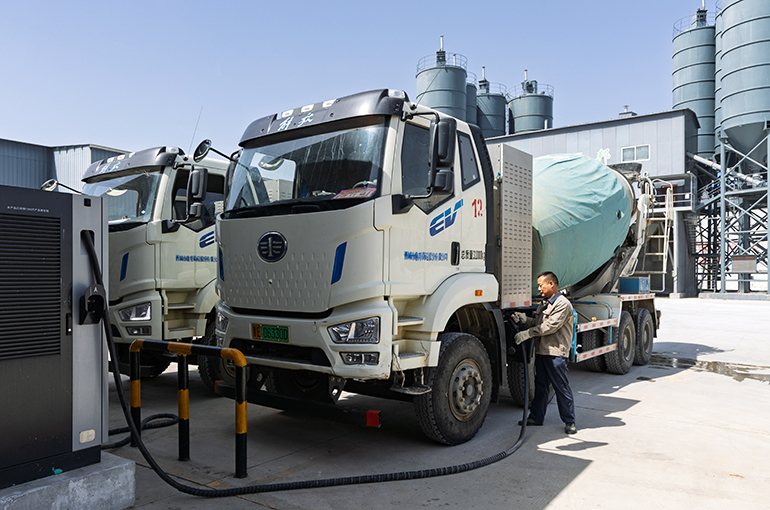
 China to Require Heavy Truck Charging Stations on Highways to Boost EV Truck Use, Cut Emissions
(Yicai) June 16 -- China has mandated the inclusion of charging and battery swapping facilities for new energy heavy-duty trucks in highway infrastructure planning, aiming to accelerate adoption of the vehicles and advance the country's decarbonization goals.
Under a development blueprint jointly issued by the Ministry of Transport and 11 other government departments, China aims to establish a 30,000-kilometer zero-carbon freight corridor by 2030 by building about 3,000 heavy-truck charging and swapping stations along major highways, while deploying hydrogen and other green-fuel refueling facilities in key freight corridors.
The new policy requires newly built expressway service areas to either install heavy truck battery charging and swapping stations or reserve space for them in the future. Highway upgrade projects must also incorporate clean energy and energy storage infrastructure into their overall plans.
The coordinated planning and construction of transport and energy-supply infrastructure is expected to remove key bottlenecks that have constrained the growth of the new energy heavy-truck sector, paving the way for large-scale commercial deployment, said Liu Xin, president of the Transport Planning and Research Institute under the Ministry of Transport.
Despite China's charging-and-swapping network exceeding 21 million stations, publicly accessible high-power chargers capable of serving heavy-duty trucks remain in short supply, according to Liang Linhe, chairman of Sany Heavy Truck. Dedicated charging bays for trucks at highway service areas are limited, while a full charge typically takes more than an hour, he said.
As a result of inadequate charging and refueling infrastructure, new energy heavy-duty trucks are largely confined to operating within a range of 300 km to 500 km and rarely travel beyond their effective driving range, Liang said.
The policy also calls on grid operators to strengthen support for heavy-truck battery charging and swapping facilities, incorporate truck-related electricity demand into power network planning, and accelerate the expansion and modernization of regional power distribution grids.
The simultaneous planning and construction of charging infrastructure alongside highway projects effectively makes heavy-truck energy supply stations a standard feature of China's expressway network, an industry insider told Yicai. It also means grid expansion and upgrades will become a necessary area of investment for power companies, he said.
China aims to raise the adoption rate for new energy heavy-duty trucks to 40 percent by 2030, while expanding the national fleet to more than 1.6 million vehicles, according to the policy.
Sales of new energy heavy-duty trucks in China reached 231,100 last year, with a penetration rate of 29 percent, according to statistics from Cvworld.cn, a market intelligence and data provider. There were likely around 384,000 registered electric heavy trucks in the country as of the end of last year, according to Huatai Securities.
To achieve the goal, the share of freight moved by new energy heavy-duty trucks on highways must reach 18 percent by 2030, per the new policy. In key air-pollution-control regions, including the Beijing-Tianjin-Hebei cluster, electric vehicles must make up at least 80 percent of heavy trucks operating on short-haul fixed routes.
New energy heavy-duty trucks are central to the transport sector's decarbonization efforts, according to Li Bin, an expert at the China Electric Power Research Institute. While heavy trucks account for just 3 percent of China's entire vehicle fleet, they generate roughly half of the country's carbon emissions from road transportation, he estimates.
Editors: Tang Shihua, Martin Kadiev