



 China Targets USD1.2 Trillion Circular Economy Output by 2030
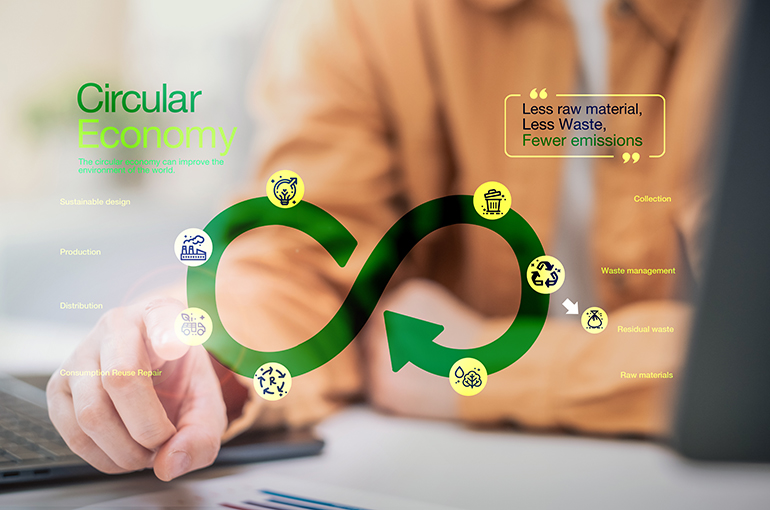
(Yicai) July 7 -- China will further improve its circular economy system, which is an economic model that aims to reduce waste and maximize resource efficiency by keeping materials in use for as long as possible, during the 15th Five-Year Plan that began this year. The country aims to expand the output value of its resource recycling industry by 60 percent by 2030 from 2025 to CNY8 trillion (USD1.2 trillion).
China’s circular economy system covering production, consumption, recycling and reuse will become more developed by 2030, with the output efficiency of major resources expected to jump about 16 percent from 2025, according to a plan recently released by the National Development and Reform Commission. Resource output efficiency is measured by the ratio of gross domestic product to the total consumption of major resources.
China has released four Five-Year Plans for developing the circular economy since 2012. Last year, the country’s resource recycling industry generated CNY5 trillion (USD735.8 billion) in output, while the output efficiency of major resource use had improved by about 77 percent from 2012, according to NDRC data.
The plan also calls for China to reduce energy and water consumption per unit of GDP by about 10 percent by 2030 from 2025 levels. Annual recycling of major renewable resources is expected to jump to 510 million tons from 410 million tons, while the comprehensive utilization of bulk solid waste is targeted to reach 4.5 billion tons.
Implementing the plan will help China build a larger-scale, higher-quality and more resilient circular economy system by 2030, strengthening resource security and supporting the country’s carbon peaking and carbon neutrality goals, Yao Xin, vice president of Tsinghua University’s Research Institute for Environmental Innovation in Suzhou New District, told Yicai.
China’s circular economy development still faces challenges, such as low resource output efficiency in key industries, inefficient recycling channels for major waste categories and technological bottlenecks, an NDRC official said in a policy briefing. Stronger institutional frameworks, improved industry management, technological innovation and industrial upgrades are needed to promote high-quality development of the circular economy.
After rapid growth in new energy industries, China is expected to enter a period of large-scale retirement of electric car batteries, photovoltaic equipment and wind power facilities during the 15th Five-Year Plan. The recycling of solid waste from these products and facilities is therefore a key focus of the new plan.
For example, the plan requires power generation companies to include the costs of recycling and disposing of retired wind and solar equipment in the construction and operation costs of power plants, and to hand over decommissioned equipment to qualified recycling companies for proper disposal.
The plan also calls for the establishment of a full lifecycle recycling system for electric car batteries and stronger product traceability management. For the first time, the plan includes waste from new infrastructure such as computing facilities and telecommunications base stations in the circular economy system.
Editors: Dou Shicong, Kim Taylor





