



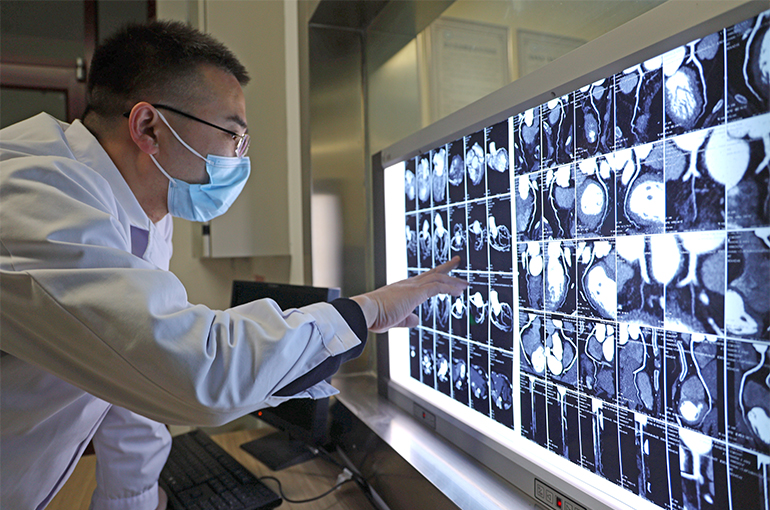
 China Moves Closer to Sharing Medical Imaging Data Nationwide
(Yicai) Dec. 3 -- China plans to allow medical institutions across the country to access medical imaging data from Beijing, Shanghai, and Guangdong province, marking another step toward a unified system that will serve its 1.4 billion citizens.
Medical imaging data from the three localities should be fully accessible through the National Health Insurance Imaging Data Cloud Sharing Center by the end of next year, the National Healthcare Security Administration announced recently.
The NHSA, which manages China’s state-backed health insurance and benefits system, launched the Health Insurance Imaging Cloud Sharing Pathway in Nanjing Drum Tower Hospital in Jiangsu province two days ago. The imaging management systems of China’s provinces can now upload catalog data to the National Health Insurance Imaging Data Cloud Sharing Center.
At the launch ceremony, Huang Huabo, deputy director of the NHSA, said he would strive to achieve a national cloud data network for medical insurance imaging by the end of 2027.
In the future, the medical insurance imaging cloud, which connects the data of 1.4 billion people, will aid the sharing and mutual recognition of diagnostic results among medical institutions. This will ensure continuity of personal health information and empower various stakeholders, including medical institutions, clinical practitioners, artificial intelligence-assisted diagnostics, cloud storage services, and insurance companies.
The NHSA also recently updated its pricing guidelines, incorporating digital imaging processing, uploading, and cloud storage into the cost structure for radiological tests. If medical institutions fail to store imaging test data on the cloud, they must cut their fees, it noted.
Such data sharing means patients will not need to repeat the same tests, thereby saving them time and money, Fu Chaoqi, director of the NHSA's Big Data Center, told Yicai, adding that this will also improve the quality and efficiency of medical services as well as enhance the performance of medical insurance funds.
Before this initiative, patients had to carry their own diagnostic films between medical institutions, which often fell short of requirements, according to Qu Feng, director of the Nanjing Drum Tower Hospital's online hospital. Electronic images have a higher definition and more detailed information, enhancing diagnostic precision and convenience for doctors, Qu noted.
Editor: Martin Kadiev





