



 Robots Begin Street Cleaning Duties in China’s Shenzhen
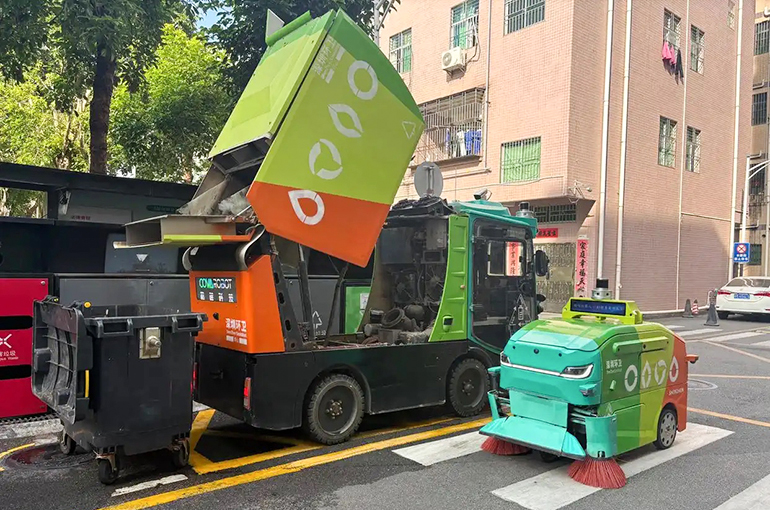
(Yicai) Dec. 4 -- Sanitation robots have started cleaning sidewalks, street corners, and even road sections in the southern Chinese city of Shenzhen, increasing efficiency and eliminating labor costs, a milestone that could help clear the way to overseas markets.
Thirty-six cleaning robots patrol an area of about 2.7 million square meters in the city’s Shijing sub-district and have been in use for some time already, according to an employee of Wuhu-based CowaRobot, which supplied the four-wheeled machines. They get straight to work as soon as they detect leaves or trash on the streets.
“The capabilities sanitation robots need are far from simple,” Wang Yu, executive president of CowaRobot's Shenzhen subsidiary, told Yicai. Garbage has no fixed shape or boundaries, which puts extremely high demands on the ability of artificial intelligence models to generalize, he said.
Training models using real-world data so robots can identify garbage is only the first step, Wang said, adding that the complexity and uncertainty of actual environments mean that robots cannot act solely on what they recognize. They must also know how to handle the trash and figure out their own solutions, he said.
“Sanitation robots not only need to see the trash, but also understand the relationship between it and the ground, including material, moisture, and adhesion, and then adjust their actions accordingly,” Wang noted.
CowaRobot's orders mainly come from local governments, according to Wang. The goal of the Shenzhen authorities is to reduce the need for three to five human workers with each robot deployed, with strict performance evaluations in place.
The average sanitation worker in Shenzhen makes about CNY70,000 (USD9,870) a year, Yicai learned from an outsourcing agency. So if a robot takes the place of three workers and its annual operating cost does not exceed CNY200,000 (USD28,210), the business model is financially viable.
But the robots are not intended to fully replace sanitation workers. The goal is to achieve human-robot teamwork, according to Liao Wenlong, CowaRobot’s chief technology officer of Cowa. This would see staff shift away from doing repetitive cleaning duties to oversight, assistance, and handling tasks that robots cannot yet handle.
“Picking up garbage from green spaces, removing waste from trash cans, and clearing away items stuck to walls are unconventional cleaning tasks that still require manual completion,” Liao pointed out.
A single sanitation worker used to be responsible for cleaning 1 kilometer of sidewalks each day, but now, one worker and a robot can jointly handle 7 to 8 km of sidewalks, said a CowaRobot staff member working in Shijing.
As robot street cleaning projects scale up in China, manufacturers have started to explore overseas expansion. Wang said CowaRobot is promoting operations in Singapore and plans to conduct commercial trials in overseas markets such as Abu Dhabi in the future.
“These regions have the basic conditions for using sanitation robots in terms of labor costs, urban scale, and governance models,” he noted.
Editors: Tang Shihua, Futura Costaglione





