



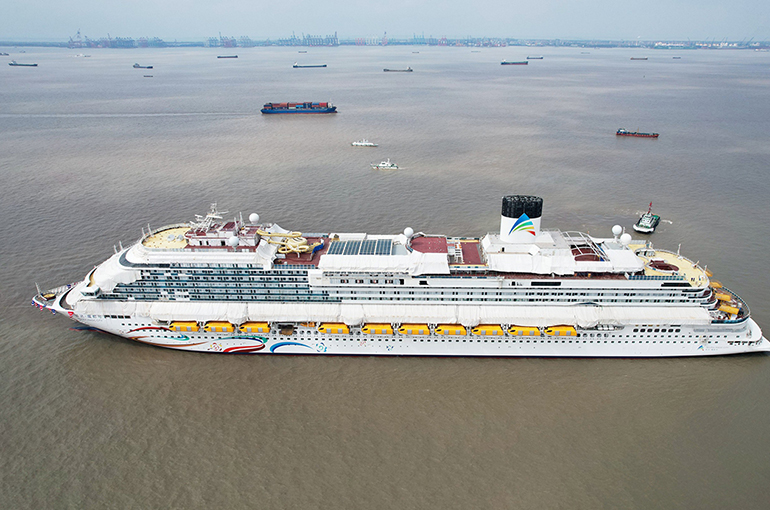
 China’s First Home-Built Large Cruise Ship Welcomes One Millionth Guest
(Yicai) Feb. 9 -- Adora Cruises has welcomed the one-millionth passenger on board the Adora Magic City, China’s first domestically built large cruise liner, underscoring the rapid growth of Shanghai’s cruise economy.
“Reaching the one-million milestone is a testament to the vibrancy of the cruise market and the trust travelers place in us,” Jia Ying, assistant vice president of marketing and e-commerce at Adora Cruises, told Yicai yesterday. The Shanghai-based firm is considering deploying more cruise ships to other domestic and overseas ports, aiming to make the sector a landmark project of the Belt and Road Initiative, she noted.
Launched in late 2013, the BRI is China’s global infrastructure and development strategy aimed at enhancing trade, investment, and connectivity across Asia, Africa, Europe, and beyond through roads, railroads, ports, energy projects, and digital infrastructure.
The Adora Magic City will make more than 80 voyages this year, mainly from its home port of Shanghai. The vessel will be deployed to Shenzhen for the first time to embark on a journey to Southeast Asia in August.
In addition to Adora Magic City, Adora Cruises operates two other large cruise ships: the Adora Mediterranean, known as the "art ship,” and the Piano Land under Astro Ocean Cruise brand.
The Adora Mediterranean will make full use of a multi-home-port advantage, operating from Tianjin, Guangzhou, Xiamen, Qingdao, Dalian, Shenzhen, and other cities for flexible deployments. On April 10, the ship will set sail from Xiamen International Cruise Home Port on a cruise to the Philippines and Vietnam.
Meanwhile, construction of the second China-made large cruise ship, the Adora Flora City, is more than 91 percent complete. The vessel is scheduled to be delivered by the end of this year, and with Guangzhou Nansha as its home port the ship will center on the Guangdong-Hong Kong-Macao Greater Bay Area, Yicai learned.
Royal Caribbean, MSC Collaboration
Adora Cruises has lined up a series of cruise itineraries this year in cooperation with Royal Caribbean International and MSC Cruises, with Shanghai and other Chinese cities serving as home ports.
Drawing on insights into travel trends in China, Royal Caribbean is rolling out new destinations, Benjamin Bouldin, president of the Florida-based company’s China arm, said recently. During the 2026-27 season, the Spectrum of the Seas will remain deployed year-round in the Chinese market, with Shanghai and Hong Kong as its key home ports, further deepening the firm’s local footprint.
MSC Cruises said its global itinerary will reach China for the first time in March, with the MSC Magnifica scheduled to call at Shanghai. In addition, the MSC Bellissima will return to Shanghai as a home port vessel, launching dual home port sailings between Shanghai and Busan.
From 2006 through last year, more than 3,500 cruise ships called in at Shanghai with over 18 million passengers, accounting for more than 60 percent of the China market and ranking it as the largest cruise home port in Asia and the fourth largest globally. Even so, the city still has room to narrow the gap with leading international cruise hubs such as Singapore and Miami.
In this year’s government work report, Shanghai underscored the need to boost consumption with greater efforts, including expanding cruise-related offerings, continuously promoting inbound tourism, improving departure tax-refund services, and facilitating cross-border payments to hasten the release of inbound consumption potential.
The newly approved Regulations on Promoting the Development of the Cruise Economy in Shanghai will come into effect on March 1.
The regulations mark a new phase for Shanghai’s cruise economy, transitioning from a model driven primarily by policy support to one underpinned by legal safeguards, said Wang Hong, a deputy to the Shanghai Municipal People’s Congress and dean of the China Europe International Business School, during the city’s annual political gathering earlier this month.
This will lay a legal foundation for Shanghai’s innovative “tri-port” model integrating a hub port, headquarters port, and manufacturing port, he added.
Editor: Martin Kadiev





