



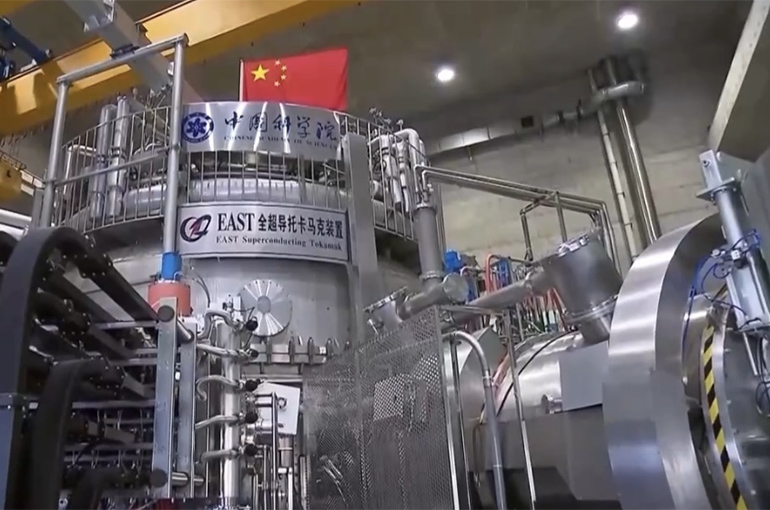
 Chinese Fusion Reactor Breaks Plasma Density Limits, Moving Closer to ‘Man-Made Sun’
(Yicai) Jan. 7 -- Researchers working on the Experimental Advanced Superconducting Tokamak, a nuclear fusion reactor developed by the Chinese Academy of Sciences, have found a way to raise the density of fusion plasma beyond conventional limits, coming closer to realizing the dream of a 'man-made sun.'
The study provides new insights into overcoming one of the most persistent physical obstacles on the path toward nuclear fusion ignition. It was co-led by Zhu Ping from Huazhong University of Science and Technology and Yan Ning from the Hefei Institutes of Physical Science of the Chinese Academy of Sciences, published on Science Advances on Jan. 1.
The team accessed a theorized 'density-free regime' for fusion plasma by realizing a novel high-density operating scheme on the tokamak device, which is located in Hefei, eastern Anhui province. This proved that plasma density can be substantially extended without triggering disruptive instabilities.
Nuclear fusion is widely regarded as a promising source of clean and sustainable energy. However, in conventional tokamak operation, plasma density is restricted by an empirical upper limit. Exceeding this limit often leads to instabilities that disrupt plasma confinement and endanger tokamak operation, posing a major challenge to improving fusion performance.
The recent development of the plasma-wall self-organization theory provides a novel perspective on understanding the disruptive density limit. The theory predicts that a new density-free regime could be accessed by achieving a delicate balance between the plasma and the metallic walls of the device.
To access this theoretical state, the EAST experiments combine control of the initial fuel gas pressure with electron cyclotron resonance heating during the startup phase, allowing effective optimization of plasma-wall interactions from the very beginning of the discharge.
Through this approach, plasma-wall interactions, impurity accumulation, and energy losses were significantly reduced, and plasma is eventually pushed into a high enough density.
"The findings suggest a practical and scalable pathway for extending density limits in tokamaks and next-generation burning plasma fusion devices," said Zhu.
The research team plans to apply the new method during high-confinement operation on EAST in the near future in an attempt to access the density-free regime under high-performance plasma conditions, according to Yan.
Editor: Futura Costaglione





