



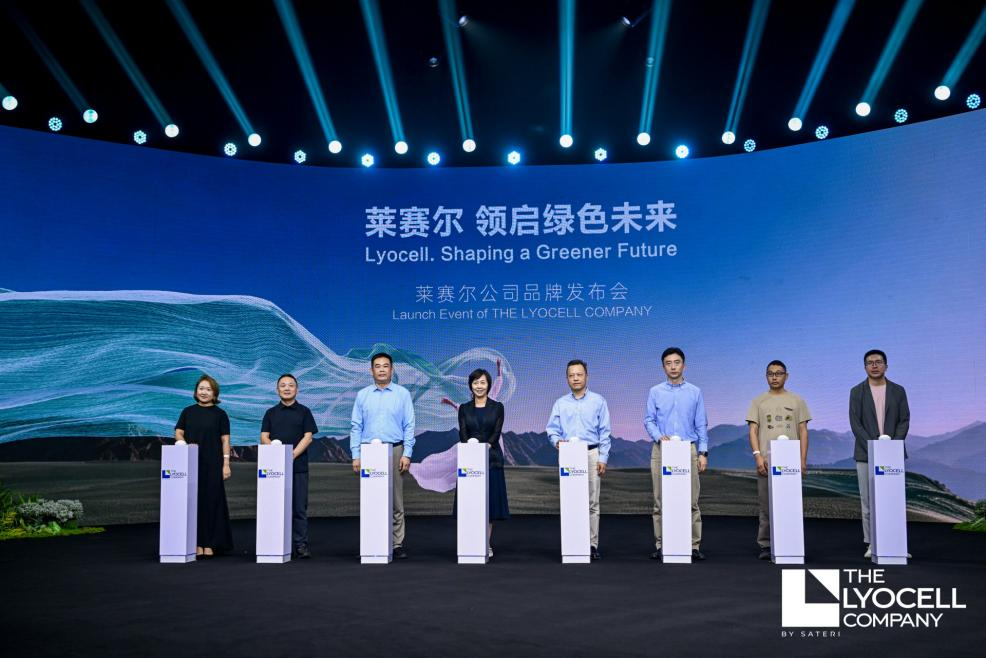
 Sateri Rolls Out Standalone Lyocell Company Brand
(Yicai) Aug. 26 – Sateri, the world's largest viscose fiber producer, has turned its lyocell business into a standalone company, aiming to turn six years of capacity building into an asset customers across the industry’s long and fragmented supply chain can recognize and trust.
The Lyocell Company is built around three pillars: scale, expertise, and trust, Sateri President Tom Liu said at a press conference for the launch of the new Shanghai-based company on Aug. 24. These are commitments rather than marketing slogans, he noted.
Scale refers to Sateri's integrated forest-to-pulp-to-fiber supply chain and four coordinated plants, each with a distinct product focus, according to Liu. Expertise is represented by its proprietary intellectual property and its in-house application research center, which works on developing and applying lyocell technologies. Trust is based on closed-loop production management and third-party sustainability certifications that to evidence the firm's environmental claims.
The launch comes as global lyocell production capacity exceeds 1.3 million tons a year, with the fiber shifting from a niche "green choice" to a mainstream input. In addition, European regulators have tightened scrutiny of producers’ environmental marketing claims.
China's lyocell exports soared 49 percent to 108,000 tons in the first 11 months of last year from a year earlier amid growing domestic capacity, while imports fell 14 percent to 89,000 tons, according to the Huajing Industry Research Institute. For upstream suppliers, the shift favors verifiable, brand-backed sustainability credentials over raw output, which is a harder proposition for an industrial material, where scale has rarely translated into brand value the way it can for consumer goods.
Sateri entered the lyocell market in May 2020 with a 20,000-ton production line in Rizhao, Shandong province, when the fiber was still a niche category worldwide. The Shanghai-headquartered business has since built factories in Changzhou and Nantong in Jiangsu province and in Jining in Shandong, which it is expanding to 600,000 tons of annual capacity.
The build-out was necessary but no longer sufficient, Liu said. "Our textile supply chain is long and highly specialized, with an enormous number of participants," he noted, adding that customers "need a partner that is highly recognizable, professional, sizable, and trustworthy to become their constant companion in innovation."
From Sales to Partnerships
The Lyocell Company is less about the name than a shift in how the business competes, said Eric Ding, general manager of Sateri's lyocell business. "This is not about putting a new name on an old business," but about layering a brand-driven strategy on top of capacity-driven growth, he stressed.
Ding pointed to fiber-level engineering as one differentiator. Lyocell is prone to fibrillation, a texture change during dyeing and finishing, and Sateri has developed a cross-linked lyocell variant alongside joint technical fixes with downstream dye houses, which has won broader industry acceptance, he noted.
That downstream engagement is central to "technical companionship," he added. Sateri's teams visit customer factories to inspect equipment and test processes and then bring back findings to the firm's research center for targeted fixes, he said.
"The high technical threshold of lyocell is not only our challenge, but it is also a challenge our downstream customers face when they use it," Ding pointed out. "Helping customers clear that threshold is the real value behind lyocell from The Lyocell Company."
Sateri is applying the same approach to expand lyocell into non-woven applications such as wipes and personal-care products, building joint development systems with yarn spinners, fabric mills, dyeing and finishing plants, and brand customers, Ding noted, calling that model a genuine supply chain partnership rather than a buyer-seller relationship.
Tracing Green Claims From Forest to Wardrobe
Lyocell's environmental pitch rests on production economics as much as raw materials. The fiber is spun from wood pulp sourced from sustainably managed plantations using a closed-loop process built around N-Methylmorpholine N-oxide, a non-toxic organic solvent that Sateri recovers and reuses at a 99.7 percent rate, with the finished fiber fully biodegradable.
Sateri's approach to sustainability operates on three levels: reducing emissions at its own mills, tracing the entire supply chain from dissolving pulp to finished garment, and helping downstream partners -- including home textiles maker Luolai, intimate-apparel brand Ubras, sportswear giant Anta Sports, and fabric firm Q21 -- adopt greener practices, Ding said.
Garments that carry a hangtag from The Lyocell Company will allow consumers to scan a code pointing back to the raw material source, responding to growing demand from brands for documentation that they can directly show to consumers, Ding stressed.
The move tracks with tightening regulation. The European Union's Empowering Consumers for the Green Transition Directive, which will come into force on Sept. 27, will bar unsubstantiated "eco-friendly" claims across the bloc, even after Brussels shelved a separate, more prescriptive Green Claims Directive proposal last year. Suppliers marketing sustainability credentials into Europe will increasingly be expected to back their claims with verifiable, traceable evidence.
Searches for textiles marketed as free of chemical additives jumped 82 percent last year, with more than half of environmentally minded consumers being "practical green" shoppers who weigh durability and versatility alongside environmental footprint, according to Accenture research presented at the launch of The Lyocell Company by Paul Ma, general manager of WGSN China. Demand from sports, outdoor, and homeware brands is also surging, he noted, citing lyocell's clean production and biodegradability as strengths that position the fiber to lead that shift.
Sateri's expansion continues, with a new production line at its Jining plant going live in March. The company operates 15 cellulosic fiber factories in China with combined viscose and lyocell capacity exceeding two million tons, a scale that smaller, specialized lyocell producers cannot easily replicate.
Editor: Martin Kadiev





