



 China's Skyworth Expands Its PV Business in SE Asia to Meet Local Energy Transition Needs
(Yicai) April 14 -- Chinese consumer electronics giant Skyworth Group is expanding its solar power generation and energy storage business in Southeast Asia to better meet local demand for renewables, as the energy supply tension due to the Middle East conflict has accelerated the region's energy transition plans.
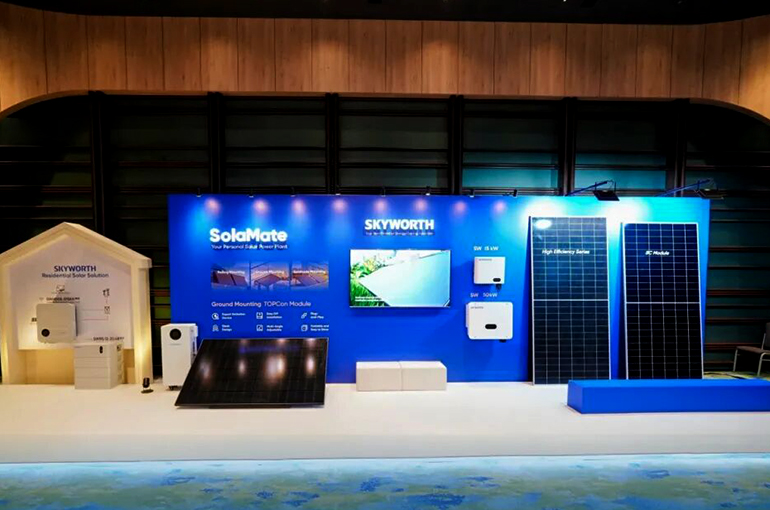
Skyworth Photovoltaic Technology will enter the Malaysian distributed PV market, the firm announced on April 10 at a press conference where it signed deals with 16 local enterprises to provide customers with a one-stop rooftop PV and energy storage solutions covering branding, supply chain, design, digitalization, operation, and financial support.
Skyworth PV had announced its entry in the Vietnamese distributed PV market a week earlier.
The Malaysian government's goal of increasing the share of renewable energy to 70 percent by 2050 is expected to continuously unleash market growth potential for Skyworth PV's 'solar + energy storage' business in the region, Wang Chundan, general manager for Asia Pacific at Skyworth PV, told Yicai.
Encouraging policies from the Malaysian government can enhance the return on investment of local rooftop PV projects and help improve the economic viability of residential and commercial rooftop energy storage projects in the country, Wang noted.
Vietnam is a strategic market for Skyworth PV, Wang said, adding that with robust economic growth, rising electricity demand, and favorable policies, the country is entering a critical stage for solar energy development.
The penetration rate of rooftop PVs in Vietnam is only about 2.7 percent, according to Wang. To quickly expand in the market, Skyworth PV has launched a 'national service provider + regional agent' model in Vietnam, signing agreements with over 30 local agents. Moreover, the company has teamed up with local financial institutions, including Joint Stock Commercial Bank for Investment and Development of Vietnam.
Skyworth PV has been laying out its Southeast Asian market strategy since last August, Chairman Fan Ruiwu told Yicai. The Middle East conflict is prompting countries to place greater emphasis on the development of new energies, which is expected to serve as a catalyst for the company to accelerate its expansion in the Southeast Asian market, he added.
Last year, Skyworth PV became the largest revenue-generating subsidiary of Skyworth, which is planning to spin it off for listing on the Hong Kong Stock Exchange. According to Skyworth's 2025 financial statement, Skyworth PV had built and put into operation solar power stations with a total installed capacity of over 29.3 gigawatts as of the end of last year.
Southeast Asian countries face relatively scarce electricity supply and higher electricity prices, Wen Jianping, founder and president of Indonesian big data analytics firm AVI Data, told Yicai.
Moreover, the local climate conditions are very favorable for the installation and use of PV power stations, and China's PV and energy storage industry has strong competitive advantages, providing significant opportunities for Chinese companies to collaborate in the region, Wen noted.
However, the successful operation of PV power stations requires a well-developed and standardized service network, along with many trained personnel to support operations, which call for additional investment, Wen pointed out. Due to the relatively underdeveloped power grids in Southeast Asia, developers also need to provide complementary energy storage solutions for local distributed PV power stations, he added.
Therefore, even though there are growth opportunities in the Southeast Asian PV market, there are still challenges compared to China, so developers need to exercise more patience in cultivating the market, Wen warned.
Editors: Tang Shihua, Futura Costaglione





