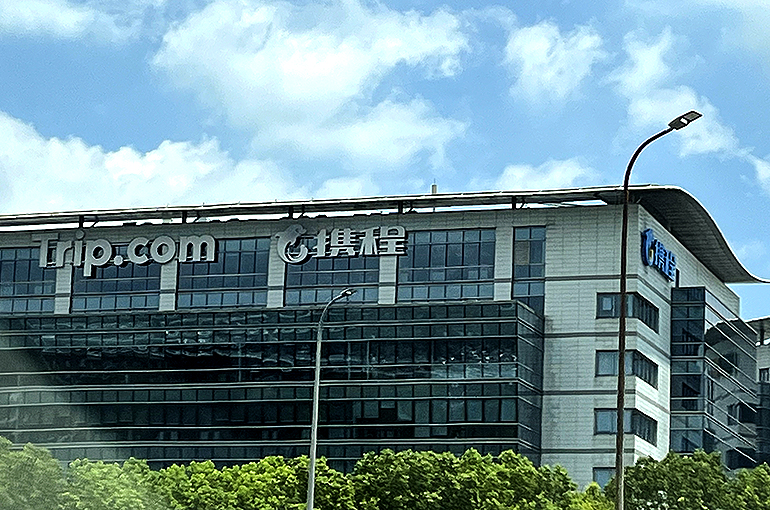
 Trip.Com Rises After China Concludes Antitrust Probe With USD768 Million Penalty
(Yicai) July 27 -- Trip.Com Group's shares gained after Chinese regulators brought a more than five month-long anti-monopoly investigation into the major online travel agency to an end, handing it a CNY5.2 billion (USD768 million) penalty for abusing its dominant position in the online hotel bookings market.
Trip.Com [HKG: 9961] ended 3.6 percent higher at HKD355.60 (USD45.35) per share in Hong Kong today, after surging by as much as 7.7 percent at one point. The stock is down 42 percent since the State Administration for Market Regulation announced on Jan. 14 that it was investigating the Shanghai-based company.
In pre-market trading in New York, the company [NASDAQ: TCOM] was trading almost 4 percent higher at USD45.37 as of 7.54 a.m. local time.
The SAMR announced on July 25 that under Articles 57 and 59 of China’s Anti-Monopoly Law, and taking into account the nature, severity, and duration of Trip.Com's monopolistic conduct, it was imposing the penalty on the company for using traffic allocation rules to force hotels into exclusive deals and low-price parity.
The penalty comprises a CNY3.5 billion fine, equal to 7.5 percent of Trip.Com's nearly CNY47 billion (USD6.9 billion) of China revenue last year, as well as a CNY1.7 billion forfeiture of illegal gains, and a CNY122 million (USD18 million) refund to affected hotel operators.
Trip.Com has abused its dominant position in China’s online hotel-booking platform market since 2020 by using its traffic allocation system to implement two types of monopolistic practices, according to the SAMR.
The first involved requiring hotels in its “exclusive brand” tier to enter into exclusive partnerships, using preferential traffic exposure and other benefits as incentives while preventing these hotels from working with rival platforms, the SAMR said.
The second involved requiring hotels in its “gold” and “unbranded” tiers to maintain the lowest available prices across all online platforms using tools such as "price adjustment assistant" and "listing manager" as well as manual intervention to automatically lower hotel prices, the SAMR said. Trip.Com enforced these requirements through punitive measures, including restricting traffic visibility, delistings, and withholding order deposits, the regulator added.
The SAMR imposed antitrust penalties on Alibaba Group Holding and Meituan in 2021, as well as CNKI in 2022, but that handed to Trip.Com represents the highest fine ratio ever applied in a platform economy antitrust case in China.
Rectification Pledge
Trip.Com said on the same day that it accepted the watchdog’s decision "sincerely and unreservedly" and pledged to implement all corrective requirements and said it had already drawn up 19 measures across five key areas. They include immediately ending exclusive collaborations, halting unreasonable network-wide lowest price requirements, safeguarding hotel operators’ pricing autonomy, strengthening consumer protections, and improving compliance.
Trip.Com said it would publish details of its rectification plan at a later stage and would accept public supervision throughout the process.
The business used algorithmic monitoring, traffic control, and ecosystem-based restrictions to carry out more sophisticated and less visible forms of monopolistic behaviour, Shi Jianzhong, vice president of the China University of Political Science and Law and a member of the State Council Anti-Monopoly Committee's expert advisory group, said in an article for the People's Daily.
Shi said Trip.Com’s “price adjustment assistant” system continuously monitored competitors’ prices in real time, creating what he described as a “price-locking” effect on hotel operators by limiting their ability to independently determine pricing strategies.
Shi said the antitrust enforcement addresses two broader policy objectives: curbing excessive “involution-style” competition and improving the overall business environment. Stronger enforcement could encourage the industry to move away from unsustainable price wars and toward competition based on service quality, innovation, and overall value, Shi added.
Involution, or neijuan in Chinese, is a self-defeating cycle of ever-intensifying competition that results in diminishing returns.
Trip.Com had a net profit of USD4.8 billion last year after revenue climbed 17 percent to CNY62.4 billion, according to the company’s financial report. Its gross profit reached CNY50.3 billion for a gross profit margin of about 80 percent.
Established in 1999, Trip.Com listed in New York in 2003 before completing a secondary listing in Hong Kong in 2021. It operates several brands, including Ctrip, Trip.Com, Qunar, and Skyscanner, with its businesses spanning flight and transportation ticketing, hotel booking, package tours, and corporate travel management.
Editor: Martin Kadiev