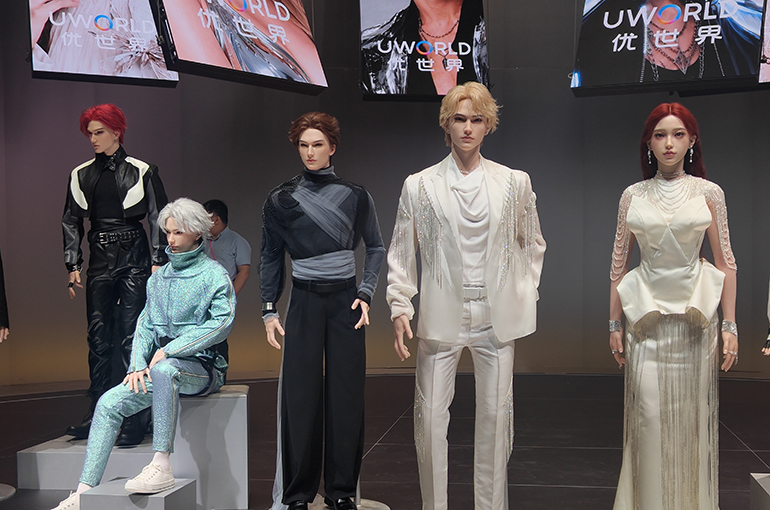
 China’s Ubtech Jumps After Revealing 11,000 Orders for Human-Like Androids Priced at Up to USD146,000
(Yicai) July 1 -- Shares of China’s Ubtech Robotics, the world's first humanoid robot maker to go public, jumped after founder Zhou Jian said the firm has already received more than 11,000 orders for its hyper-realistic humanoid robots priced at as much as CNY990,000 (USD146,000) each.
Ubtech [HKG: 9880] ended 7.5 percent higher at HKD102.80 (USD13.11) per share in Hong Kong today. The stock is still down almost 19 percent since the end of last year.
If no restrictions are placed on orders for the UWORLD U1 series of full-size ultra-bionic androids, then the Shenzhen-based company expects to receive at least 30,000 to 50,000 orders by the end of this year, Zhou, who is also chief executive, said at yesterday’s launch event. Orders started being taken early last month.
Dozens of U1 robots with highly lifelike facial features and dressed in a variety of outfits took to the stage at the event to speak and dance alongside humans. Even though their movements still fall short of real human fluidity, they show drastically enhanced realism compared to previous models.
The half-size U1 Lite is priced at CNY119,800, the full-size U1 Pro at CNY169,800, the premium female U1 Ultra at CNY880,000, and the male U1 Ultra at CNY990,000, it was announced. In comparison, mainstream humanoid robots on the market has dipped below CNY30,000 (USD4,200).
A CNY100,000 to CNY200,000 price tag is reasonable for bionic robots that can do housework, provide emotional support, and look highly realistic, Zhou said. Production costs and retail prices will fall as the user base expands, he pointed out.
The core competitive moat for companionship robots is emotional intelligence, posing a major hurdle for new market entrants, Zhou said. In addition, manufacturing hyper-realistic androids involves extreme technical complexity, with every individual eyelash having to be manually implanted, he added.
Long Development Cycles
Production scaling and iterative upgrades to the emotional large language model will require prolonged development cycles, he stressed, but noted that U1 output will likely top 50,000 units next year.
The U1 series targets well-off middle-class consumers aged 35 to 50 who are living alone, young, and single, along with anime enthusiasts, and members in the otome culture community, according to Ubtech.
Ubtech's prior humanoid robot lineup was deployed exclusively for industrial use, Zhou said. However, the industrial space has limited potential for vibrant ecosystem development, and participants will converge on comparable technical capabilities over time, so household robots will instead define a manufacturer's core competitiveness and unlock robust ecosystem growth opportunities, he pointed out.
Hyper-realistic household androids can be divided into two categories: those focused on household chores and those built for emotional companionship, Zhou noted. Future revenue streams will consist of one-time hardware sales and recurring ecosystem service charges, which could yield higher profit margins than industrial androids, he said.
Zhou acknowledged that hyper-realistic humanoid robots for the home remain akin to high-end toys at the current development stage. Their emotional companionship has not undergone long-term market validation, they lack functional support for routine housework, and their battery life remains constrained, he noted.
He also said conversational interaction alone may not be enough to create lasting user engagement. Without compelling long-term utility, many owners could lose interest after the initial novelty fades, leaving expensive robots largely unused, Zhou noted.
Editors: Tang Shihua, Martin Kadiev